Retrato de Bruno Liljefors

Pinturas de Bruno Liljefors: Las 74 más famosas, bajo la mirada de una galería

Actualizado noviembre 2026 · clasificado según nuestro índice de popularidad (búsquedas, visitas y pedidos de cada obra) · 77 obras de Bruno Liljefors en nuestro catálogo

En resumen

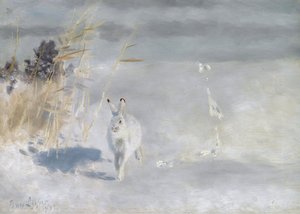
Para el ojo de la galería, la pintura más famosa de Bruno Liljefors es Título en sueco: Duvhök och orrar (1884), cuya obra original se encuentra en el Nationalmuseum, Estocolmo. Liebre de invierno (Liebre de las nieves), (1932) y Título en sueco: Rävfamilj (1886) completan el trío que toda mirada reconoce. De las 77 obras de Bruno Liljefors en nuestro catálogo, la galería presenta a continuación las 74 más famosas; cada una original, con su año, su museo y aquello que la hace única.

1860 – 1939, Falun Impresionismo Más obras: Nationalmuseum

Las 10 mejores pinturas de Bruno Liljefors en la galería

1
Título en sueco: Duvhök och orrar (1884) de Bruno Liljefors

Título en sueco: Duvhök och orrar

1884 · Óleo sobre lienzo · Nationalmuseum, Estocolmo

El paisaje congelado de Ärentuna sirve como escenario para un encuentro repentino y violento. En este óleo sobre lienzo de 1884, un azor desciende con las alas y las garras extendidas, acechando a un ave juvenil en medio de un torbellino de urogallos. La escena captura un momento preciso de depredación aviar, donde la quietud de la nieve se ve interrumpida por el movimiento frenético del vuelo y la tensión…

3
Título en sueco: Rävfamilj (1886) de Bruno Liljefors

Título en sueco: Rävfamilj

1886 · Óleo · Nationalmuseum, Estocolmo

En esta obra de 1886, nos encontramos observando un instante privado en la naturaleza salvaje de Suecia. Una familia de zorros ocupa un prado, con sus formas acunadas entre la hierba alta y las flores silvestres. Existe aquí una sensación de quietud, una pausa en el movimiento constante del mundo natural. Varios adultos y sus crías se distribuyen por toda la escena; algunos más cerca del espectador y otros retrocediendo…

4
Cat on a flowery meadow (1887) de Bruno Liljefors

Cat on a flowery meadow

1887 · Oil · Nationalmuseum, Estocolmo

In this 1887 oil painting, a black and white cat rests within a dense meadow of wildflowers. The animal is positioned in the lower right foreground, its body oriented toward the left side of the frame. Its fur is rendered in solid patches of black and white, contrasting with the surrounding vegetation. The meadow is composed of various flora, including yellow wildflowers and small white blossoms, interspersed with green grass…

5
The Fox (1893) de Bruno Liljefors

The Fox

1893 · Oil On Canvas · Nationalmuseum, Estocolmo

The Fox is an oil on canvas work by Bruno Liljefors, dated about 1893. The subject features a single red fox moving through a snowy landscape. This naturalist study captures the animal within its natural habitat, focusing on the interaction between the creature and the winter environment.

6
Landscape with Fox (Fox pursued by Jackals) (1899) de Bruno Liljefors

Landscape with Fox (Fox pursued by Jackals)

1899 · Oil On Canvas · Rijksmuseum Twenthe, Enschede

The scene unfolds within the oil on canvas work titled Landscape with Fox (Fox pursued by Jackals). This piece, created by Bruno Liljefors, captures a moment of tension amidst the forest. The artist, Bruno Liljefors, was born in Uppsala Cathedral Assembly, Sweden, in 1860 and lived until 1939. His hand guides the viewer through this natural setting, where the subject matter is deeply rooted in the wild realities of the…

8
An Eagle Owl (1905) de Bruno Liljefors

An Eagle Owl

1905 · Oil · Nationalmuseum, Estocolmo

An Eagle Owl by Bruno Liljefors, created about 1905, features a centered composition where the bird occupies much of the middle ground. The owl is positioned against a dark, indistinct background that suggests the interior of a hollow or a shaded forest floor. This setting creates a shallow depth, focusing the viewer's attention entirely on the subject. The color palette is dominated by earthy tones, including various shades of brown,…

9
Duckling (1903) de Bruno Liljefors

Duckling

1903 · Oil On Board

This naturalist oil painting, created in 1903, presents an intimate and highly realistic depiction of a single young duckling. The composition is centered, with the small bird positioned slightly off-center towards the left to evoke a sense of natural spontaneity. Rendered on a rectangular substrate, likely wood or board, the work focuses entirely on the subject, which emerges from a shallow, atmospheric, and indistinct background.

Pinturas de Bruno Liljefors, clasificadas de la 11 a la 74

11Självporträtt (1913) de Bruno LiljeforsSjälvporträtt1913 · National Portrait Gallery of Sweden 12Foxes Emerging from Snowy Forest Edge (1919) de Bruno LiljeforsFoxes Emerging from Snowy Forest Edge1919 · Rijksmuseum Twenthe 13Peregrine Falcon with Little Owl (?) as Prey at its Eyrie on the Coast (1923) de Bruno LiljeforsPeregrine Falcon with Little Owl (?) as Prey at its Eyrie on the Coast1923 · Rijksmuseum Twenthe 14Fox in Winter Landscape (1938) de Bruno LiljeforsFox in Winter Landscape1938 · Nationalmuseum 15A Family of Foxes de Bruno LiljeforsA Family of Foxes 16Título en sueco: Nötskrikor (1886) de Bruno LiljeforsTítulo en sueco: Nötskrikor1886 · Nationalmuseum 17Eluding the fox de Bruno LiljeforsEluding the fox 18Cat Hunting Birds (1883) de Bruno LiljeforsCat Hunting Birds1883 · Gothenburg Museum of Art 19Sledging (1882) de Bruno LiljeforsSledging1882 · Nationalmuseum 20A Cat with a Young Bird in its Mouth. Five studies in one frame NM 2223-2227 (1885) de Bruno LiljeforsA Cat with a Young Bird in its Mouth. Five studies in one frame NM 2223-22271885 · Nationalmuseum 21Sparrows in a Cherry Tree. Five studies in one frame, NM 2223-2227 (1885) de Bruno LiljeforsSparrows in a Cherry Tree. Five studies in one frame, NM 2223-22271885 · Nationalmuseum 22A Cat and a Chaffinch. Five animal studies in one frame, NM 2223-2227 (1885) de Bruno LiljeforsA Cat and a Chaffinch. Five animal studies in one frame, NM 2223-22271885 · Nationalmuseum 23Chaffinches and Dragonflies. Five studies in one frame, NM 2223-2227 (1885) de Bruno LiljeforsChaffinches and Dragonflies. Five studies in one frame, NM 2223-22271885 · Nationalmuseum 24Redstarts and Butterflies. Five studies in one frame, NM 2223-2227 (1885) de Bruno LiljeforsRedstarts and Butterflies. Five studies in one frame, NM 2223-22271885 · Nationalmuseum 25Swedish Foxhound and Fox (1885) de Bruno LiljeforsSwedish Foxhound and Fox1885 · Nationalmuseum 26Black Grouse Display (1889) de Bruno LiljeforsBlack Grouse Display1889 · Colecciones de Pintura del Estado Bávaro 27Nestlings of Red-Backed Shrike (1887) de Bruno LiljeforsNestlings of Red-Backed Shrike1887 · Nationalmuseum 28Four Bird Studies, Red-Backed Shrike, Corncrake, Chaffinches, Willow Warbler. (1887) de Bruno LiljeforsFour Bird Studies, Red-Backed Shrike, Corncrake, Chaffinches, Willow Warbler.1887 · Nationalmuseum 29The Hunter (1891) de Bruno LiljeforsThe Hunter1891 · Nationalmuseum 30Man Warping (1888) de Bruno LiljeforsMan Warping1888 · Nationalmuseum 31Hooded Crows (1891) de Bruno LiljeforsHooded Crows1891 · Gothenburg Museum of Art 32Wild Geese (1898) de Bruno LiljeforsWild Geese1898 · Statens Museum for Kunst 33Sea Eagles (1897) de Bruno LiljeforsSea Eagles1897 · Nationalmuseum 34Eider Ducks (1894) de Bruno LiljeforsEider Ducks1894 · Nationalmuseum 35Landscape (Fox pursued by Snipe) (1899) de Bruno LiljeforsLandscape (Fox pursued by Snipe)1899 · Rijksmuseum Twenthe 36Dovekies (1901) de Bruno LiljeforsDovekies1901 · National Museum of Art, Architecture and Design 37Capercaillies in a Winter Landscape (1899) de Bruno LiljeforsCapercaillies in a Winter Landscape1899 · Galería Nacional Finlandesa 38Capercailzie Hen (1904) de Bruno LiljeforsCapercailzie Hen1904 · Nationalmuseum 39White-tailed Eagle with White-tailed Eagle Prey at its Nest on the Coast (1907) de Bruno LiljeforsWhite-tailed Eagle with White-tailed Eagle Prey at its Nest on the Coast1907 · Rijksmuseum Twenthe 40Sparrowhawk Buffeting a Reed Bunting (1907) de Bruno LiljeforsSparrowhawk Buffeting a Reed Bunting1907 · Rijksmuseum Twenthe 41Blackgame in Springtime (1907) de Bruno LiljeforsBlackgame in Springtime1907 · Nationalmuseum 42Curlew (1907) de Bruno LiljeforsCurlew1907 · Nationalmuseum 43Sea Eagle's Nest (1907) de Bruno LiljeforsSea Eagle's Nest1907 · Nationalmuseum 44Wildgeese Settling (1907) de Bruno LiljeforsWildgeese Settling1907 · Nationalmuseum 45Red Grouse In The Snow de Bruno LiljeforsRed Grouse In The Snow 46Eider Ducks Above Turbulent Sea (1912) de Bruno LiljeforsEider Ducks Above Turbulent Sea1912 · Rijksmuseum Twenthe 47Rolling Capercaillie with Three Hens (1913) de Bruno LiljeforsRolling Capercaillie with Three Hens1913 · Rijksmuseum Twenthe 48Autumn Landscape with Partridges (1913) de Bruno LiljeforsAutumn Landscape with Partridges1913 · Nationalmuseum 49Bellowing Capercaillies with Them (1919) de Bruno LiljeforsBellowing Capercaillies with Them1919 · Rijksmuseum Twenthe 50Grazing Brent Geese at Sunset (1921) de Bruno LiljeforsGrazing Brent Geese at Sunset1921 · Rijksmuseum Twenthe 51Pair of wild ducks by a hole in the ice (1919) de Bruno LiljeforsPair of wild ducks by a hole in the ice1919 · Rijksmuseum Twenthe 52Partridges (1922) de Bruno LiljeforsPartridges1922 · Galería Nacional Finlandesa 53Pair of Male and Female Ducks by a Cliff (1928) de Bruno LiljeforsPair of Male and Female Ducks by a Cliff1928 · Rijksmuseum Twenthe 54White-tailed Eagle Strikes at Wigeon Nest (1924) de Bruno LiljeforsWhite-tailed Eagle Strikes at Wigeon Nest1924 · Rijksmuseum Twenthe 55Whooper Swans on Evening Migration (1925) de Bruno LiljeforsWhooper Swans on Evening Migration1925 · Rijksmuseum Twenthe 56Winter Landscape with Snow Hare (1923) de Bruno LiljeforsWinter Landscape with Snow Hare1923 · Rijksmuseum Twenthe 57Herring Gulls and Arctic Terns on the Skerries off the Scandinavian Coast (1923) de Bruno LiljeforsHerring Gulls and Arctic Terns on the Skerries off the Scandinavian Coast1923 · Rijksmuseum Twenthe 58Two curlews in a peat landscape (1927) de Bruno LiljeforsTwo curlews in a peat landscape1927 · Rijksmuseum Twenthe 59Black Grouse in a Treetop (1923) de Bruno LiljeforsBlack Grouse in a Treetop1923 · Galería Nacional Finlandesa 60Moose shifting across a swamp in Sweden (1929) de Bruno LiljeforsMoose shifting across a swamp in Sweden1929 · Rijksmuseum Twenthe 61Moose Family Entering a Clearing (1930) de Bruno LiljeforsMoose Family Entering a Clearing1930 · Minneapolis Institute of Art 62Hawk attacking prey de Bruno LiljeforsHawk attacking prey 63Wild Geese in Winter Landscape de Bruno LiljeforsWild Geese in Winter Landscape 64By the Sea. A Spring Day de Bruno LiljeforsBy the Sea. A Spring DayNationalmuseum 65Flying bird (Schnepfe) de Bruno LiljeforsFlying bird (Schnepfe) 66Fox In A Winter Landscape de Bruno LiljeforsFox In A Winter Landscape 67I know this works ''Hans Dahl'' de Bruno LiljeforsI know this works ''Hans Dahl'' 68Rocher Dans Une Foret de Bruno LiljeforsRocher Dans Une Foret 69Study Of A Wild Duck de Bruno LiljeforsStudy Of A Wild Duck 70Fox By The Fence de Bruno LiljeforsFox By The Fence 71A sea eagle chasing eider duck de Bruno LiljeforsA sea eagle chasing eider duck 72The Morning Sun (i Know This Works ''august Wilhelm Nikolaus Hagborg'') de Bruno LiljeforsThe Morning Sun (i Know This Works ''august Wilhelm Nikolaus Hagborg'') 73A Poacher (1894) de Bruno LiljeforsA Poacher1894 · Nationalmuseum 74Morning Mood by the Sea (1896) de Bruno LiljeforsMorning Mood by the Sea1896 · Thiel Gallery

Pinturas famosas de Bruno Liljefors, época por época

Los temas que cautivaron la mirada de Bruno Liljefors

Los cuatro temas que se repiten con más frecuencia en estas obras originales, cada uno con su mejor ejemplo.

Los museos que conservan los originales de Bruno Liljefors

Los 8 museos que albergan la mayoría de las pinturas de esta página.

Museos Ciudad Obras de Bruno Liljefors Pinturas de esta lista
Nationalmuseum, EstocolmoNationalmuseum Estocolmo 29 Título en sueco: Duvhök och orrar, Título en sueco: Rävfamilj, Cat on a flowery meadow
Rijksmuseum Twenthe, EnschedeRijksmuseum Twenthe Enschede 19 Landscape with Fox (Fox pursued by Jackals), Landscape with Hounds (Fox pursued by Brachies), Foxes Emerging from Snowy Forest Edge
Galería Nacional Finlandesa, HelsinkiGalería Nacional Finlandesa Helsinki 3 Capercaillies in a Winter Landscape, Partridges, Black Grouse in a Treetop
Gothenburg Museum of Art, GotemburgoGothenburg Museum of Art Gotemburgo 2 Cat Hunting Birds, Hooded Crows
National Portrait Gallery of Sweden, SträngnäsNational Portrait Gallery of Sweden Strängnäs 1 Självporträtt
Colecciones de Pintura del Estado Bávaro, MúnichColecciones de Pintura del Estado Bávaro Múnich 1 Black Grouse Display
Statens Museum for Kunst, CopenhagueStatens Museum for Kunst Copenhague 1 Wild Geese
National Museum of Art, Architecture and Design, OsloNational Museum of Art, Architecture and Design Oslo 1 Dovekies

Bruno Liljefors, una pintura emblemática por década

Obras por década

Elige una década para ver la obra original que la define.

Pinturas de Bruno Liljefors: la galería responde

¿Cuál es la pintura más famosa de Bruno Liljefors?Descubre la respuesta

Título en sueco: Duvhök och orrar (1884), Nationalmuseum, Estocolmo. A Liebre de invierno (Liebre de las nieves), (1932) y Título en sueco: Rävfamilj (1886) le siguen.

¿Qué edad tenía Bruno Liljefors al completar Título en sueco: Duvhök och orrar?Descubre la respuesta

24 años: Título en sueco: Duvhök och orrar data de 1884, y Bruno Liljefors nació en 1860.

¿Cuáles son las 10 pinturas principales de Bruno Liljefors?Descubre la respuesta

Título en sueco: Duvhök och orrar, Liebre de invierno (Liebre de las nieves), (1932), Título en sueco: Rävfamilj, Cat on a flowery meadow, The Fox, Landscape with Fox (Fox pursued by Jackals), Landscape with Hounds (Fox pursued by Brachies), An Eagle Owl, Duckling y Fox with Cubs. La clasificación anterior indica el año y el museo de cada una.

¿Cuántas obras creó Bruno Liljefors?Descubre la respuesta

Nuestro catálogo cuenta con 77 obras de Bruno Liljefors, datadas desde 1882 hasta 1938.

¿Dónde se exhiben los originales más famosos de Bruno Liljefors?Descubre la respuesta

Principalmente en Nationalmuseum (Estocolmo), Rijksmuseum Twenthe (Enschede) y Galería Nacional Finlandesa (Helsinki). La tabla de museos arriba los enumera todos.

¿Cuándo creó Bruno Liljefors sus pinturas más famosas?Descubre la respuesta

En 1880s: 16 de las 74 obras de esta página se realizaron entonces, Título en sueco: Duvhök och orrar de ellas.

¿Cuáles son las primeras y últimas obras famosas de Bruno Liljefors?Descubre la respuesta

En esta página, la más antigua es Sledging (1882) y la más reciente Fox in Winter Landscape (1938).

¿A qué temas volvió Bruno Liljefors con más frecuencia?Descubre la respuesta

Arte sueco (3), Naturaleza (3) y Fox (3), en las 74 obras de esta página.

¿En qué técnica trabajó más Bruno Liljefors?Descubre la respuesta

Oil On Canvas, para 3 de las 74 obras de esta página.

¿A qué movimiento se asocia Bruno Liljefors?Descubre la respuesta

Impresionismo, a juzgar por los originales de esta página.

¿Qué obras originales de Bruno Liljefors posee el Nationalmuseum?Descubre la respuesta

Título en sueco: Duvhök och orrar, Título en sueco: Rävfamilj y Cat on a flowery meadow: el Nationalmuseum, Estocolmo posee 29 de las obras de esta página.

Bruno Liljefors: el artista

Vida Temprana y Formación (1864-1883)

  • Nacimiento: Carl Larsson nació el 28 de septiembre de 1864 en Estocolmo, Suecia. Fue el cuarto de cinco hijos de Johan Larsson, un oficial naval, y Carolina Charlotta Andersson.
  • Primeros Años: Su infancia estuvo marcada por la inestabilidad económica debido a los problemas financieros de su padre. La familia se mudó varias veces durante sus primeros años.
  • Educación Artística Inicial: Comenzó a mostrar interés por el arte desde una edad temprana y recibió algunas lecciones básicas de dibujo. En 1879, ingresó en la Escuela de Bellas Artes de Estocolmo (Kungliga Konsthögskolan).
  • Influencias Tempranas: Durante sus estudios iniciales, se vio influenciado por el arte realista y naturalista predominante en Suecia.

Primeros Éxitos y Viajes (1883-1890)

  • Matrimonio con Karin Bergöö: En 1883, se casó con Karin Bergöö, una mujer de una familia acomodada que le brindó apoyo financiero y emocional.
  • Viajes a París: Entre 1885 y 1890, realizó varios viajes a París, donde estudió arte y se familiarizó con las tendencias impresionistas y postimpresionistas.
  • Primeras Exposiciones: Participó en algunas exposiciones de arte en Estocolmo durante este período, obteniendo reconocimiento por su talento.
  • Influencias Parísinas: En París, se vio influenciado por artistas como Pierre-Auguste Renoir y Edgar Degas, lo que se reflejó en su estilo artístico.

La Creación del Hogar Larsson y el Estilo Artístico (1890-1910)

  • Construcción de Bofors: En 1890, la familia Larsson se mudó a Bofors, una propiedad cerca de Laxå, donde construyeron una casa diseñada por el arquitecto Axel Anderberg.
  • El Hogar como Estudio: La casa de Bofors se convirtió en su estudio y fuente de inspiración. Pintó numerosas escenas de la vida familiar y del entorno rural circundante.
  • Desarrollo del Estilo Artístico: Su estilo artístico evolucionó hacia un enfoque más luminoso, alegre y naturalista, caracterizado por colores vibrantes y pinceladas sueltas.
  • Temas Recurrentes: Sus obras se centraron en temas como la vida familiar, los niños jugando, el paisaje rural y las actividades cotidianas.

Logros Destacados y Reconocimiento Internacional (1910-1914)

  • Exposiciones Internacionales: Participó en numerosas exposiciones de arte internacionales, incluyendo la Exposición Universal de París en 1900.
  • Reconocimiento Crítico: Recibió elogios de la crítica por su habilidad para capturar la alegría y la espontaneidad de la vida cotidiana.
  • Publicación de Álbumes Familiares: Publicó varios álbumes familiares que documentaban la vida en Bofors, lo que contribuyó a su popularidad internacional.
  • Miembro de Academias de Arte: Fue nombrado miembro de varias academias de arte prestigiosas, incluyendo la Real Academia Sueca de Bellas Artes.

Legado e Importancia Histórica (1914-Presente)

  • Influencia en el Arte Moderno: Su obra influyó en el desarrollo del arte moderno, especialmente en la pintura naturalista y alegre.
  • Representación de la Vida Familiar Sueca: Se le considera un importante representante de la vida familiar sueca a finales del siglo XIX y principios del XX.
  • Popularidad Duradera: Sus obras siguen siendo populares en todo el mundo, apreciadas por su belleza, alegría y capacidad para evocar recuerdos nostálgicos.
  • Fallecimiento y Legado Final: Falleció el 28 de enero de 1914, dejando un legado artístico duradero que continúa inspirando a artistas y amantes del arte en todo el mundo.