Portrait of Herbert Bayer

The 23 Most Famous Herbert Bayer Paintings, a Gallery Selection

Updated November 2026 · ranked by our popularity score (searches, visits and orders for each work) · 33 works by Herbert Bayer in our catalogue

In short

Of all the originals Herbert Bayer left, the most famous is The News That's Never Read, from the Early Series (1939). Close behind it come Iron Winding Stair (1928) and The limits of my language mean the limits of my world. Ludwig Wittgenstein, Tractatus logigo philosphicus, 1922. From the series Great Ideas of Western Man (1979). Our catalog holds 33 works by Herbert Bayer; the gallery has kept the 23 the world admires most, each shown with its date, its museum and its story.

1900 – 1985, Haag am Hausruck Most works: Städel Museum

Herbert Bayer's top 10 paintings: the gallery's choice

1
The News That's Never Read, from the Early Series (1939) by Herbert Bayer

The News That's Never Read, from the Early Series

1939 · Painting

In this 1939 work from the early series, we find ourselves looking at a scene of profound stillness. The composition centers on a stack of newspapers, their headlines declaring "The News That's Never Read." It is a heavy, physical presence of paper, piled haphazardly, accompanied by a simple box of tissues. The monochromatic palette strips away the distractions of color, leaving us with a stark, almost clinical view of domestic…

2
Iron Winding Stair (1928) by Herbert Bayer

Iron Winding Stair

1928 · Gelatin Silver Print

In this work, titled Iron Winding Stair, we encounter a precise study of form and structure created by Herbert Bayer. The piece dates from about 1928, a period when the artist was deeply engaged with the principles of modern design. It captures a functional architectural element, transforming a simple winding staircase into a subject of geometric investigation.

3
The limits of my language mean the limits of my world. Ludwig Wittgenstein, Tractatus logigo philosphicus, 1922. From the series Great Ideas of Western Man (1979) by Herbert Bayer

The limits of my language mean the limits of my world. Ludwig Wittgenstein, Tractatus logigo philosphicus, 1922. From the series Great Ideas of Western Man

1979 · Painting

The work titled The limits of my language mean the limits of my world. Ludwig Wittgenstein, Tractatus logigo philosphicus, 1922. From the series Great Ideas of Western Man is a creation by the artist Herbert Bayer. It emerged from the Great Ideas of Western Man advertising campaign, a project spanning the years 1950 to 1975. This specific piece was created about 1979.

4
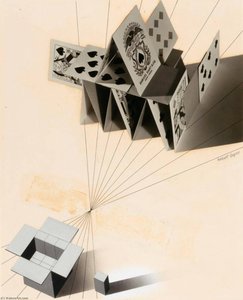
Paperboard Packs a Mighty Wallop, from the Early Series (1942) by Herbert Bayer

Paperboard Packs a Mighty Wallop, from the Early Series

1942 · Pencil

The scene unfolds within the lines of Paperboard Packs a Mighty Wallop, from the Early Series. This work emerges from the hand of Herbert Bayer, an artist whose origins trace back to Haag am Hausruck, Austria, in 1900. The image captures a moment of tension and logistical urgency, frozen in time as the world experiences the shifts of the early 1940s. It dates to about 1942, a period when the…

The Herbert Bayer selection continues, 11 to 23

11Ugly Duckling of the Office, from the Early Series (1939) by Herbert BayerUgly Duckling of the Office, from the Early Series1939 12Weakness into Strength, from the Early Series (1941) by Herbert BayerWeakness into Strength, from the Early Series1941 13Destiny of an Old Directory, from the Early Series (1939) by Herbert BayerDestiny of an Old Directory, from the Early Series1939 14Paperboard that goes to war is paper that wasn't burned. From the Early Series (1942) by Herbert BayerPaperboard that goes to war is paper that wasn't burned. From the Early Series1942 15Fire Steals Too Much of an Important Resource, from the Early Series (1942) by Herbert BayerFire Steals Too Much of an Important Resource, from the Early Series1942 16(Seven Convolutions, portfolio) (1948) by Herbert Bayer(Seven Convolutions, portfolio)1948 17I hold that while man exists it is his duty to improve not only his own condition but to assist in ameliorating mankind. Abraham Lincoln on Man's Responsibility. From the series Great Ideas of Western Man (1956) by Herbert BayerI hold that while man exists it is his duty to improve not only his own condition but to assist in ameliorating mankind. Abraham Lincoln on Man's Responsibility. From the series Great Ideas of Western Man1956 18Every new opinion, at its starting, is precisely in a minority of one. Thomas Carlyle, Heroes and Hero Worship, II, 1840, lecture in London, May 8. From the series Great Ideas of Western Man (1961) by Herbert BayerEvery new opinion, at its starting, is precisely in a minority of one. Thomas Carlyle, Heroes and Hero Worship, II, 1840, lecture in London, May 8. From the series Great Ideas of Western Man1961 19God made the world and all things therein.and has made of one blood all nations of men for to dwell on the face of the earth. St. Paul. Fromthe series Great Ideas of Western Man (1958) by Herbert BayerGod made the world and all things therein.and has made of one blood all nations of men for to dwell on the face of the earth. St. Paul. Fromthe series Great Ideas of Western Man1958 20The art of progress is to preserve order amid change and to preserve change amid order. Alfred North Whitehead (1861 1947). From the series Great Ideas of Western Man (1964) by Herbert BayerThe art of progress is to preserve order amid change and to preserve change amid order. Alfred North Whitehead (1861 1947). From the series Great Ideas of Western Man1964 21Reason Is Language, Logos. Johann Georg Hamann (1730 1738). From the series Great Ideas (1966) by Herbert BayerReason Is Language, Logos. Johann Georg Hamann (1730 1738). From the series Great Ideas1966 22Articulated Wall by Herbert BayerArticulated WallRuta de la Amistad Patronato Ruta de la Amistad A.C. 23The things that will destroy America are prosperity at any price, peace at any price, safety first instead of duty first, and love of soft living and the get rich quick theory of life. Theodore Roosevelt. From the series Great Ideas of Western Man (1959) by Herbert BayerThe things that will destroy America are prosperity at any price, peace at any price, safety first instead of duty first, and love of soft living and the get rich quick theory of life. Theodore Roosevelt. From the series Great Ideas of Western Man1959

The subjects that held Herbert Bayer's eye

The four subjects that come back most often in these originals, each with its finest example.

The museums that keep Herbert Bayer's originals

The 3 museums that hold the most of the paintings on this page.

Museum City Works by Herbert Bayer Paintings from this list
Städel Museum, FrankfurtStädel Museum Frankfurt 1 Sundeck
Lentos Kunstmuseum Linz, LinzLentos Kunstmuseum Linz Linz 1 Selfportrait
Ruta de la Amistad Patronato Ruta de la Amistad A.C., Mexico CityRuta de la Amistad Patronato Ruta de la Amistad A.C. Mexico City 1 Articulated Wall

Herbert Bayer decade by decade: the original that defines each

Works per decade

Pick a decade to see the original that defines it.

Collectors' questions about Herbert Bayer's paintings

Which work is Herbert Bayer most famous for?Reveal the answer

The News That's Never Read, from the Early Series (1939). Iron Winding Stair (1928) and The limits of my language mean the limits of my world. Ludwig Wittgenstein, Tractatus logigo philosphicus, 1922. From the series Great Ideas of Western Man (1979) come next.

What age was Herbert Bayer when The News That's Never Read, from the Early Series was made?Reveal the answer

39 years old: The News That's Never Read, from the Early Series dates from 1939, and Herbert Bayer was born in 1900.

What are the ten most famous Herbert Bayer paintings?Reveal the answer

The News That's Never Read, from the Early Series, Iron Winding Stair, The limits of my language mean the limits of my world. Ludwig Wittgenstein, Tractatus logigo philosphicus, 1922. From the series Great Ideas of Western Man, Paperboard Packs a Mighty Wallop, from the Early Series, Sundeck, Selfportrait, Billions of Powdered Eggs, from the Early Series, Strength Out of Straw, from the Early Series, Waste Paper to Package, from the Early Series and Aim High from the Early Series. The ranking above gives each one's year and museum.

How many paintings did Herbert Bayer leave?Reveal the answer

Our catalog holds 33 works by Herbert Bayer, dated from 1928 to 1979.

In which museums do Herbert Bayer's masterpieces hang?Reveal the answer

Mostly in Städel Museum (Frankfurt), Lentos Kunstmuseum Linz (Linz) and Ruta de la Amistad Patronato Ruta de la Amistad A.C. (Mexico City). The museum table above lists them all.

In which years did Herbert Bayer paint the most famous works?Reveal the answer

In 1940s: 8 of the 23 works on this page were made then, Paperboard Packs a Mighty Wallop, from the Early Series among them.

What are the first and the last famous originals of Herbert Bayer?Reveal the answer

On this page, the earliest is Iron Winding Stair (1928) and the latest The limits of my language mean the limits of my world. Ludwig Wittgenstein, Tractatus logigo philosphicus, 1922. From the series Great Ideas of Western Man (1979).

Which subjects did Herbert Bayer choose most often?Reveal the answer

Black and white (3), Abstract composition (2) and Men (2), across the 23 works on this page.

Which technique did Herbert Bayer use most?Reveal the answer

Painting, for 2 of the 23 works on this page.

Herbert Bayer: life and work

Herbert Bayer: Architect of a Minimalist Vision

Herbert Bayer (1900-1985) stands as a singular figure in 20th-century art and design, a pivotal bridge between the radical experimentation of the Bauhaus and the burgeoning modernism that shaped American culture. Born in The Hague, Croatia (though he later identified primarily with Austria), Bayer’s life was a testament to artistic reinvention, marked by a relentless pursuit of simplification and a profound impact on typography, architecture, and corporate identity. His journey from apprentice under Georg Schmidthammer to director of printing at the Bauhaus, then art director for *Vogue*, and finally as a key figure in shaping the visual language of Atlantic Richfield Company (ARCO), reveals an artist constantly adapting and pushing the boundaries of his craft.

Bayer’s early training at the Weimar Bauhaus was foundational. Immersed in the school's philosophy of “form follows function,” he quickly absorbed the principles of reductive design championed by Walter Gropius. However, it wasn’t merely adherence to established doctrine that defined his approach; Bayer possessed a uniquely intuitive sense for visual communication. He experimented with typography, rejecting traditional hierarchies and embracing a bold, all-lowercase sans-serif style – a deliberate departure from the conventions of the time. This “universal alphabet,” conceived in 1925 but never fully realized as a commercial typeface, remains a cornerstone of his legacy, influencing subsequent type designers like ITC Bauhaus and Architype Bayer.

The Bauhaus Legacy: Typography and Beyond

Bayer’s work at the Bauhaus was characterized by an unwavering commitment to clarity and efficiency. He meticulously redesigned publications for the school, utilizing a crisp, geometric sans-serif typeface that prioritized legibility and reduced visual clutter. This approach extended beyond typography; he explored graphic design principles, advocating for a minimalist aesthetic rooted in geometric abstraction. His designs were not merely decorative but served as tools for effective communication – a philosophy deeply ingrained within the Bauhaus ethos.

Leaving Germany in 1937 due to the rise of Nazism, Bayer found new opportunities in Berlin and later America. He joined *Vogue* magazine’s Berlin office, continuing his exploration of modern design principles. His time in the United States marked a shift towards corporate art direction, culminating in his influential role at ARCO. This period saw him transform the company's visual identity, establishing a sophisticated and instantly recognizable brand through a combination of striking typography, architectural designs, and memorable logos.

ARCO and the Corporate Art Collection

Bayer’s tenure as art director for Atlantic Richfield Company (ARCO) represents perhaps his most significant and enduring achievement. Recognizing the power of visual communication to shape corporate culture, he assembled one of the world's largest and most influential corporate art collections. He wasn’t simply purchasing artwork; he was curating an environment that reflected the company’s values – innovation, dynamism, and a forward-looking perspective.

His influence extended beyond mere selection; Bayer designed the ARCO Plaza headquarters in Los Angeles, incorporating his signature minimalist aesthetic into the building's architecture. He also created iconic visual elements for the company, including its logo and promotional materials. The “Double Ascension” fountain between the twin towers of ARCO Plaza stands as a testament to his creative vision and enduring legacy within the corporate world.

A Lasting Influence: Minimalism and Beyond

Herbert Bayer’s impact on 20th-century design is undeniable. His pioneering work in typography, particularly his development of the all-lowercase sans-serif typeface, continues to influence designers today. His reductive aesthetic—characterized by simplicity, clarity, and geometric abstraction—laid the groundwork for movements like Minimalism and Swiss Style.

Beyond specific techniques, Bayer’s approach to design – a focus on functionality, communication, and visual impact – remains remarkably relevant in our increasingly complex world. He demonstrated that good design isn't about ornamentation; it's about creating meaningful connections between ideas and audiences. His legacy endures not only through his iconic designs but also as an inspiration for generations of artists and designers seeking to shape a more visually compelling future.