The Quiet Intensity of Axel Søeborg
In the soft, shifting light of the early twentieth century, the Danish painter Axel Søeborg carved out a space for himself that was profoundly intimate and psychologically resonant. Born in 1872, Søeborg’s journey into the world of fine art began far from the prestigious academies; he first worked as a house painter, a humble beginning that perhaps instilled in him a foundational respect for the physical properties of pigment and surface. This early tactile relationship with color would later evolve into a sophisticated mastery of light and shadow, allowing him to capture the subtle transitions of the natural world and the heavy silences of domestic life.
His formal education was rigorous and steeped in tradition, beginning at the drawing school of the Vermehren brothers, Gustav and Sophulated. He continued his refinement at the Royal Danish Academy of Fine Arts, studying under masters such as Laurits Tuxen and Peter Alfred Schou. It was from Schou, in particular, that Søeborg drew much of his creative inspiration, adopting a penchant for moody, dark interiors that utilized dramatic chiaroscuro to evoke deep emotion. This training provided him with the technical vocabulary to transform simple scenes into profound meditations on existence.
Landscapes and the Soul of the North
Søeborg’s oeuvre is characterized by a remarkable versatility, ranging from the expansive, atmospheric landscapes of the Swedish countryside to the claustrophobic, contemplative depths of his portraits. For twenty years, he wandered through regions such as Småland and Lapland, documenting the changing seasons with a singular, distinctive hand. His landscapes are not merely topographical records but emotional maps; they capture the ochre yawn of autumn and the bitter sleep of winter, imbuing the Scandinavian wilderness with a sense of living, breathing solitude.
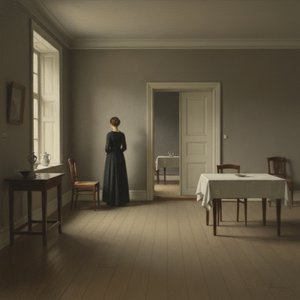
Beyond the horizon, Søeborg turned his gaze inward. His interior scenes are masterclasses in atmosphere, often featuring simply furnished rooms where the play of light against shadow creates a palpable tension. In these quiet spaces, he frequently depicted subjects—often himself or an unknown female sitter—whose piercing gazes seem to confront the viewer directly. These works are imbued with a psychological intensity, where a single candle placed upon a palette or the silvery light reflecting off a distant lake can shift the entire emotional temperature of the canvas.
A Legacy of Introspection
The significance of Axel Søeborg lies in his ability to find the extraordinary within the ordinary. His self-portraits, often executed with a dramatic flair, serve as windows into an artist who was perpetually searching for meaning through observation. Whether he was painting a priest lost in scripture or a landscape shrouded in twilight, his work remains anchored by a sense of profound stillness and a reverence for the quiet moments of life.
Throughout his career, several key elements defined his artistic identity:
- Technical Mastery: A transition from house painter to academic master, utilizing light and shadow to create depth and drama.
- Thematic Depth: An exploration of the psychological connection between humans and their environments, from vast landscapes to intimate rooms.
- Atmospheric Focus: A unique ability to capture the specific, fleeting moods of the Nordic seasons and domestic solitude.
Though his life ended in 1939, Søeborg’s contribution to Danish and Swedish art remains a testament to the power of the introspective gaze. He remains an artist for those who find beauty in the shadows and meaning in the silence.