
 Preview
 Send
Send Share
Share
 Details
 Guide
Guide

 Download
 Similars
 X-Ray
X-Ray Diaporama
 Stats
StatsPeaceable Kingdom


 Read More
Purchase a high-resolution, enhanced digital image, far superior to the online preview.
Each file is meticulously prepared by our in-house specialists using advanced tools and expert manual retouching. We ensure every image has exceptional clarity, precise color accuracy, and fine detail.
The final file is delivered via email within 72 hours, optimized for immediate use in professional, editorial, and print environments. This is the same quality trusted by top-tier design studios, publishers, and galleries.
Digital Image
Download a high-resolution file for personal display, printing, and creative projects. ( Switch to Print Buy Hand Made Painting)
Included in Every Digital Image Order
Expert Digital Delivery, Guaranteed
When you choose OriginalUniqueArt.com, you're not just getting an image - you're receiving a professionally enhanced digital artwork, crafted with precision and backed by a satisfaction guarantee. Here's everything that comes with your order, automatically:

Fast Email Delivery
Your high-resolution digital image file will be emailed to you within 72 hours of ordering - ready for immediate use.

AI-Enhanced Digital File
Your artwork is professionally optimized using advanced AI tools and manual editing, ensuring maximum detail, clarity, and color accuracy.

Free Lifetime Re-Delivery
Accidentally deleted or lost your file? No worries - we'll resend it to you anytime, free of charge.

No Import Fees - Ever
Enjoy your artwork instantly with zero customs, duties, or delivery fees - digital downloads are always tax-free.

Color Accuracy Guarantee
We ensure your digital image reflects the original colors as closely as possible using professional tools and color management.

100-Day Satisfaction Guarantee
If you're not satisfied with your digital image, we'll revise it or refund 100% within 100 days - no questions asked.

100% Money-Back Guarantee
Not satisfied? Get a full refund within 100 days of receiving your digital file - no questions asked.

Bulk Order Discounts
Buy 3 images, save 10% - Buy 5, save 15% - Buy 10+, save 20%. Great for creative projects, galleries, and agencies.
A Pastoral Vision of Dominion: Edward Hicks’ “Peaceable Kingdom”
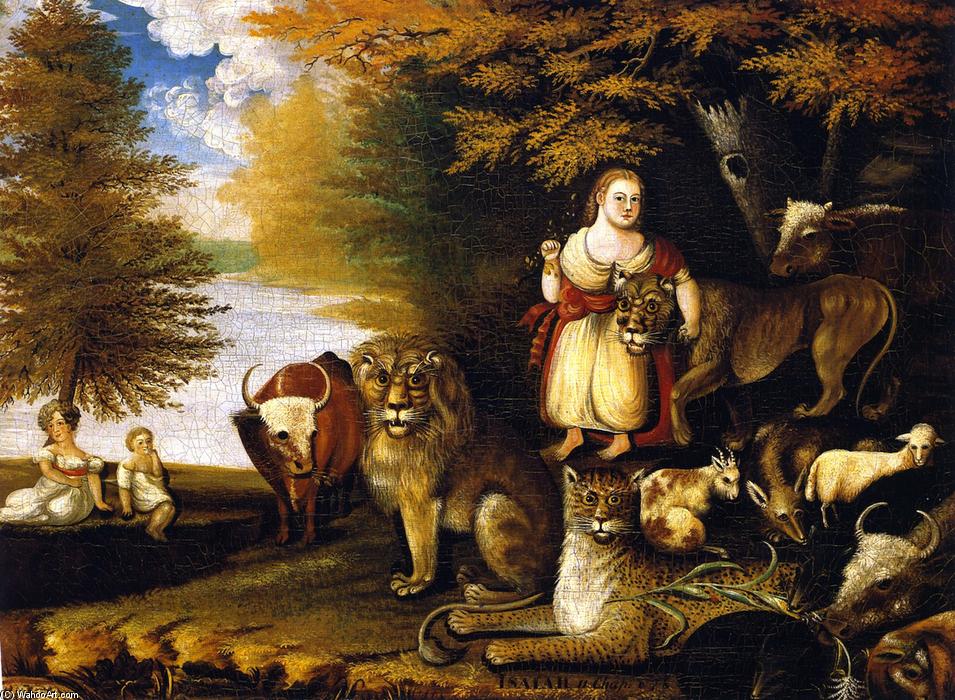
Edward Hicks' "Peaceable Kingdom," painted in 1830, is more than just a beautiful depiction of a rural landscape; it’s a profound meditation on faith, power, and the delicate balance between humanity and nature. This monumental oil painting, now a cornerstone of American art history, offers a glimpse into the heart of Quaker belief and Hicks' uniquely expressive artistic vision. The scene unfolds with an almost overwhelming sense of serenity – a vast meadow teeming with life, dominated by a central female figure holding aloft a symbolic crown or scepter. Lions, bulls, leopards, sheep, and cows gather around her, seemingly rendered docile and content under her watchful gaze. It’s a tableau that immediately evokes the grandeur of Renaissance allegories while retaining a distinctly American sensibility.
The Quaker Narrative: Faith as Foundation
Understanding Hicks' artistic practice requires acknowledging his deep connection to the Religious Society of Friends, or Quakers. Born into an Anglican family but raised by the devout Matron Elizabeth Twining, Hicks’ life was fundamentally shaped by their core tenets – simplicity, peace, and a belief in the “inner light” – that resided within each individual. "Peaceable Kingdom" isn't simply a landscape; it’s a visual representation of this spiritual philosophy. The central figure is often interpreted as representing Christ or Providence, embodying divine authority and offering a message of reconciliation and harmony. The animals, traditionally symbols of earthly power and potential conflict, are rendered peaceful and obedient, suggesting that true dominion comes not through force but through grace and understanding.
Technique and Composition: A Masterclass in Detail
Hicks’ masterful technique is immediately apparent upon close inspection. The painting is executed in the rich, layered style of oil paint, utilizing a meticulous approach to detail that was characteristic of his work. He employs a carefully constructed composition, drawing the eye towards the central figure through strategic use of light and shadow. The receding planes of land and trees create a sense of depth, while the vibrant colors – dominated by warm golds, browns, and reds – contribute to the painting’s overall warmth and inviting quality. Noticeably, Hicks utilizes impasto in certain areas, particularly within the foliage and animal fur, adding textural richness and emphasizing the tactile nature of the scene. The flattened perspective, reminiscent of earlier Renaissance styles, is skillfully balanced by a dynamic arrangement of figures and elements, preventing the composition from feeling static.
Symbolism Unveiled: A Tapestry of Meaning
Beyond its immediate visual appeal, “Peaceable Kingdom” is laden with symbolic meaning. The animals themselves carry significant weight – the lion representing strength, the bull symbolizing fertility and earthly power, the leopard embodying cunning and vigilance, while sheep represent innocence and vulnerability. The woman’s crown or scepter isn't merely a symbol of authority; it represents the divine right to rule, not through coercion but through benevolent guidance. The presence of two women seated beneath the tree on the left side adds another layer of interpretation, potentially representing the role of female wisdom and nurturing within this harmonious landscape. Even the body of water reflecting the sky reinforces the theme of interconnectedness – mirroring the heavens in the earth below.
“Peaceable Kingdom” remains a powerful testament to Edward Hicks’ artistic vision and his unwavering faith. It's a painting that invites contemplation, prompting viewers to consider their own relationship with nature, power, and the enduring promise of peace. Reproductions offer an accessible way to experience this remarkable work of art, bringing its serene beauty and profound symbolism into any space.
Questions & Answers
At what size is "Peaceable Kingdom" suggested for a living room?
The recommended pairing for "Peaceable Kingdom" by Edward Hicks: a medium print in a living room.
Can I preview "Peaceable Kingdom" by Edward Hicks before ordering?
A preview of "Peaceable Kingdom" by Edward Hicks is available on the artwork's Preview page.
Can the image of "Peaceable Kingdom" by Edward Hicks be freely reproduced?
"Peaceable Kingdom" by Edward Hicks is in the public domain - its copyright has expired. This status governs how the image of the work may be reproduced.
Artist Biography
A Life Rooted in Faith and Vision
Edward Hicks, born April 4th, 1780, in the tranquil landscape of Attleboro (now Langhorne), Bucks County, Pennsylvania, was a figure uniquely positioned at the intersection of religious conviction and artistic expression. His story is not simply that of a self-taught painter, but of a dedicated Quaker minister whose spiritual journey profoundly shaped his distinctive visual language. Though born to Anglican parents, young Edward’s life took a pivotal turn when he came under the care of Matron Elizabeth Twining, a devout Quaker who instilled in him the core tenets of this faith – simplicity, peace, and an unwavering belief in the “inner light.” This early exposure would become the bedrock upon which his artistic vision was built. From the age of thirteen, Hicks apprenticed with coach makers William and Henry Tomlinson, mastering the techniques of decorative painting that would initially sustain him. However, even as he honed his skills in rendering ornate designs on carriages, a deeper calling resonated within him, one that would ultimately lead him down a path less traveled – a path where faith and artistry converged. By 1803, Hicks had fully embraced the Society of Friends, marrying Sarah Worstall and embarking on a life of itinerant preaching throughout Philadelphia, all while continuing to support his growing family through his painting skills.The Evolving Canvas: From Coachwork to Spiritual Landscapes
Hicks’s artistic development was far from conventional. He wasn't formally trained in the academic traditions of the time; instead, he cultivated a distinctly American folk art style born from observation, necessity, and deeply held beliefs. Initially, his paintings served practical purposes – house painting, coach decoration, tavern signs, and even decorative work on furniture and farm equipment. These early commissions provided financial stability but often conflicted with the Quaker emphasis on plainness and eschewal of worldly vanities. A period of hardship in 1815 saw Hicks briefly abandon ornamental painting for farming, a venture that proved unsuccessful. It was through encouragement from friends that he returned to his brushes in 1816, a turning point that allowed him to reconcile his artistic talents with his spiritual calling. This return wasn’t merely a resumption of previous work; it marked the beginning of a unique exploration of religious themes and allegorical landscapes. He began to imbue his paintings with symbolic meaning, reflecting his Quaker worldview and personal interpretations of scripture. His canvases became vehicles for conveying messages of peace, harmony, and the promise of a divinely ordained order.The Peaceable Kingdom: A Vision of Harmony
Edward Hicks is most celebrated today for his series of paintings known collectively as *The Peaceable Kingdom*. Comprising over sixty variations created throughout his life, these works are arguably the most iconic examples of American folk art. Inspired by Isaiah 11:6-9 – a passage foretelling a time when natural predators would coexist peacefully – Hicks depicted scenes of wild animals and children living in idyllic harmony. The paintings often feature figures from colonial Pennsylvania history, such as William Penn negotiating treaties with Native Americans, further grounding the biblical vision within an American context. *The Peaceable Kingdom* is not simply a charming depiction of animal life; it’s a powerful statement about Hicks's belief that Pennsylvania represented a fulfillment of this prophetic ideal – a place where peace and justice could prevail. Each version of *The Peaceable Kingdom* possesses subtle variations in composition, color palette, and detail, reflecting Hicks’s evolving artistic sensibilities and deepening spiritual understanding. Notable examples include *Peaceable Kingdom (31)* housed at Yale University Art Gallery, and *Peaceable Kingdom (34)* which portrays Noah's Ark amidst a serene landscape.Beyond the Kingdom: A Broader Artistic Scope
While *The Peaceable Kingdom* remains his signature achievement, Edward Hicks’s artistic output extended beyond this celebrated series. He painted landscapes, portraits, and historical scenes, each imbued with his characteristic folk art style and Quaker sensibility. His *Falls of Niagara*, now at the Abby Aldrich Rockefeller Folk Art Center, demonstrates his ability to capture the grandeur of nature while maintaining a sense of simplicity and reverence. Similarly, his depiction of *George Washington with his army crossing the Delaware* – also held at the Abby Aldrich Rockefeller Folk Art Center – offers a unique folk perspective on this iconic moment in American history. Even seemingly mundane subjects like *Grave of William Penn at Jordans in England*, reveal Hicks’s deep connection to Quaker heritage and his ability to find spiritual significance in everyday scenes. These works, taken together, demonstrate the breadth of Hicks's artistic vision and his commitment to using art as a means of expressing his faith and values.A Lasting Legacy: The Folk Art Icon
Edward Hicks passed away on August 23rd, 1849, in Newtown, Pennsylvania, leaving behind a body of work that continues to resonate with audiences today. He is now recognized as a pivotal figure in American folk art, celebrated for his distinctive style, recurring themes, and profound spiritual depth. His paintings offer invaluable insights into the beliefs and values of the Society of Friends during the 19th century, providing a visual record of their commitment to peace, simplicity, and social justice. Hicks’s unique ability to blend religious faith with artistic expression created a body of work that is both visually compelling and spiritually meaningful. His legacy extends beyond the museums and collections where his paintings are displayed; it lives on in the continued appreciation for his art and the enduring power of his vision – a vision of a “peaceable kingdom” where harmony reigns between humanity, nature, and the divine. He remains a testament to the power of self-taught artistry and the profound impact that faith can have on creative expression.
Edward Hicks
1780 - 1849 , United States of America
Quick Facts
- Full Name: Edward Hicks
- Nationality: American
- Date Of Birth: 1780
- Date Of Death: 1849
- Place Of Birth: Attleboro, United States of America
- Notable Artworks:
- Peaceable Kingdom (31)
- Falls of Niagara
- George Washington crossing...
- Peaceable Kingdom (34)
- Artistic Movement Or Style: Folk Art