 Send
Send Share
Share
 Details
 Guide
Guide

 Download
 Similars
 Diaporama
 Stats
StatsLipstick - (74)


 Read More
The artwork displayed on this page is protected by copyright law, which means we cannot legally create or sell an identical reproduction. This protection is enforced under international agreements such as the Berne Convention and by national laws, including those outlined by the U.S. Copyright Law - Title 17.
This method fully complies with copyright regulations because it does not involve copying or duplicating the protected artwork. Instead, it is a creative reinterpretation - a new painting that is influenced by the original but not identical to it.
Giclée / Art Print
Museum-quality giclée or canvas print with fast production and flexible finish options. ( Buy Hand Made Painting Switch to Digital Image)




































Pick from our preset sizes that match the artwork's original proportions.

Type the width and the height you need, to fit your frame or your wall. A print can only be cut, never made bigger than the picture, so a size with a different shape loses a part of the image. We send you a digital mockup to approve before we print anything. The picture shown on this page does not show the real cut — only the mockup does.
Worldwide Delivery () in 2 weeks instead of standard 4/5 weeks. (27 October)

Free Worldwide Express Shipping

High-Quality Linen Canvas

Full Shipping Insurance

Customs Tax Refund Guarantee

True Color Matching Guarantee

100-Day Return Policy (Defects Only)

100% Money-Back Guarantee

Bulk Discount Offer
 Glass option is only available in size under 110 CM

Lipstick - (74)
Giclée / Art Print
Reproduction Size
-


Total Price
$ 81
Subject and Visual Impact
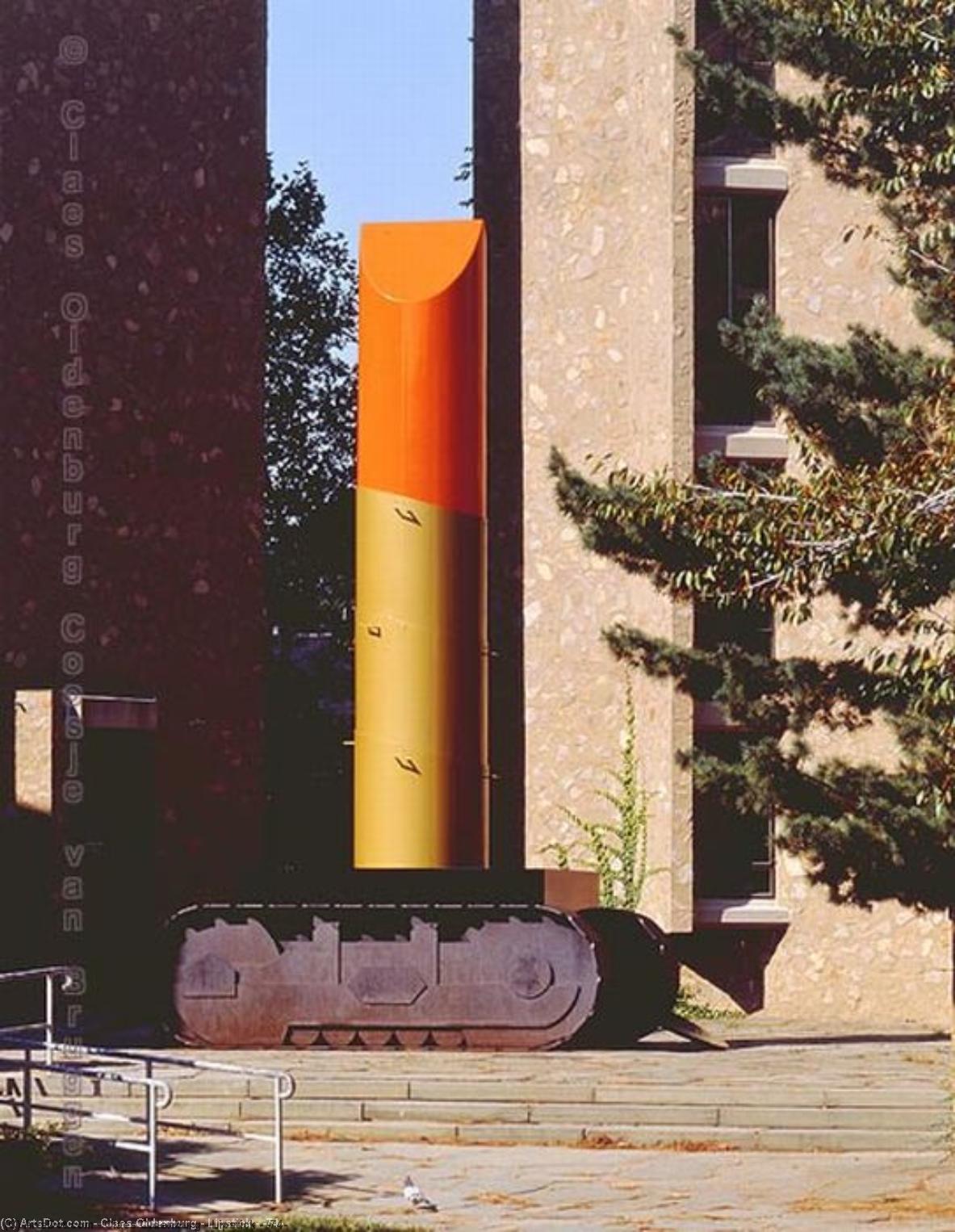
This striking sculpture captures the imagination with its bold, oversized depiction of a lipstick, transforming a familiar object into a monumental work of art. Its vibrant colors—rich reds, oranges, and yellows—immediately draw the eye, creating a focal point that commands attention. The piece’s exaggerated scale and vivid palette evoke a sense of playfulness and empowerment, making it a captivating centerpiece in any space. Its sleek, smooth surface contrasts with the textured background, emphasizing the object’s modernist aesthetic and inviting viewers to explore its form from multiple angles.Style and Technique
Rooted in the Pop Art movement, this sculpture exemplifies Oldenburg’s signature approach of enlarging everyday objects to elevate their cultural significance. Crafted with meticulous attention to detail, the piece employs a combination of industrial techniques and artistic craftsmanship, resulting in a smooth, polished finish that accentuates its bold contours. The use of bright, contrasting colors enhances its visual impact, while the simplified, stylized form aligns with modernist principles of abstraction and minimalism. This fusion of technique and style creates a dynamic interplay between realism and abstraction, making it both a statement piece and a work of fine art.Historical Context and Artistic Significance
Created during a period of social and cultural upheaval, this sculpture reflects the ethos of the Pop Art movement, which sought to challenge traditional notions of fine art by incorporating imagery from popular culture. Oldenburg’s work often comments on consumerism, mass media, and the commodification of everyday objects. As a public installation, it also embodies the democratization of art, making high art accessible and engaging for diverse audiences. Its placement in urban environments and public spaces underscores its role as a conversation starter, blending art with societal commentary.Symbolism and Emotional Resonance
Beyond its playful appearance, the sculpture symbolizes themes of femininity, identity, and self-expression. The lipstick, a universal symbol of beauty and empowerment, invites viewers to reflect on notions of gender, beauty standards, and personal confidence. Its larger-than-life presence evokes feelings of admiration, joy, and a touch of whimsy, encouraging viewers to reconsider the ordinary objects that surround them daily. Whether as a statement piece in a modern interior or a focal point in a public space, this artwork inspires a sense of wonder and curiosity, making it a meaningful addition to any collection or environment.Perfect for Collectors and Interior Design
This high-quality reproduction offers art lovers and interior designers an exceptional opportunity to incorporate a piece of contemporary cultural history into their spaces. Its vibrant colors and iconic form make it ideal for modern, eclectic, or minimalist interiors, adding a splash of personality and artistic flair. As a conversation starter and a symbol of pop culture innovation, it appeals to collectors seeking a distinctive, impactful work that combines artistic excellence with cultural relevance. Whether displayed in a gallery, office, or private collection, this sculpture promises to inspire and delight for years to come.Questions & Answers
What saturation and intensity does "Lipstick - (74)" by Claes Thure Oldenburg show?
"Lipstick - (74)" by Claes Thure Oldenburg is recorded with a subtle color saturation and a balanced intensity.
What atmosphere would a reproduction of "Lipstick - (74)" by Claes Thure Oldenburg bring to a room?
The playful atmosphere of "Lipstick - (74)" by Claes Thure Oldenburg matches its recommended space: a living room.
At what size is "Lipstick - (74)" suggested for a living room?
The recommended pairing for "Lipstick - (74)" by Claes Thure Oldenburg: a large print in a living room.
Artist Biography
The Architect of the Everyday: The Visionary World of Claes Oldenburg
To encounter the work of Claes Oldenburg is to witness a delightful subversion of reality, where the mundane is elevated to the monumental and the familiar becomes strangely surreal. Born in Stockholm, Sweden, in 1929, Oldenburg possessed an uncanny ability to strip the ordinary of its invisibility. His artistic journey, which would eventually define much of the Pop Art movement, was rooted in a profound fascination with the textures and shapes of daily life. Whether it was the soft sag of a fabric-covered object or the towering presence of a giant utensil, Oldenburg’s oeuvre challenged the viewer to reconsider the very objects that populate our domestic and urban landscapes.
His early years were shaped by an avant-garde sensibility, absorbing the radical energies of Surrealism and Dada. This foundation allowed him to approach sculpture not as a rigid medium of stone or bronze, but as a fluid language capable of expressing absurdity and wit. After moving to New York in 1956, he became a central figure in the city's burgeoning experimental scene. His early installations, such as The Street (1960) and The Store (1961), were transformative performances of space and commerce, utilizing urban debris and plaster replicas of consumer goods to blur the line between high art and the grit of the marketplace.
Softness, Scale, and the Pop Art Revolution
One of Oldenburg’s most enduring legacies lies in his pioneering development of soft sculpture. By utilizing pliable materials like polyurethane foam and heavy fabrics, he introduced a sense of vulnerability and organic life to inanimate objects. These "floppy" versions of hard items—clothespins, telephones, or even toilets—defied the traditional permanence of sculpture, inviting a tactile, almost psychological engagement from the audience. This technique allowed him to capture the ephemeral essence of consumer culture, rendering the industrial in a state of soft, yielding repose.
As his career progressed, Oldenburg’s ambitions expanded from the intimate scale of the gallery to the grand stage of the public square. In collaboration with his late wife and creative partner, Coosje van Bruggen, his work achieved a new level of architectural grandeur. Together, they mastered the art of the monumental, creating massive installations that integrated seamlessly into the urban fabric while simultaneously disrupting it. Their collaborative spirit breathed life into iconic pieces that transformed city skylines, turning public spaces into playgrounds of imagination.
A Legacy Carved in the Public Imagination
The historical significance of Claes Oldenburg cannot be overstated; he fundamentally altered the relationship between art and the spectator. His work remains a cornerstone of 20th-century art history due to several key achievements:
- Redefining Materiality: Through his use of soft, yielding materials, he broke the "monumental" tradition of heavy, static sculpture.
- Pop Art Iconography: He successfully bridged the gap between high culture and popular consumerism, using symbols like hamburgers and lipsticks to comment on modern identity.
- Public Engagement: His massive outdoor installations, such as the celebrated Spoonbridge & Cherry, democratized art by bringing it out of museums and into the daily paths of millions.
- Collaborative Vision: His partnership with Coosje van Bruggen demonstrated how shared creative voices could push the boundaries of scale and environmental integration.
Though he passed away in 2022, Oldenburg’s influence persists in every oversized sculpture that makes us pause, smile, or question our surroundings. He left behind a world that feels slightly more magical, reminding us that even the most overlooked object—a spoon, a plug, or a piece of fruit—holds the potential for greatness if viewed through the lens of a truly transformative imagination.

Claes Thure Oldenburg
1929 - 2022 , Sweden
Quick Facts
- Full Name: Claes Oldenburg
- Nationality: Swedish-American
- Date Of Birth: 1929
- Date Of Death: 2022
- Place Of Birth: Stockholm, Sweden
- Notable Artworks:
- Knifeship - (85)
- Store poster
- Split button
- Artistic Movement Or Style: Pop Art
- Artists Who Influenced This Artist: ['Hannah Wilke']
- Artists Or Movements Influenced By This Artist: ['Minimalism']
Related Articles

Crimson Threads of Narrative: Exploring Symbolism & Representation in Artworks Featuring the Red Dress
Explore the rich symbolism of the red dress in art history! From ancient power displays to iconic portraits like Cézanne’s 'Madame Cezanne', discover the cultural and artistic significance behind this captivating color. Expert analysis & insights.

The Enduring Form: Sculpture Across History, Technique & Emotional Resonance
Explore the rich history of sculpture with OriginalUniqueArt. Discover key techniques, influential artists & investment potential for discerning collectors. Expert insights into valuing and collecting timeless masterpieces.

Bronze Sculptures That Defined Art History | OriginalUniqueArt
Journey through art history with our Top 10 bronze sculptures! Explore masterpieces by Rodin, Michelangelo & more. Discover stories behind iconic statues and find museum-quality reproductions for your home decor at OriginalUniqueArt.com.

Bronze Age to Modern Masters: 10 Sculptures That Redefined Art | OriginalUniqueArt
Journey through art history with 10 legendary bronze sculptures – from Michelangelo's David to Rodin’s Thinker. Explore the stories, techniques & timeless beauty of these masterpieces. Find museum-quality reproductions & elevate your home decor on OriginalUniqueArt.com.

The Enduring Form: Exploring Themes & Techniques in Sculpture Across Historical Periods
Explore the rich history of sculpture from ancient masterpieces to contemporary innovations. Discover key techniques, influential artists & investment potential for discerning art collectors.