Preview
 Send
Send Share
Share
 Details
 Guide
Guide

 Download
 Similars
 X-Ray
X-Ray Diaporama
 Q&A
Q&A Stats
StatsDelos

- 76.0 x 54.0 cm


 Read More
The artwork displayed on this page is protected by copyright law, which means we cannot legally create or sell an identical reproduction. This protection is enforced under international agreements such as the Berne Convention and by national laws, including those outlined by the U.S. Copyright Law - Title 17.
This method fully complies with copyright regulations because it does not involve copying or duplicating the protected artwork. Instead, it is a creative reinterpretation - a new painting that is influenced by the original but not identical to it.
Giclée / Art Print
Museum-quality giclée or canvas print with fast production and flexible finish options. ( Buy Hand Made Painting Switch to Digital Image)




P118B $10

P118H $10

P118W $10

P438Z $10

P508JH $12

P508YH $12

P805H $10

P805Z $10

P919BZ $10

P919G $10

P919XJ $10

P959ZH $10

P968JZ $12

W106C $8

W218G $10

W218JH $8

W218Y $10

W307PJ $10

W316G $10

W316PJ $8

W316Y $10

W398PJ $8

W4111J $10

W500HY $15

W500JH $15

W692G $12

W849H $8

W940BG $15

W953PJ $8




Pick from our preset sizes that match the artwork's original proportions.

Type the width and the height you need, to fit your frame or your wall. A print can only be cut, never made bigger than the picture, so a size with a different shape loses a part of the image. We send you a digital mockup to approve before we print anything. The picture shown on this page does not show the real cut — only the mockup does.
Worldwide Delivery () in 2 weeks instead of standard 4/5 weeks. (31 October)

Free Worldwide Express Shipping

High-Quality Linen Canvas

Full Shipping Insurance

Customs Tax Refund Guarantee

True Color Matching Guarantee

100-Day Return Policy (Defects Only)

100% Money-Back Guarantee

Bulk Discount Offer
 Glass option is only available in size under 110 CM

Delos
Giclée / Art Print
Reproduction Size
-


Total Price
$ 81
Delos: A Meditation on Form and Void by Barbara Hepworth
Barbara Hepworth’s “Delos,” created in 1971, is more than just a painting; it's an invitation to contemplate the relationship between solidity and emptiness, form and space. The work immediately draws the eye with its striking palette of yellows and blacks – a deliberate contrast that speaks volumes about the artist’s core concerns. The dominant yellow, reminiscent of sun-drenched stone or aged parchment, provides a warm, almost luminous backdrop for the carefully sculpted voids represented by the stark black circles. These aren't merely decorative elements; they are crucial to understanding Hepworth’s intention – to suggest a profound sense of absence and the inherent tension within any form.
Hepworth, a pivotal figure in 20th-century British art, was deeply influenced by both European modernism and her own experiences with sculpture. Her work moved beyond representational imagery, seeking instead to capture essential qualities – weight, texture, and the dynamic interplay of positive and negative space. “Delos” echoes this approach, translating the tactile experience of three-dimensional form into a two-dimensional plane. The painting’s genesis lies partly in Hepworth's fascination with Greek mythology, particularly the island of Delos, sacred to Apollo and Artemis and renowned for its ancient ruins. The title itself acts as a direct reference to this historical and symbolic significance, grounding the abstract composition within a rich cultural context.
Technique and Composition: A Study in Contrasts
The painting’s technique is deceptively simple yet remarkably sophisticated. Hepworth employed a layered approach, building up the yellow ground with thin washes of color to create subtle tonal variations. The black circles are not painted directly onto the surface; rather, they appear as carefully applied areas of concentrated pigment, suggesting a deliberate process of carving or subtraction. This technique reinforces the idea of form emerging from void – a central theme in Hepworth’s oeuvre. The placement of the circles is equally important. The largest circle dominates the center of the composition, acting as a visual anchor and drawing the eye inward. Smaller circles are strategically positioned around it, creating a dynamic balance between stability and movement.
Hepworth's use of color is particularly noteworthy. The yellow isn’t a bright, cheerful hue; it possesses a muted quality, hinting at age and weathering – qualities that resonate with the ancient ruins of Delos itself. The black circles, conversely, are intensely dark, creating a powerful contrast that demands attention. This interplay of light and shadow generates a sense of depth and volume, inviting the viewer to explore the painting’s surface and contemplate its hidden dimensions.
Symbolism and Emotional Resonance
Beyond its formal qualities, “Delos” is imbued with a profound sense of symbolism. The circles can be interpreted as representing the absence of something – perhaps loss, memory, or the unknowable mysteries of the universe. They also evoke the idea of holes or voids within forms, suggesting that even the most solid and substantial objects are ultimately defined by their emptiness. This concept aligns with Hepworth’s broader exploration of the relationship between form and space, a theme she consistently revisited throughout her career.
The painting's emotional impact is subtle yet deeply affecting. It doesn’t offer easy answers or explicit narratives; instead, it invites contemplation and introspection. There’s a sense of quiet melancholy, a recognition of the transient nature of existence, and a profound appreciation for the beauty that can be found in emptiness. “Delos” ultimately serves as a reminder that true understanding often arises not from filling every space with detail, but from embracing the power of suggestion and allowing the mind to complete the picture.
A Legacy of Form and Space
Barbara Hepworth’s “Delos” stands as a testament to her pioneering spirit and her profound insights into the nature of art. It's a work that transcends its simple composition, offering viewers a glimpse into the artist’s inner world and inviting them to engage in a dialogue with timeless themes of form, space, and existence. Reproductions of this piece offer an accessible way to experience Hepworth’s vision, bringing her evocative exploration of emptiness and solidity into any interior space – a reminder that sometimes, the most powerful art is found not in what is shown, but in what is left unsaid.
Questions & Answers
How much light do the colors of "Delos" appear to reflect?
The colors of "Delos" show a luminous luminance.
Where can I buy a print of "Delos" by Barbara Hepworth?
To get a print of "Delos" by Barbara Hepworth, simply order it on its Fine Art Print page: a fine art print on cotton canvas or archival canvas paper.
Where is "Delos" by Barbara Hepworth on display today?
"Delos" by Barbara Hepworth is on display at The Hepworth Wakefield, Wakefield, United Kingdom. The museum listing refers to the original work, not to reproductions.
Artist Biography
early life and education
dame barbara hepworth, a renowned english artist and sculptor, was born on january 10, 1903, in wakefield, yorkshire. she attended the leeds school of art from 1920 and later won a county scholarship to study at the royal college of art (rca) in london from 1921 until she was awarded the diploma in 1924.artistic career
- dame barbara hepworth's work exemplifies modernism, particularly modern sculpture. she was one of the few female artists to achieve international prominence.
- in 1933, she co-founded the unit one art movement with ben nicholson, paul nash, and others, seeking to unite surrealism and abstraction in british art.
- hepworth's early work was characterized by abstraction and her involvement with the paris-based art movement, abstraction-création.
notable works and exhibitions
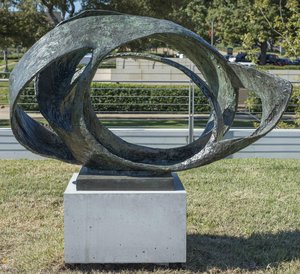
- oval form (trezion), a bronze sculpture, is part of the kimbell art museum collection in fort worth, united states. (view on OriginalUniqueArt)
- two forms, a sculpture, is exhibited at the hepworth wakefield in wakefield, united kingdom. (view on OriginalUniqueArt)
- totem, a marble sculpture, is also part of the collection at the hepworth wakefield. (view on OriginalUniqueArt)
legacy and museum collections
barbara hepworth's work is widely recognized, with her sculptures and paintings forming part of various museum collections worldwide. the hepworth wakefield, named after the artist, houses numerous masterpieces from renowned artists, including hepworth's own works. (discover more about the hepworth wakefield on OriginalUniqueArt)conclusion
dame barbara hepworth's pioneering work in modern british sculpture has left an indelible mark on the art world. her legacy continues to inspire artists and art enthusiasts alike, with her works remaining a testament to her innovative spirit and artistic genius. more about barbara hepworth on wikipedia
Barbara Hepworth
1903 - 1975 , United Kingdom
Quick Facts
- Full Name: Barbara Hepworth
- Nationality: British
- Date Of Birth: 1903
- Date Of Death: 1975
- Place Of Birth: Wakefield, United Kingdom
- Notable Artworks:
- Oval Form (Trezion)
- Two Forms
- Totem
- Artistic Movement Or Style: Modernism, Abstraction
- Artists Who Influenced This Artist:
- Henry Moore
- Ben Nicholson
- Artists Or Movements Influenced By This Artist:
- Abstraction-Création
- Unit One
Related Articles

The Enduring Form: Exploring Themes & Techniques in Sculpture Across Historical Periods
Explore the rich history of sculpture from ancient masterpieces to contemporary innovations. Discover key techniques, influential artists & investment potential for discerning art collectors.

Bronze Sculptures That Defined Art History | OriginalUniqueArt
Journey through art history with our Top 10 bronze sculptures! Explore masterpieces by Rodin, Michelangelo & more. Discover stories behind iconic statues and find museum-quality reproductions for your home decor at OriginalUniqueArt.com.
Barbara Hepworth: A Sculptural Dialogue with Form, Space & the Human Condition
Explore the profound world of Barbara Hepworth's sculpture. Discover her artistic evolution, iconic forms, and lasting influence on modern art. A guide for collectors & enthusiasts.

Bronze Age to Modern Masters: 10 Sculptures That Redefined Art | OriginalUniqueArt
Journey through art history with 10 legendary bronze sculptures – from Michelangelo's David to Rodin’s Thinker. Explore the stories, techniques & timeless beauty of these masterpieces. Find museum-quality reproductions & elevate your home decor on OriginalUniqueArt.com.

The Enduring Form: Sculpture Across History, Technique & Emotional Resonance
Explore the rich history of sculpture with OriginalUniqueArt. Discover key techniques, influential artists & investment potential for discerning collectors. Expert insights into valuing and collecting timeless masterpieces.