 Preview
 Send
Send Share
Share
 Details
 Guide
Guide

 Download
 Similars
 X-Ray
X-Ray Diaporama
 Q&A
Q&A Stats
StatsRomulus and Remus


 Read More
The artwork displayed on this page is protected by copyright law, which means we cannot legally create or sell an identical reproduction. This protection is enforced under international agreements such as the Berne Convention and by national laws, including those outlined by the U.S. Copyright Law - Title 17.
This method fully complies with copyright regulations because it does not involve copying or duplicating the protected artwork. Instead, it is a creative reinterpretation - a new painting that is influenced by the original but not identical to it.
Giclée / Art Print
Museum-quality giclée or canvas print with fast production and flexible finish options. ( Buy Hand Made Painting Switch to Digital Image)




P118B $10

P118H $10

P118W $10

P438Z $10

P508JH $12

P508YH $12

P805H $10

P805Z $10

P919BZ $10

P919G $10

P919XJ $10

P959ZH $10

P968JZ $12

W106C $8

W218G $10

W218JH $8

W218Y $10

W307PJ $10

W316G $10

W316PJ $8

W316Y $10

W398PJ $8

W4111J $10

W500HY $15

W500JH $15

W692G $12

W849H $8

W940BG $15

W953PJ $8




Pick from our preset sizes that match the artwork's original proportions.

Type the width and the height you need, to fit your frame or your wall. A print can only be cut, never made bigger than the picture, so a size with a different shape loses a part of the image. We send you a digital mockup to approve before we print anything. The picture shown on this page does not show the real cut — only the mockup does.
Worldwide Delivery () in 2 weeks instead of standard 4/5 weeks. (2 November)

Free Worldwide Express Shipping

High-Quality Linen Canvas

Full Shipping Insurance

Customs Tax Refund Guarantee

True Color Matching Guarantee

100-Day Return Policy (Defects Only)

100% Money-Back Guarantee

Bulk Discount Offer
 Glass option is only available in size under 110 CM

Romulus and Remus
Giclée / Art Print
Reproduction Size
-


Total Price
$ 81
A Moment Frozen in Steel: Exploring Calder’s “Romulus and Remus”
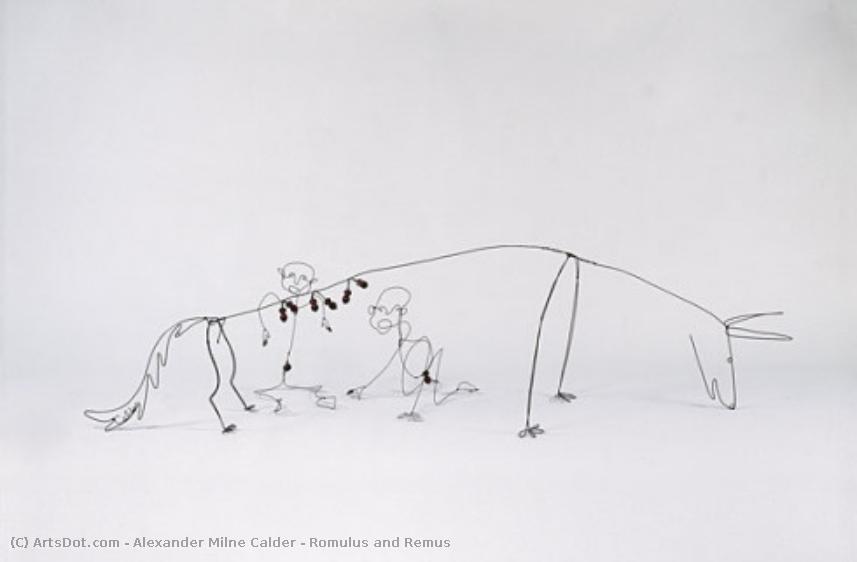
Alexander Milne Calder's "Romulus and Remus," crafted in 1928, isn’t merely a sculpture; it’s a distilled essence of myth rendered in delicate wire. This piece, a testament to the artist’s pioneering approach to three-dimensional form, transcends its subject matter – the legendary founders of Rome – to become a profound meditation on beginnings, brotherhood, and the very act of creation itself. Calder, deeply influenced by Constructivism and early Modernism, sought to liberate sculpture from the constraints of traditional materials, embracing the inherent qualities of industrial wire as both medium and metaphor.
The sculpture’s stark simplicity is its most arresting feature. Two figures, rendered with astonishing grace despite their skeletal construction, stand beneath a subtly arching structure that evokes a horizon line or perhaps a stylized landscape. The color palette – a resolute black and white punctuated by subtle grays – amplifies the work's austerity, forcing the viewer to focus entirely on form and movement. The lines themselves are paramount; thin, almost impossibly delicate wires define every contour, creating an illusion of both fragility and strength. This deliberate reductionist approach mirrors Calder’s broader philosophy: to strip away the superfluous and reveal the fundamental elements of a subject.
The Poetics of Chance and Kinetic Form
Calder's work in this period – particularly his “Cirque Calder” series – exemplifies his fascination with chance and spontaneity. He didn’t meticulously plan every curve or angle; instead, he allowed the wire to guide him, embracing the unpredictable nature of the material. This process is vividly captured in "Romulus and Remus," where the figures appear to be caught mid-action, poised on the precipice of a narrative yet undefined. The slight wobble inherent in the sculpture’s construction – a subtle consequence of its wire composition – hints at a kinetic energy, suggesting that even stillness can hold a dynamic potential.
The technique itself is deceptively complex. Calder skillfully bent and assembled hundreds of individual wires, creating a surprisingly robust structure despite its delicate appearance. The varying thicknesses of the wire contribute to the sculpture’s textural richness, offering subtle shifts in sheen as light catches the metal. This careful manipulation of material speaks to Calder's mastery of his chosen medium – a testament to his ability to transform industrial components into objects of profound beauty and intellectual resonance.
Myth, Brotherhood, and the Dawn of Rome
The subject matter—the story of Romulus and Remus—is deeply rooted in Roman mythology. The legend of the twins suckled by a she-wolf is an enduring symbol of resilience, survival, and the founding of civilization. Calder’s sculpture doesn't simply depict this narrative; it captures its essence – the primal struggle for existence, the bond between brothers, and the birth of a new order. The wire itself can be interpreted as representing the threads that connect us to our past, shaping our present and influencing our future.
Created in 1928, “Romulus and Remus” stands as a pivotal work in Calder’s oeuvre, marking a significant shift towards abstraction while retaining a powerful connection to his artistic roots. It's a sculpture that invites contemplation, prompting viewers to consider the interplay of form, material, and narrative – a timeless meditation on the foundations of human experience.
Questions & Answers
Is "Romulus and Remus" by Alexander Milne Calder kept in the artist's home country?
No - the artwork is kept abroad. The birth country of Alexander Milne Calder is United Kingdom, and the museum holding the original of "Romulus and Remus" is in United States of America.
What are the author and date of "Romulus and Remus"?
The author of "Romulus and Remus" is Alexander Milne Calder, and the work is dated 1928.
Where can I find statistics about "Romulus and Remus" by Alexander Milne Calder?
The Stats page of "Romulus and Remus" by Alexander Milne Calder presents public visit statistics: monthly visits of this artwork, a comparison with the artist's most viewed works, and where its visitors come from.
Artist Biography
introduction to alexander milne calder
alexander milne calder was a scottish american sculptor, born in aberdeen, scotland in 1846. he is best known for his architectural sculpture of philadelphia city hall, and both his son, alexander stirling calder, and grandson, alexander 'sandy' calder, became significant sculptors in the 20th century.early life and career
alexander milne calder began his career in scotland, working for sculptor john rhind, while attending the royal academy in edinburgh. he moved to london and worked on the albert memorial. calder immigrated to the united states in 1868 and settled in philadelphia, where he studied with joseph a. bailly and took classes with thomas eakins at the pennsylvania academy of fine arts.notable works
some of alexander milne calder's notable works include:- philadelphia city hall: a commission that involved more than 250 pieces in marble and bronze, taking calder 20 years to complete.
- william penn: a colossal bronze statue that was to crown the city hall's tower.
- indian figure: a sculpture prior to its installation on city hall.
- south portal and west portal: illuminated with colored lights, showcasing calder's attention to detail.
legacy
alexander milne calder's legacy extends beyond his own work, as both his son and grandson became prominent sculptors. his contributions to the world of art can be seen in various museums, including the smithsonian american art museum and the galleria civica di arte moderna e contemporanea torino. to learn more about alexander milne calder and his work, visit https://OriginalUniqueArt.com/@/alexander-milne-calder or explore the wahoo art timeline for a detailed overview of art history. important to note that alexander milne calder's work has been recognized and appreciated by art enthusiasts and scholars alike, making him a significant figure in the world of art. his contributions will continue to be celebrated and studied for generations to come.
Alexander Milne Calder
1898 - 1976 , United Kingdom
Quick Facts
- Full Name: Alexander Milne Calder
- Nationality: Scottish-American
- Date Of Birth: 1898
- Date Of Death: 1976
- Place Of Birth: Aberdeen, United Kingdom
- Notable Artworks:
- Philadelphia City Hall
- William Penn statue
- Indian figure
- Artistic Movement Or Style: Architectural sculpture
- Artists Who Influenced This Artist: ['John Rhind']
- Artists Or Movements Influenced By This Artist:
- Alexander Stirling Calder
- Alexander Calder
Related Articles

Bronze Age to Modern Masters: 10 Sculptures That Redefined Art | OriginalUniqueArt
Journey through art history with 10 legendary bronze sculptures – from Michelangelo's David to Rodin’s Thinker. Explore the stories, techniques & timeless beauty of these masterpieces. Find museum-quality reproductions & elevate your home decor on OriginalUniqueArt.com.
Alexander Calder: Kinetic Sculpture, Mobile Art & the Poetics of Chance
Explore the revolutionary world of Alexander Calder's kinetic sculptures & mobiles. Discover insights for collectors, acquisition advice, and the enduring legacy of this modern master. Expert analysis & art valuation.

The Enduring Form: Exploring Themes & Techniques in Sculpture Across Historical Periods
Explore the rich history of sculpture from ancient masterpieces to contemporary innovations. Discover key techniques, influential artists & investment potential for discerning art collectors.

The Enduring Form: Sculpture Across History, Technique & Emotional Resonance
Explore the rich history of sculpture with OriginalUniqueArt. Discover key techniques, influential artists & investment potential for discerning collectors. Expert insights into valuing and collecting timeless masterpieces.

Bronze Sculptures That Defined Art History | OriginalUniqueArt
Journey through art history with our Top 10 bronze sculptures! Explore masterpieces by Rodin, Michelangelo & more. Discover stories behind iconic statues and find museum-quality reproductions for your home decor at OriginalUniqueArt.com.


