Chuck Close: A Revolution in Portraiture
Charles Thomas Close (1940–2021) stands as a monumental figure within the landscape of contemporary art, irrevocably altering our understanding of portraiture and establishing himself as one of the most influential artists of his generation. Born in Monroe, Washington, on July 5, 1940, Close’s life was marked by both profound artistic innovation and debilitating physical challenges—a neuromuscular condition compounded by dyslexia shaping his unique perspective from an early age. These difficulties fostered a deep observation of the world around him, cultivating a meticulous dedication to detail that would become central to his groundbreaking artistic practice. His childhood memories are imbued with the formative influence of Jackson Pollock’s drip paintings at the Seattle Art Museum, sparking within him a fervent desire to push artistic boundaries and question established conventions.- Early Artistic Influences: Close's fascination with Pollock ignited a passion for abstraction, yet he swiftly rejected its spontaneity in favor of a more analytical approach—one rooted in photographic observation.
- Formal Education & Exploration Abroad: He pursued formal education at the University of Washington (B.A., 1962) and Yale University (BFA, 1963; M.F.A., 1964), broadening his artistic horizons with a Fulbright scholarship to Vienna’s Akademie der Bildenden Künste.
The Birth of Photorealism: A Methodical Transformation
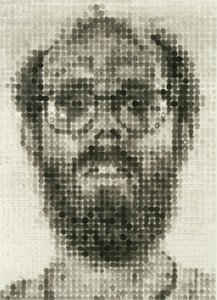
Close’s artistic trajectory took its decisive turn in the late 1960s when he embarked on photorealism—a revolutionary technique that fundamentally redefined portraiture. Rejecting the expressive freedom of abstraction, Close turned to photography as his primary source material, recognizing it not merely as a tool for capturing likeness but as a catalyst for artistic interpretation. His method wasn’t about flawless replication; instead, he developed an intricate process of translation. Utilizing a grid system—a technique borrowed from Josef Albers—he meticulously transferred photographic images onto enormous canvases, breaking down the image into manageable squares and replicating each detail with painstaking accuracy using acrylic paints and airbrush techniques. This deliberate fragmentation served to expose the underlying structure of perception itself, highlighting the mechanical limitations inherent in both photography and representation.- The Grid System: Close’s grid system was a cornerstone of his method, allowing him to dissect complex images into manageable components while maintaining compositional integrity.
- Airbrush Technique & Color Palette: He employed airbrushing extensively to achieve subtle gradations of color and texture, creating an illusionistic depth that surpassed the capabilities of traditional painting.
Scale, Detail, and Imperfection: Defining Close’s Aesthetic
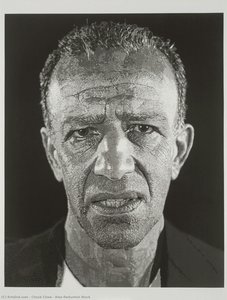
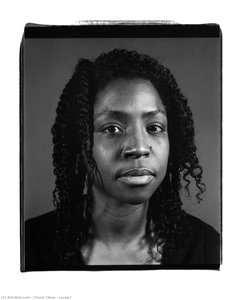
Close’s monumental portraits—often exceeding six feet in height—were characterized by their breathtaking scale and unparalleled level of detail. He deliberately eschewed idealized representations, embracing imperfections—bloodshot eyes, broken capillaries, wrinkles—as integral to the artistic process. These deliberate inclusions weren't a critique of beauty standards but rather an exploration of the inherent limitations of human experience and the complexities of visual perception. His work challenged viewers to confront the physicality of representation, prompting them to consider how we perceive and interpret images.- Emphasis on Texture & Imperfection: Close’s portraits celebrated the nuances of skin texture and facial features—capturing subtle variations in color and surface detail with remarkable precision.
- Psychological Depth: His art delves into themes of identity, vulnerability, and emotional resonance, conveying profound psychological insight through meticulously rendered imagery.
Legacy & Influence
Chuck Close’s artistic legacy extends far beyond his technical innovations—it resides in his unwavering perseverance and his ability to transform adversity into creative impetus. Following a spinal artery occlusion in 1988 that resulted in paralysis from the neck down, Close continued to paint using innovative techniques adapted to his physical limitations—even mastering the art of painting with his mouth. This extraordinary feat stands as a testament to his artistic spirit and resilience, inspiring countless artists worldwide. His work has been exhibited extensively across continents and resides in prestigious museum collections such as the Art Institute of Chicago, the Museum of Modern Art (New York), and the Tate Gallery (London). Close’s influence continues to resonate within contemporary art, shaping approaches to portraiture and demonstrating that artistic creativity can flourish even amidst profound personal challenges. His enduring vision—one rooted in meticulous observation and unwavering dedication—solidifies his place as one of the most important artists of the 20th and 21st centuries.Ερωτήσεις & Απαντήσεις
Μπορώ να εξερευνήσω τα έργα του/της Τσάκ Κλος ανά φάσμα χρωμάτων;
Τα έργα του Τσάκ Κλος μπορούν να εξερευνηθούν ανά χρώμα στη σελίδα Φασματική Κατάλογος του καλλιτέχνη.
Μπορώ να μελετήσω τη χρήση χρώματος του/της Τσάκ Κλος σε όλα τα έργα του/της;
Η Γενετικό Χρώμα Παλέτας του Τσάκ Κλος είναι μια σελίδα που παρουσιάζει το χρωματικό προφίλ του έργου του καλλιτέχνη.
Πού μπορώ να βρω στατιστικά στοιχεία για τα έργα του/της Τσάκ Κλος;
Στατιστικά στοιχεία για τα έργα του/της Τσάκ Κλος είναι διαθέσιμα στη σελίδα στατιστικών του/της Στατιστικά.