


1


Ενημερωμένο Οκτώβριος 2026 · κατάταξη βάσει του σκορ δημοφιλίας μας (αναζητήσεις, επισκέψεις και παραγγελίες για κάθε έργο) · 36 έργα του Alan Davie στον κατάλογό μας
Με σύντομη περιγραφή
Στο μάτι της γκαλερί, το πιο διάσημο έργο του Alan Davie είναι το Woman Arranging Flowers (1945). Ο Untitled Abstract και ο Self Portrait with Brushes (1937) ολοκληρώνουν το τρίο που κάθε μάτι αναγνωρίζει. Από τα 36 έργα του Alan Davie στον κατάλογό μας, η γκαλερί παρουσιάζει παρακάτω τα 36 πιο διάσημα, όπου κάθε ένα είναι πρωτότυπο, με την χρονολογία του, το μουσείο του και το τι το κάνει μοναδικό.


 Joe's Magic Lantern1961
12
 Joe's Lucky Dip1961
13
 Keep Your Fingers Crossed1961
14
 Hopi Studies No.32, Opus 0.11731991 · University of Hertfordshire
15
 Hopi Studies No.30 (Big Blue) (Opus O.1171)1991
16
 Homage to an Earth Goddess No.61992
17
 Symbols in a Landscape1994 · The Pier Arts Centre
18
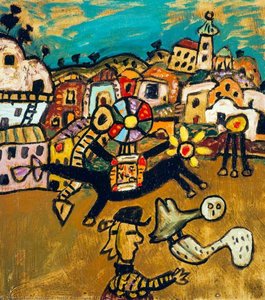 Village Witch (Opus O.1263)1994
19
 Magic Casket1997 · Εθνική Πινέλου Αρχαιολογικού Μουσείου
20
 Celtic Landscape (Dreamscape)1996 · The Pier Arts Centre
21
 Magic Landscape (Opus O.1337)1996
22
 The Alchemist's Mirror No.1 (Opus 1357)1997
23
 Cosmic Signals I2000
24
 Cosmic Signals No.72000
25
 The Golden Palace1999
26
 Magician's Mirror No.22000 · The Mercer Art Gallery
27
 Serpent's Idea of a Horse2000
28
 The Magician's Mirror No.3 (Opus 1450)2000
29
 Without Devices2004 · Pembroke College Oxford Jcr Art Collection
30
 Around and Around in the PinkΕθνική Πινακοθήκη του Καναδά
31
 Kaleidoscope for a Parrot
32
 Prize for a Serpent
33
 Flowers on a TableThe Fleming Collection
34Prophet in a Tree, 1963Μουσείο Φιτσίουελλ
35
 Double MonumentRobinson College
36
 Hallucination with Monster and Cock
Τα 8 μουσεία που φιλοξενούν το μεγαλύτερο μέρος των έργων σε αυτήν τη σελίδα.
| Μουσείο | Πόλη | Έργα του Alan Davie | Πάτρια από αυτή τη λίστα |
|---|---|---|---|
 The Pier Arts Centre |
Stromness | 2 | Symbols in a Landscape, Celtic Landscape (Dreamscape) |
 University of Hertfordshire |
North Hatley | 1 | Hopi Studies No.32, Opus 0.1173 |
 Εθνική Πινέλου Αρχαιολογικού Μουσείου |
Έδιμβουργο | 1 | Magic Casket |
 The Mercer Art Gallery |
Harrogate | 1 | Magician's Mirror No.2 |
 Pembroke College Oxford Jcr Art Collection |
Oxford | 1 | Without Devices |
 Εθνική Πινακοθήκη του Καναδά |
Οττάβα | 1 | Around and Around in the Pink |
 The Fleming Collection |
London | 1 | Flowers on a Table |
 Μουσείο Φιτσίουελλ |
Κέμπριτζ | 1 | Prophet in a Tree, 1963 |
Επιλέξτε μια δεκαετία για να δείτε το πρωτότυπο έργο που την χαρακτηρίζει.


Το Woman Arranging Flowers (1945). Στη συνέχεια ακολουθούν το Untitled Abstract και το Self Portrait with Brushes (1937).
25 ετών: το έργο Woman Arranging Flowers είναι του 1945, και ο/η Alan Davie γεννήθηκε το 1920.
Woman Arranging Flowers, Untitled Abstract, Self Portrait with Brushes, The Saint, Entrance to a Paradise, Jingling Space, Ram Grip, Piggy Chain, Joy Bag No. 1 και Entrance For A Red Temple No. 4. Η κατάταξη παραπάνω αναγράφει το έτος και το μουσείο για το κάθε έργο.
Ο κατάλογός μας περιλαμβάνει 36 έργα του Alan Davie, με ημερομηνίες από 1937 έως 2004.
Κυρίως σε The Pier Arts Centre (Stromness), University of Hertfordshire (North Hatley) και Εθνική Πινέλου Αρχαιολογικού Μουσείου (Έδιμβουργο). Ο πίνακας μουσείου παραπάνω τους περιλαμβάνει όλους.
Κατά την περίοδο 1990s: 10 από τα 36 έργα σε αυτήν τη σελίδα δημιουργήθηκαν τότε, με Hopi Studies No.32, Opus 0.1173 από αυτά να είναι μοναδικά.
Σε αυτήν τη σελίδα, το παλαιότερο είναι Self Portrait with Brushes (1937) και το νεότερο Without Devices (2004).
Abstract expressionism, όπως προκύπτει από τα πρωτότυπα σε αυτήν τη σελίδα.
Symbols in a Landscape και Celtic Landscape (Dreamscape): το The Pier Arts Centre, Stromness διαθέτει 2 από τα έργα σε αυτήν τη σελίδα.