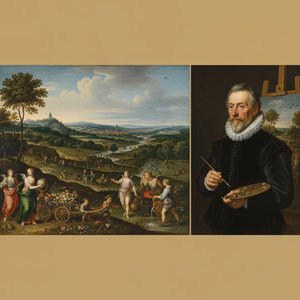
The Master of the Burin: The Life and Legacy of Theodoor Galle
In the heart of Antwerp, a city pulsing with the intellectual and commercial energy of the late sixteenth century, a master was forged in the tradition of fine craftsmanship. Theodoor Galle, born Dirk on July 16, 1571, emerged not merely as an engraver but as a vital architect of the Flemish Baroque visual language. His journey began under the watchful and expert eye of his father, Philip Galle, a man whose reputation as a publisher and engraver provided the foundation for Theodoor’s lifelong devotion to the copperplate. This early immersion in the printmaking guilds of Antwerp instilled in him a precision that would later define the golden age of Flemish engraving, allowing him to translate complex human emotions and classical grandeur into the delicate, rhythmic lines of his work.
The trajectory of Galle’s life was irrevocably altered by a union that merged artistic talent with industrial power. In 1595, his marriage to Catharina Moerentorff—the daughter of the legendary printer Jan Moretus—placed him at the very epicenter of European intellectual life. Through this connection, Galle became a cornerstone of the illustrious Plantin Moretus printing house, a crucible of humanist scholarship where art and literature intertwined. Within these storied walls, he was not merely a technician but a collaborator with the era's most luminous minds. Working alongside luminaries such as Pieter Brueghel III and Johannes Stradanus, Galle helped produce works that were much more than mere illustrations; they were profound explorations of allegory, philosophy, and the revival of classical antiquity.
A Symphony of Line and Allegory
To gaze upon a Galle engraving is to witness a masterful command of light and shadow achieved through the meticulous application of the burin. His technique was characterized by an extraordinary attention to detail, where every cross-hatch and fine line served to breathe life into his subjects. His oeuvre is a rich tapestry of diverse themes, ranging from the intimate dignity of portraiture to the sweeping complexity of allegorical narratives. He possessed a rare ability to capture the likenesses of prominent contemporary figures while simultaneously navigating the ethereal realms of myth and morality.
His artistic output often delved into the symbolic, using the medium of print to communicate deep-seated philosophical concepts to a wide audience across Europe. Some of his most enduring contributions include:
- Portraiture: Capturing the essence of historical and contemporary figures, such as his evocative depictions of Pieter Coecke Van Aelst The Elder and members of the Brueghel lineage.
- Allegorical Narratives: Creating intricate scenes that explored moral virtues, vices, and the complexities of the human condition through classical imagery.
- Classical Revivals: Translating the grandeur of antiquity into a modern Flemish context, bridging the gap between the Renaissance spirit and Baroque drama.
Historical Significance and Enduring Influence
Theodoor Galle’s importance extends far beyond the physical boundaries of his prints. As a member of the Guild of St. Luke, rising to the esteemed position of deacon in 1609, he played a crucial role in maintaining the high standards of Antwerp's artistic community. His influence was also generational; as a teacher to his son Jan Galle and other aspiring engravers like Adriaen Millaert, he ensured that the meticulous traditions of the Flemish Baroque would endure well into the next century.
His legacy is etched into the very fabric of art history. By integrating the precision of engraving with the intellectual depth of the humanist movement, Galle helped transform the printed image from a simple reproductive tool into a sophisticated medium of high art. Today, his works remain a testament to a period when Antwerp stood as a beacon of creativity, and his ability to capture the eternal through the ephemeral medium of ink continues to captivate scholars and art lovers alike.