Πορτρέτο του Ρίτσαρντ Μαρς

Τα 31 πιο διάσημα έργα του Ρίτσαρντ Μαρς, μια επιλογή γκαλερί

Ενημερωμένο Νοέμβριος 2026 · κατάταξη βάσει του σκορ δημοφιλίας μας (αναζητήσεις, επισκέψεις και παραγγελίες για κάθε έργο) · 34 έργα του Ρίτσαρντ Μαρς στον κατάλογό μας

Με σύντομη περιγραφή

Από όλα τα πρωτότυπα που άφησε ο Ρίτσαρντ Μαρς, το πιο διάσημο είναι το The Bowery (1930). Ακολουθούν στενά η The Irving Place Burlesque 1930 (1913) και η The Steeplechase (1932). Ο κατάλογός μας περιλαμβάνει 34 έργα του Ρίτσαρντ Μαρς· η γκαλερί έχει διατηρήσει τα 31 κομμάτια που θαυμάζει ο κόσμος, το καθένα με την ημερομηνία, το μουσείο και την ιστορία του.

1898 – 1954, Παρίσι Social realism Περισσότερα έργα: Art Institute of Chicago

Τα 10 κορυφαία έργα του Ρίτσαρντ Μαρς: η επιλογή της γκαλερί

1
The Bowery (1930) του Ρίτσαρντ Μαρς

The Bowery

1930

The Bowery is a painting by Reginald Marsh created in 1930. This work depicts a crowded scene of down and out men standing along Bowery Street. Above the street level, the Third Avenue elevated railway is visible, cutting across the upper portion of the composition. The scene captures a specific segment of urban life in New York City during the 1920s and 1930s.

3
The Steeplechase (1932) του Ρίτσαρντ Μαρς

The Steeplechase

1932 · Etching

A monochromatic world of sharp lines and sudden shadows defines this 1932 etching. The scene is a frantic collision of muscle and metal. Horses and riders surge through a tight, compressed space, their forms defined by the heavy, rhythmic weight of the etching needle. There is no room for air here, only the urgent, overlapping geometry of a struggle. The light falls from an unseen height, catching the curve of…

4
Milo the Mule Face Boy του Ρίτσαρντ Μαρς

Milo the Mule Face Boy

Drawing

The work reflects the grit of the early twentieth century. It avoids the polished surface of traditional portraiture to find truth in the unvarnished reality of the street. The lines trace the textures of a lived-in environment, where every person is a part of a larger, moving mass. There is a sense of the individual being swallowed by the collective motion of the metropolis. The boy's face, suggested by the…

5
A Paramount Picture (1934) του Ρίτσαρντ Μαρς

A Paramount Picture

1934 · Photography · Μουσείο Τέχνης Κλίβελαντ, Κλίβελαντ

Reginald Marsh, an American painter born in Paris, France, in 1898, focused his practice on the textures of urban existence. His approach to A Paramount Picture, created about 1934, aligns with his commitment to social realism. Having studied under Kenneth Hayes Miller and George Luks, Marsh developed a method for capturing the density of metropolitan life. His work often addressed the social divisions and economic pressures of the Great Depression,…

6
Asbury Park The Morrow Castle (1934) του Ρίτσαρντ Μαρς

Asbury Park The Morrow Castle

1934 · Charcoal

In "Asbury Park The Morrow Castle" by Reginald Marsh, a large warship anchors the center of a black and white sketch. The vessel sits heavy and still, a symbol of concentrated power amidst a sea of movement. Around this iron hull, a dense crowd gathers. Soldiers, sailors, and civilians press toward the edges of the frame, their forms arranged on both sides of the central ship to create a dynamic,…

9
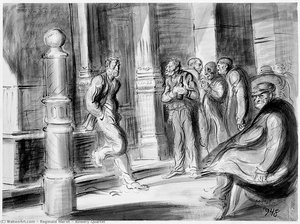
Bowery Quartet (1948) του Ρίτσαρντ Μαρς

Bowery Quartet

1948 · Charcoal

The air inside this dim interior feels heavy, thick with the scent of stale smoke and the low murmur of voices. A group of men gathers in a tight, restless cluster, their bodies leaning into one another as they occupy a corner of this urban sanctuary. A massive column anchors the left side of the frame, a silent, heavy presence that seems to hold up the weight of the room.…
10
Tattoo and Haircut (1932) του Ρίτσαρντ Μαρς

Tattoo and Haircut

1932 · Etching · Art Institute of Chicago, Σικάγκο

In this 1932 work, titled Tattoo and Haircut, the artist Reginald Marsh captures a specific, unvarnished moment from the urban landscape of New York. The scene is set within the Bowery, a district of the Lower East Side, during the height of the Great Depression. It is a quiet observation of the people and the architecture that defined this particular corner of the city during a difficult era.

Η επιλογή του Ρίτσαρντ Μαρς συνεχίζεται, από τον 11 έως τον 31

Τα θέματα που κίνησαν το ενδιαφέρον του Ρίτσαρντ Μαρς

Τα τέσσερα θέματα που εμφανίζονται πιο συχνά σε αυτά τα πρωτότυπα έργα, το καθένα με το εξαιρετικό του παράδειγμα.

Τα μουσεία που διατηρούν τα πρωτότυπα έργα του Ρίτσαρντ Μαρς

Τα 8 μουσεία που φιλοξενούν το μεγαλύτερο μέρος των έργων σε αυτήν τη σελίδα.

Μουσείο Πόλη Έργα του Ρίτσαρντ Μαρς Πάτρια από αυτή τη λίστα
Art Institute of Chicago, ΣικάγκοArt Institute of Chicago Σικάγκο 2 Tattoo and Haircut, Striptease at New Gotham Theatre
Μουσείο Τέχνης Κλίβελαντ, ΚλίβελαντΜουσείο Τέχνης Κλίβελαντ Κλίβελαντ 1 A Paramount Picture
Toledo Museum of Art, ToledoToledo Museum of Art Toledo 1 Pursuit
Μουσείο Τέχνης Βοστώνης, ΜπόσττονΜουσείο Τέχνης Βοστώνης Μπόσττον 1 U.S. Marine
Cincinnati Art Museum, ΣινσινάτιCincinnati Art Museum Σινσινάτι 1 WALKING WOMAN (recto) / WOMAN IN HAT WALKING (verso)
Payne Gallery, Μπεθλεέμ, PennsylvaniaPayne Gallery Μπεθλεέμ, Pennsylvania 1 Προεδρος Ράινμαρτ Σ. Χαουπερτ και Μοραβιανό Κολέζιο
Pennsylvania Academy of Fine Arts, ΦιλαδέλφειαPennsylvania Academy of Fine Arts Φιλαδέλφεια 1 Five Women (sketch)
Chrysler Museum of Art, ΝόρφολκChrysler Museum of Art Νόρφολκ 1 Down at Jimmy Kelly

Ο Ρίτσαρντ Μαρς δεκαετία προς δεκαετία: το πρωτότυπο που ορίζει κάθε μία

Έργα ανά δεκαετία

Επιλέξτε μια δεκαετία για να δείτε το πρωτότυπο έργο που την χαρακτηρίζει.

Ερωτήσεις συλλεκτών για τα έργα του Ρίτσαρντ Μαρς

Για ποιο έργο είναι πιο γνωστός ο Ρίτσαρντ Μαρς;Αποκαλύψτε την απάντηση

Το The Bowery (1930). Στη συνέχεια ακολουθούν το The Irving Place Burlesque 1930 (1913) και το The Steeplechase (1932).

Πόσο ηλικία είχε ο/η Ρίτσαρντ Μαρς όταν δημιουργήθηκε το The Bowery;Αποκαλύψτε την απάντηση

32 ετών: το έργο The Bowery είναι του 1930, και ο/η Ρίτσαρντ Μαρς γεννήθηκε το 1898.

Ποια είναι τα δέκα πιο διάσημα έργα του Ρίτσαρντ Μαρς;Αποκαλύψτε την απάντηση

The Bowery, The Irving Place Burlesque 1930, The Steeplechase, Milo the Mule Face Boy, A Paramount Picture, Asbury Park The Morrow Castle, Locomotives, Jersey City, Pursuit, Bowery Quartet και Tattoo and Haircut. Η κατάταξη παραπάνω αναγράφει το έτος και το μουσείο για το κάθε έργο.

Πόσα έργα δημιούργησε ο/η Ρίτσαρντ Μαρς;Αποκαλύψτε την απάντηση

Ο κατάλογός μας περιλαμβάνει 34 έργα του Ρίτσαρντ Μαρς, με ημερομηνίες από 1913 έως 1954.

Σε ποια μουσεία εκτίθενται τα αριστούργημα του Ρίτσαρντ Μαρς;Αποκαλύψτε την απάντηση

Κυρίως σε Art Institute of Chicago (Σικάγκο), Μουσείο Τέχνης Κλίβελαντ (Κλίβελαντ) και Toledo Museum of Art (Toledo). Ο πίνακας μουσείου παραπάνω τους περιλαμβάνει όλους.

Σε ποιες χρονιές δημιούργησε ο/η Ρίτσαρντ Μαρς τα πιο διάσημα έργα του/της;Αποκαλύψτε την απάντηση

Κατά την περίοδο 1930s: 12 από τα 31 έργα σε αυτήν τη σελίδα δημιουργήθηκαν τότε, με The Bowery από αυτά να είναι μοναδικά.

Ποια είναι τα πρώτα και τα τελευταία διάσημα πρωτότυπα του Ρίτσαρντ Μαρς;Αποκαλύψτε την απάντηση

Σε αυτήν τη σελίδα, το παλαιότερο είναι The Irving Place Burlesque 1930 (1913) και το νεότερο Προεδρος Ράινμαρτ Σ. Χαουπερτ και Μοραβιανό Κολέζιο (1954).

Ποια θέματα επέλεξε πιο συχνά ο Ρίτσαρντ Μαρς;Αποκαλύψτε την απάντηση

People (5), American art (3) και Crowd (2), σε συνολικά 31 έργα σε αυτήν τη σελίδα.

Ποια τεχνική χρησιμοποίησε περισσότερο ο Ρίτσαρντ Μαρς;Αποκαλύψτε την απάντηση

Etching, για 3 από τα 31 έργα σε αυτήν τη σελίδα.

Σε ποιο καλλιτεχνικό κίνημα ανήκει ο/η Ρίτσαρντ Μαρς;Αποκαλύψτε την απάντηση

Social realism, όπως προκύπτει από τα πρωτότυπα σε αυτήν τη σελίδα.

Ποια έργα του Ρίτσαρντ Μαρς εκτίθενται στο Art Institute of Chicago;Αποκαλύψτε την απάντηση

Tattoo and Haircut και Striptease at New Gotham Theatre: το Art Institute of Chicago, Σικάγκο διαθέτει 2 από τα έργα σε αυτήν τη σελίδα.

Ρίτσαρντ Μαρς: ζωή και έργο

The Urban Chronicler: The Life and Legacy of Reginald Marsh

Reginald Marsh stands as a pivotal figure in American Social Realism, renowned for his strikingly detailed depictions of New York City during the 1920s and 1930s. More than just documenting scenes of Coney Island beaches or burlesque performances—though these undeniably populate his oeuvre—Marsh’s art embodies a profound engagement with the textures and rhythms of urban life, underpinned by an unwavering commitment to artistic exploration. His legacy resides not only in his iconic images but also in his pioneering techniques and enduring influence on subsequent generations of artists.

Born in Paris in 1898 above the Café du Dome, Marsh's formative years were steeped in a rich artistic heritage. The son of Frederick Dana Marsh—a muralist who championed American Impressionism—and Alice Randall—a miniaturist painter—Marsh’s family fostered an environment where creativity flourished from his earliest days. Moving to Nutley, New Jersey, at the age of two, he benefited from proximity to Frank Fowler's Artist Colony, a haven for American painters seeking inspiration and camaraderie, which further cemented his connection to the artistic tradition. This early exposure to both the delicate precision of miniature painting and the grand scale of muralism would later inform his ability to capture both the intimate human moment and the sweeping energy of the metropolis.

A Journey from Law to the Canvas

Marsh’s path to becoming a master of urban realism was far from linear. He pursued formal education with great diligence, earning a Bachelor’s degree in Law from Yale University in 1920 before subsequently delving into art studies at the Yale Art School. During this period, he honed his skills as an illustrator for the Yale Record, immersing himself in the vibrant spirit of collegiate life and developing an early mastery of visual storytelling. This formative period solidified his artistic sensibilities and prepared him for a career dedicated to capturing the essence of human experience through compelling imagery.

As his professional journey began in New York City, Marsh tirelessly sought to document the pulse of the streets. His work often utilized diverse media to achieve specific atmospheric effects, ranging from the gritty energy of conte crayon and gouache to the thick, dynamic impasto of oil paintings. Whether he was portraying the hedonistic atmosphere of Jimmy Kelly's burlesque nightclub or the maritime commerce found in his mural studies like Atlantic Liner in Harbor, Marsh possessed a unique ability to translate the chaos of the city into structured, rhythmic compositions.

The Essence of Social Realism and Urban Grit

The significance of Reginald Marsh lies in his role as a visual historian of a vanished era. His work serves as a window into the Social Realist movement, focusing on the lives of the working class and the raw, unvarnished reality of New York's most famous districts, such as the Bowery and Coney Island. His paintings are characterized by:

  • Dynamic Movement: A mastery of capturing the frantic, overlapping motion of crowds in subway stations, beaches, and dance halls.
  • Textural Depth: The use of varied techniques to replicate the grime, light, and physical weight of an industrializing city.
  • Human Connection: An ability to find poignant, individual emotions within massive, anonymous urban gatherings.

Beyond his crowded street scenes, Marsh also demonstrated a remarkable capacity for portraiture, blending realism with subtle emotion as seen in his black and white oil works. Through his dedication to the "urban grit," Reginald Marsh did more than paint New York; he immortalized its soul, ensuring that the energy of the early twentieth century would continue to resonate through the decades.