The Resonance of Earth and Memory
Born in the vibrant city of Kano, Nigeria, in 1974, Otobong Nkanga has emerged as a profound voice in contemporary art, weaving together the geological and the sociological. Her artistic journey is one of deep exploration, beginning with formal studies at Obafemb Awolowo University in Ile-Ife before expanding into the rich European traditions at the École nationale supérieure des beaux-arts in Paris. This unique dual grounding allows her to navigate the complexities of both African landscapes and global art discourses, creating a practice that is as much about materiality as it is about memory. Today, living and working in Antwerp, Belgium, Nkanga continues to bridge these worlds, using her art to examine how the very ground beneath our feet holds the weight of history, extraction, and identity.
Nkanga’s work is a sensory experience that transcends traditional boundaries, blending tapestry weaving, performance, sculpture, and photography into a cohesive narrative of interconnectedness. She often employs textiles not merely as a medium, but as a metaphor for the layers of the earth itself. Her canvases, frequently monochrome and meticulously layered, mirror geological strata, suggesting that just as soil contains fossils and minerals, our cultural landscapes contain the residues of colonialism and migration. Through her use of fabric, she invites the viewer to consider how natural resources are not just commodities but are deeply imbued with ancestral knowledge and symbolic significance.
Tracing the Scars of Extraction
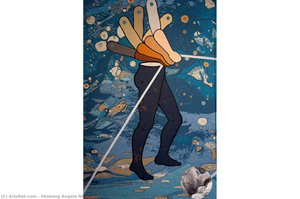
A central theme in Nkanga’s oeuvre is the investigation of land and the value of natural resources. She poignantly explores how the extraction of minerals and the exploitation of earth leave permanent marks on both the environment and the human psyche. In her evocative work, The Weight of Scars (2015), she utilizes a large four-panel textile piece integrated with photographic images to reflect on the fractured landscapes of former mining areas in Namibia. Through these visual layers, she reveals the tension between the promise of economic prosperity and the reality of abandoned, drained terrains. Her art serves as a witness to the struggle for balance, repair, and renewal in a world where our bodies and the landscape are inextricably entangled.
Her technical mastery allows her to manipulate different media to evoke specific emotional responses:
- Tapestry Weaving: Used to create structural layers that represent geological and historical depth.
- Performance Art: A medium through which she explores themes of displacement, resilience, and the physical presence of history.
- Photography: Employed to investigate the boundary between documentary truth and the invisible narratives that exist outside the frame.
- Installation: Large-scale works that transform spaces into immersive environments of geological and social inquiry.
Legacy and Global Recognition
The significance of Otobong Nkanga’s contribution to contemporary art has been recognized by some of the most prestigious institutions in the world. Her receipt of the Yanghyun Prize in 2015 marked a pivotal moment, propelling her into the international spotlight and validating her commitment to conceptual depth and innovation. Her work has found homes and resonance in major collections and exhibitions, including:
- Tate Modern, London
- Stedelijk Museum, Amsterdam
- KW Institute for Contemporary Art, Berlin
- Sharjah Biennial
- Sydney Biennale
As her career continues to flourish, Nkanga remains a vital figure in the dialogue surrounding environmental justice and post-colonial identity. By treating the earth as a repository of cultural memory, she challenges us to look closer at the textures of our world—to see not just the surface, but the profound, often painful, histories etched into every grain of soil and every thread of cloth.