Πορτρέτο του ΜัตΣουο Μπάσο

Τα 4 πιο διάσημα έργα του ΜัตΣουο Μπάσο, μια επιλογή γκαλερί

Ενημερωμένο Οκτώβριος 2026 · κατάταξη βάσει του σκορ δημοφιλίας μας (αναζητήσεις, επισκέψεις και παραγγελίες για κάθε έργο) · 4 έργα του ΜัตΣουο Μπάσο στον κατάλογό μας

Με σύντομη περιγραφή

Από όλα τα πρωτότυπα που άφησε ο ΜัตΣουο Μπάσο, το πιο διάσημο είναι το Record of a haiku exchange on kaishi writing paper (601). Ακολουθούν στενά η Poetry Painting (601) και η Manuscript Scroll of Nozaraishi Kikō\n\n- Atsuta Shrine, Nagoya. Ο κατάλογός μας περιλαμβάνει 4 έργα του ΜัตΣουο Μπάσο· η γκαλερί έχει διατηρήσει τα 4 κομμάτια που θαυμάζει ο κόσμος, το καθένα με την ημερομηνία, το μουσείο και την ιστορία του.

1644 – 1694, Ueno Περισσότερα έργα: Fukuda Art Museum

Τα 10 κορυφαία έργα του ΜัตΣουο Μπάσο: η επιλογή της γκαλερί

1
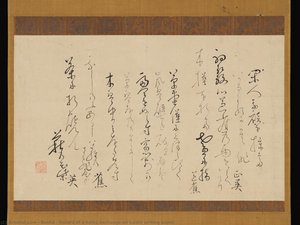
Record of a haiku exchange on kaishi writing paper (601) του ΜัตΣουο Μπάσο

Record of a haiku exchange on kaishi writing paper

601 · Ink On Paper

The Artist: Matsuo Bashō Matsuo Bashō (1644-1694) is widely recognized as one of the four great masters of haiku, alongside Kobayashi Issa, Masaoka Shiki, and Kawahigashi Hekigoto. Born in Ueno, Japan, Bashō's poetry is internationally renowned, and, in Japan, many of his poems are reproduced on monuments and traditional sites. The Painting: Record of a Haiku Exchange on Kaishi Writing Paper This sheet of kaishi writing paper is inscribed with…

3
Manuscript Scroll of Nozaraishi Kikō\n\n- Atsuta Shrine, Nagoya του ΜัตΣουο Μπάσο

Manuscript Scroll of Nozaraishi Kikō\n\n- Atsuta Shrine, Nagoya

· Fukuda Art Museum, Κιότο

Nozarashi Kikō is the first travelogue written by Basho. In August 1684, at the age of 41, Bashō left Edo to travel via Nagoya and Ise to his hometown of Iga. Returning to Edo via Kyoto, then through Ōmi and Nagoya, at the end of April he arrived back at his hut in Fukagawa. Along the way he composed haiku and the record of this journey largely took this form.…

Τα μουσεία που διατηρούν τα πρωτότυπα έργα του ΜัตΣουο Μπάσο

Τα 2 μουσεία που φιλοξενούν το μεγαλύτερο μέρος των έργων σε αυτήν τη σελίδα.

Μουσείο Πόλη Έργα του ΜัตΣουο Μπάσο Πάτρια από αυτή τη λίστα
Fukuda Art Museum, ΚιότοFukuda Art Museum Κιότο 2 Manuscript Scroll of Nozaraishi Kikō\n\n- Atsuta Shrine, Nagoya, Haiku,“Old Pond”
Μετροπολιτικό Μουσείο Τέχνης, Νέα ΥόρκηΜετροπολιτικό Μουσείο Τέχνης Νέα Υόρκη 1 Poetry Painting

Ερωτήσεις συλλεκτών για τα έργα του ΜัตΣουο Μπάσο

Για ποιο έργο είναι πιο γνωστός ο ΜัตΣουο Μπάσο;Αποκαλύψτε την απάντηση

Το Record of a haiku exchange on kaishi writing paper (601). Στη συνέχεια ακολουθούν το Poetry Painting (601) και το Manuscript Scroll of Nozaraishi Kikō\n\n- Atsuta Shrine, Nagoya.

Πόσα έργα δημιούργησε ο/η ΜัตΣουο Μπάσο;Αποκαλύψτε την απάντηση

Ο κατάλογός μας περιλαμβάνει 4 έργα του ΜัตΣουο Μπάσο.

Σε ποια μουσεία εκτίθενται τα αριστούργημα του ΜัตΣουο Μπάσο;Αποκαλύψτε την απάντηση

Κυρίως σε Fukuda Art Museum (Κιότο) και Μετροπολιτικό Μουσείο Τέχνης (Νέα Υόρκη). Ο πίνακας μουσείου παραπάνω τους περιλαμβάνει όλους.

Ποια έργα του ΜัตΣουο Μπάσο εκτίθενται στο Fukuda Art Museum;Αποκαλύψτε την απάντηση

Manuscript Scroll of Nozaraishi Kikō\n\n- Atsuta Shrine, Nagoya και Haiku,“Old Pond”: το Fukuda Art Museum, Κιότο διαθέτει 2 από τα έργα σε αυτήν τη σελίδα.

ΜัตΣουο Μπάσο: ζωή και έργο

Matsuo Bashō: Life and Legacy

Early Life and Background

  • Born Matsuo Kinsaku in 1644 near Ueno, Iga Province, Japan.
  • Came from a family with samurai roots, though his father was likely a low-ranking retainer.
  • Received an early education and showed an aptitude for poetry.
  • Served as a page to Tōdō Yoshitada, fostering his interest in *haikai no renga* (linked verse).

Artistic Development and Influences

  • Initially focused on collaborative poetry forms like *renga*.
  • The death of his patron, Tōdō Yoshitada, in 1666 marked a turning point, leading him to dedicate himself fully to poetry.
  • Influenced by Zen Buddhism, which emphasized simplicity, mindfulness, and connection with nature.
  • Early works showed conventional styles but gradually evolved towards a more minimalist and evocative approach.
  • Chinese poetry also played a role in shaping his aesthetic sensibilities.

The Rise of Haiku and Bashō’s Style

  • Bashō is credited with elevating the *hokku* (the opening verse of a *renga*) to an independent poetic form, later known as haiku.
  • His haiku are characterized by their concise language, vivid imagery, and focus on nature.
  • He sought to capture fleeting moments and evoke deep emotions with minimal words.
  • Emphasized *sabi* – the beauty of transience, imperfection, and age – in his work.

Travels and Major Works

  • Bashō embarked on several journeys throughout Japan, seeking inspiration for his poetry.
  • His most famous travelogue is Oku no Hosomichi (The Narrow Road to the Deep North), published in 1694.
  • Other notable works include *Nozarashi kikō* (Records of a Weather-Exposed Skeleton) and numerous collections of haiku and *renga*.
  • His travel writings blended poetry with prose, creating a unique literary style known as haibun.

Achievements and Historical Significance

  • Widely regarded as the greatest master of haiku in Japanese history.
  • Revolutionized the art of *haikai no renga* by emphasizing naturalness and emotional depth.
  • His work influenced generations of poets and continues to be studied and admired today.
  • Bashō’s poetry is often reproduced on monuments and traditional sites throughout Japan, demonstrating his enduring cultural impact.
  • He helped establish haiku as a major art form, recognized for its ability to capture the essence of life in a few carefully chosen words.

Legacy

  • Bashō’s emphasis on direct experience and observation continues to resonate with artists and writers worldwide.
  • His minimalist style has influenced modern poetry and other art forms.
  • He remains a symbol of Japanese artistic excellence and spiritual depth.