


1


Ενημερωμένο Νοέμβριος 2026 · κατάταξη βάσει του σκορ δημοφιλίας μας (αναζητήσεις, επισκέψεις και παραγγελίες για κάθε έργο) · 3 έργα του Jost Haller στον κατάλογό μας
Με σύντομη περιγραφή
Στο μάτι της γκαλερί, το πιο διάσημο έργο του Jost Haller είναι το Crucifixion (1445), το πρωτότυπο του οποίου εκτίθεται στο Musée d'Unterlinden, Κολμάρ. Ο Beheading of John the Baptist (1465) και ο Tempelhof Altarpiece (1445) ολοκληρώνουν το τρίο που κάθε μάτι αναγνωρίζει. Από τα 3 έργα του Jost Haller στον κατάλογό μας, η γκαλερί παρουσιάζει παρακάτω τα 3 πιο διάσημα, όπου κάθε ένα είναι πρωτότυπο, με την χρονολογία του, το μουσείο του και το τι το κάνει μοναδικό.
Τα 2 μουσεία που φιλοξενούν το μεγαλύτερο μέρος των έργων σε αυτήν τη σελίδα.
| Μουσείο | Πόλη | Έργα του Jost Haller | Πάτρια από αυτή τη λίστα |
|---|---|---|---|
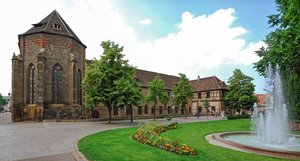 Musée d'Unterlinden |
Κολμάρ | 2 | Crucifixion, Tempelhof Altarpiece |
 Bavarian State Painting Collections |
Μόναχο | 1 | Beheading of John the Baptist |
21 χρόνια της τέχνης του Jost Haller, από το 1445 έως το 1465: η γκαλερί τους ακολουθεί πλάγια, πλάγια, χρόνο προς χρόνο, μέσα από τα πιο διάσημα πρωτότυπα κάθε χρονιάς.
Επιλέξτε μια χρονιά για να δείτε τα πρωτότυπα έργα της.

Crucifixion (1445), Musée d'Unterlinden, Κολμάρ. Στη συνέχεια ακολουθούν το Beheading of John the Baptist (1465) και το Tempelhof Altarpiece (1445).
Ο κατάλογός μας περιλαμβάνει 3 έργα του Jost Haller, με ημερομηνίες από 1445 έως 1465.
Κυρίως σε Musée d'Unterlinden (Κολμάρ) και Bavarian State Painting Collections (Μόναχο). Ο πίνακας μουσείου παραπάνω τους περιλαμβάνει όλους.
Κατά την περίοδο 1445: 2 από τα 3 έργα σε αυτήν τη σελίδα δημιουργήθηκαν τότε, με Crucifixion από αυτά να είναι μοναδικά.
Σε αυτήν τη σελίδα, το παλαιότερο είναι Crucifixion (1445) και το νεότερο Beheading of John the Baptist (1465).
Crucifixion και Tempelhof Altarpiece: το Musée d'Unterlinden, Κολμάρ διαθέτει 2 από τα έργα σε αυτήν τη σελίδα.
In the quiet corridors of art history, some names linger in the shadows for centuries, waiting for a modern eye to catch their light. Jost Haller is such a figure—a master whose identity was lost to the tides of time until a dramatic rediscovery in 1980. Active during the mid-15th century, this Alsatian painter breathed life into the Gothic tradition, leaving behind a legacy that speaks of chivalry, devotion, and the intricate beauty of the International Gothic style. Often referred to by the evocative moniker Le peintre des chevaliers, or "The Painter of the Knights," Haller’s work captures the romanticized splendor of an era defined by armored nobility and profound religious fervor.
Haller’s journey through the artistic landscape of the Rhine Valley was one of movement and prestige. His career traced a path through some of the most significant cultural hubs of the period, beginning in Strasbourg before extending his influence to Metz and Saarbrücken. This mobility allowed him to weave together the regional nuances of Alsatian art with the broader, more refined aesthetics flowing through Europe. His hand is felt in both the delicate precision of illuminated manuscripts and the monumental scale of religious altarpieces, demonstrating a versatility that commanded respect across different mediums.
The true essence of Haller’s genius is perhaps most vibrantly realized in his most celebrated masterpiece, the Tempelhof Altarpiece. Created around 1445, this breathtaking work of oil on fir wood serves as a window into the spiritual heart of the 15th century. Within its panels, one finds a profound narrative depth, where figures like John the Baptist and Saint George emerge from a world of meticulous detail and symbolic richness. The way Haller manipulates light and texture suggests an artist deeply attuned to the emerging possibilities of oil paint, using it to render the heavy folds of drapery and the glint of steel with an almost tactile realism.
Beyond the altarpieces, Haller’s artistic footprint extends to the very walls of the sacred spaces he inhabited. He is believed to be the hand behind the magnificent fresco of Saint Michael defeating Satan in Strasbourg’s St. Thomas' Church. This massive undertaking, measuring an imposing eight meters in height, showcases his ability to command vast architectural spaces, transforming stone and plaster into a theater of cosmic struggle. His work often balances the delicate elegance of the Gothic line with a burgeoning interest in the dramatic tension that would eventually pave the way for later Renaissance developments.
The story of Jost Haller is not merely one of artistic creation, but one of historical reclamation. For hundreds of years, his contributions were attributed to anonymous masters, his name a mere ghost in the archives of the Unterlinden Museum and other great repositories. It was only through the rigorous scholarship of art historian Charles Sterling that Haller was pulled from obscurity, allowing us to once again credit a specific, brilliant mind with the wonders we admire today. This restoration of identity has fundamentally changed our understanding of the Alsatian school of painting.
Today, Haller stands as a vital link in the evolution of Northern European art. His ability to blend the spiritual intensity of Christian iconography with the secular elegance of knightly culture makes his oeuvre a unique study in 15th-century duality. To look upon a work by Haller is to witness the twilight of the Middle Ages and the dawn of a new, more observant era—a time when the artist began to claim their place as an individual voice in the grand tapestry of human history.
