Πορτρέτο του John D. Batten

Τα 9 πιο διάσημα έργα του John D. Batten, μια επιλογή γκαλερί

Ενημερωμένο Νοέμβριος 2026 · κατάταξη βάσει του σκορ δημοφιλίας μας (αναζητήσεις, επισκέψεις και παραγγελίες για κάθε έργο) · 10 έργα του John D. Batten στον κατάλογό μας

Με σύντομη περιγραφή

Από όλα τα πρωτότυπα που άφησε ο John D. Batten, το πιο διάσημο είναι το Eve and the Serpent (1895). Ακολουθούν στενά η Pandora (1913) και η Snowdrop and the seven little men (1897). Ο κατάλογός μας περιλαμβάνει 10 έργα του John D. Batten· η γκαλερί έχει διατηρήσει τα 9 κομμάτια που θαυμάζει ο κόσμος, το καθένα με την ημερομηνία, το μουσείο και την ιστορία του.

1865 – 1932, Plymouth Περισσότερα έργα: The University of Reading

Τα 10 κορυφαία έργα του John D. Batten: η επιλογή της γκαλερί

1
Eve and the Serpent (1895) του John D. Batten

Eve and the Serpent

1895 · Tempera

John D. Batten’s Eve and the Serpent, created about 1895, captures a pivotal moment of theological narrative within the Garden of Eden. The work focuses on the encounter between Eve and the serpent, a scene central to the biblical story of temptation. Batten utilizes the subject to explore the intersection of myth and human emotion through a structured, detailed lens.

2
Pandora (1913) του John D. Batten

Pandora

1913 · Tempera · The University of Reading, Reading

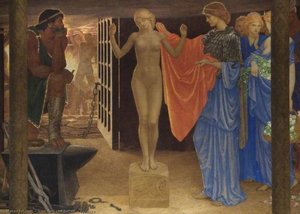
In this 1913 work, the artist John D. Batten presents a depiction of the mythological figure Pandora. The scene captures the pivotal moment in which she opens the box, an act that releases all the evils into the world. It is a composition that focuses on the weight of this singular, transformative action.

3
Snowdrop and the seven little men (1897) του John D. Batten

Snowdrop and the seven little men

1897 · Tempera On Panel · Art Gallery of New South Wales, Σίδνεϊ

Snowdrop and the seven little men by John D. Batten presents a narrative scene from folklore within a horizontal composition. The central focus is a woman resting in a large, canopy bed. Surrounding her are several small, gnome-like figures, creating a scene of interaction between a sleeping figure and industrious, miniature creatures. The arrangement utilizes a shallow, stage-like perspective, where depth is established through the overlapping of figures and the…

4
Beauty and the Beast (1904) του John D. Batten

Beauty and the Beast

1904 · Oil On Canvas · Birmingham Museum and Art Gallery, Μπέρμινγκχαμ

In this work, Beauty and the Beast, John D. Batten constructs a scene of profound emotional tension within the quiet confines of an enclosed garden. The composition relies on a deliberate imbalance; on the left, the verticality of a woman in a long, flowing blue gown draws the eye upward, her face turned toward the sky with an expression of either anguish or ecstasy. This movement is countered on the…

Τα θέματα που κίνησαν το ενδιαφέρον του John D. Batten

Τα τέσσερα θέματα που εμφανίζονται πιο συχνά σε αυτά τα πρωτότυπα έργα, το καθένα με το εξαιρετικό του παράδειγμα.

Τα μουσεία που διατηρούν τα πρωτότυπα έργα του John D. Batten

Τα 3 μουσεία που φιλοξενούν το μεγαλύτερο μέρος των έργων σε αυτήν τη σελίδα.

Μουσείο Πόλη Έργα του John D. Batten Πάτρια από αυτή τη λίστα
The University of Reading, ReadingThe University of Reading Reading 1 Pandora
Art Gallery of New South Wales, ΣίδνεϊArt Gallery of New South Wales Σίδνεϊ 1 Snowdrop and the seven little men
Birmingham Museum and Art Gallery, ΜπέρμινγκχαμBirmingham Museum and Art Gallery Μπέρμινγκχαμ 1 Beauty and the Beast

Ο John D. Batten δεκαετία προς δεκαετία: το πρωτότυπο που ορίζει κάθε μία

Έργα ανά δεκαετία

Επιλέξτε μια δεκαετία για να δείτε το πρωτότυπο έργο που την χαρακτηρίζει.

Ερωτήσεις συλλεκτών για τα έργα του John D. Batten

Για ποιο έργο είναι πιο γνωστός ο John D. Batten;Αποκαλύψτε την απάντηση

Το Eve and the Serpent (1895). Στη συνέχεια ακολουθούν το Pandora (1913) και το Snowdrop and the seven little men (1897).

Πόσο ηλικία είχε ο/η John D. Batten όταν δημιουργήθηκε το Eve and the Serpent;Αποκαλύψτε την απάντηση

30 ετών: το έργο Eve and the Serpent είναι του 1895, και ο/η John D. Batten γεννήθηκε το 1865.

Πόσα έργα δημιούργησε ο/η John D. Batten;Αποκαλύψτε την απάντηση

Ο κατάλογός μας περιλαμβάνει 10 έργα του John D. Batten, με ημερομηνίες από 1886 έως 1922.

Σε ποια μουσεία εκτίθενται τα αριστούργημα του John D. Batten;Αποκαλύψτε την απάντηση

Κυρίως σε The University of Reading (Reading), Art Gallery of New South Wales (Σίδνεϊ) και Birmingham Museum and Art Gallery (Μπέρμινγκχαμ). Ο πίνακας μουσείου παραπάνω τους περιλαμβάνει όλους.

Σε ποιες χρονιές δημιούργησε ο/η John D. Batten τα πιο διάσημα έργα του/της;Αποκαλύψτε την απάντηση

Κατά την περίοδο 1880s: 2 από τα 9 έργα σε αυτήν τη σελίδα δημιουργήθηκαν τότε, με The Family από αυτά να είναι μοναδικά.

Ποια είναι τα πρώτα και τα τελευταία διάσημα πρωτότυπα του John D. Batten;Αποκαλύψτε την απάντηση

Σε αυτήν τη σελίδα, το παλαιότερο είναι The Family (1886) και το νεότερο Atlanta and Milanion (detail for the fresco painting 'Atlanta's Race') (1922).

Ποια θέματα επέλεξε πιο συχνά ο John D. Batten;Αποκαλύψτε την απάντηση

Woman (4) και Garden (2), σε συνολικά 9 έργα σε αυτήν τη σελίδα.

Ποια τεχνική χρησιμοποίησε περισσότερο ο John D. Batten;Αποκαλύψτε την απάντηση

Tempera, για 2 από τα 9 έργα σε αυτήν τη σελίδα.

John D. Batten: ζωή και έργο

The Tempera Revivalist

To understand the impact of John Dickson Batten, one must look at the specific technical vacuum he helped fill during the Edwardian era. He did not merely paint; he revived a dying language. By turning to egg tempera, Batten moved away from the heavy, oily textures common in his time, opting instead for a medium that demanded precision and a certain luminous austerity. His work is defined by this discipline. He was a man of dualities, beginning his professional life reading law at Trinity College, Cambridge, before abandoning the legal career of a barrister to study at the Slade School of Fine Arts. This transition from the rigid logic of law to the meticulous observation of art shaped a style that was both intellectually structured and visually detailed.

His early fascination with ornithology and the mechanics of animal flight provided a scientific foundation for his later, more imaginative works. This wasn't mere whimsy. There is a structural accuracy in his depictions of movement that separates his illustrations from the purely decorative. He brought a researcher's eye to the mythological and the allegorical, ensuring that even his most fantastical subjects possessed a tangible, physical presence.

Narrative and Myth

Batten’s output was vast, ranging from small-scale book illustrations to large-scale frescoes. He possessed a specific ability to translate complex folklore into visual narratives. His work often focused on the intersection of myth and human emotion, utilizing the delicate qualities of tempera to bring light to ancient stories. His repertoire included:

His involvement with the Society of Painters in Tempera was not a side interest; it was a central part of his professional identity. Alongside figures like Arthur Gaskin, he helped establish a renewed appreciation for the medium's expressive potential. His 1913 work, Pandora, which was presented to Reading University, remains a primary example of his ability to handle large-scale narrative depth through the tempera technique.

A Legacy of Precision

The significance of Batten lies in his refusal to settle for the easy or the ephemeral. While many of his contemporaries were moving toward more fluid or abstract expressions, he doubled down on the technical rigors of the past. He was a prolific writer as well, producing volumes of poetry and an article on the practice of tempera painting, proving that his interest in art was as much academic as it was creative. He understood the mechanics of his craft from the inside out.

His work remains a vital point of reference for anyone studying the revival of traditional painting methods in Britain. He did not just illustrate stories; he gave them a specific, luminous weight. From the detailed rendering of a bird's flight to the somber emotion of a religious portrait, Batten’s career was a sustained argument for the power of meticulous, disciplined art.