Πορτρέτο του Γκουνάρ Μπερντσον

Πάτσαδες του Γκουνάρ Μπερντσον: Τα 42 πιο διάσημα, μέσα από το βλέμμα μιας γκαλερί

Ενημερωμένο Νοέμβριος 2026 · κατάταξη βάσει του σκορ δημοφιλίας μας (αναζητήσεις, επισκέψεις και παραγγελίες για κάθε έργο) · 42 έργα του Γκουνάρ Μπερντσον στον κατάλογό μας

Με σύντομη περιγραφή

Στο μάτι της γκαλερί, το πιο διάσημο έργο του Γκουνάρ Μπερντσον είναι το Portrait of a Jewish Man (1873), το πρωτότυπο του οποίου εκτίθεται στο Finnish National Gallery, Helsinki. Ο Self-Portrait in 17th-Century Costume (1884) και ο Nude Female Model (1883) ολοκληρώνουν το τρίο που κάθε μάτι αναγνωρίζει. Από τα 42 έργα του Γκουνάρ Μπερντσον στον κατάλογό μας, η γκαλερί παρουσιάζει παρακάτω τα 42 πιο διάσημα, όπου κάθε ένα είναι πρωτότυπο, με την χρονολογία του, το μουσείο του και το τι το κάνει μοναδικό.

1854 – 1895, Ελσίνκι Realism Περισσότερα έργα: Finnish National Gallery

Τα 10 κορυφαία έργα του Γκουνάρ Μπερντσον στη γκαλερέι

2
Self-Portrait in 17th-Century Costume (1884) του Γκουνάρ Μπερντσον

Self-Portrait in 17th-Century Costume

1884 · Oil · Finnish National Gallery, Helsinki

In this intimate oil painting, titled Self-Portrait in 17th-Century Costume, the artist Gunnar Berndtson gazes back from the canvas. He captures his own likeness, presenting himself through a lens of historical character. The work functions as a self-portrait, a moment where the creator and the subject become one. He appears dressed in the fashion of a bygone era, a choice that shifts the viewer's focus toward the persona he inhabits…

3
Nude Female Model (1883) του Γκουνάρ Μπερντσον

Nude Female Model

1883 · Pastel · Finnish National Gallery, Helsinki

In the 1883 pastel portrait titled Nude Female Model, the artist Gunnar Berndtson presents a classical nude study. The subject is a female model positioned in a seated, reclining pose. She is turned slightly toward the viewer's left, creating a sense of quiet contemplation. The figure is draped in satin-like fabric that cascades in fluid folds around her form. This blue drapery provides a cool-toned backdrop that contrasts with the…

4
Woman with a Bird at the Castle of Maison Laffitte (1882) του Γκουνάρ Μπερντσον

Woman with a Bird at the Castle of Maison Laffitte

1882 · Oil · Finnish National Gallery, Helsinki

The air in the grand room feels still, held in a delicate balance between the heavy architecture and the soft presence of the woman. She sits amidst the opulence of the Castle of Maison Laffitte, her figure framed by the rhythmic geometry of doorways and columns that pull the eye deep into the shadowy recesses of the castle. A soft light, perhaps filtering from an unseen window to the left,…

7
The Mirror ; The Toilet (1889) του Γκουνάρ Μπερντσον

The Mirror ; The Toilet

1889 · Oil · Finnish National Gallery, Helsinki

The air in the room feels heavy with the scent of expensive powders and the soft rustle of silk. A woman sits in profile, her silhouette a graceful curve against the muted backdrop of a private chamber. She is draped in a gown of luminous green satin that catches the light from an unseen window, the fabric shimmering with a liquid quality that suggests the cool touch of high-quality silk.…

8
Portrait of Counsellor of State Maria von Wahlberg (b. Sinebrychoff) (1892) του Γκουνάρ Μπερντσον

Portrait of Counsellor of State Maria von Wahlberg (b. Sinebrychoff)

1892 · Oil On Panel · Finnish National Gallery, Helsinki

The gaze of Maria von Wahlberg meets the viewer in the Portrait of Counsellor of State Maria von Wahlberg (b. Sinebrychoff). Painted in 1892 by the Finnish artist Gunnar Berndtson, this oil on panel captures a woman of significant presence. She is depicted as Mrs Maria von Wahlberg, born into the Sinebrychoff family, a lineage that carries a quiet weight within the frame. The portrait exists now within the Finnish…

9
Head of a Girl, Study for the Family Portrait of Baron Magnus von Born (1890) του Γκουνάρ Μπερντσον

Head of a Girl, Study for the Family Portrait of Baron Magnus von Born

1890 · Oil · Finnish National Gallery, Helsinki

In Head of a Girl, Study for the Family Portrait of Baron Magnus von Born, Gunnar Berndtson employs a close-up composition that focuses on the subject's face and upper shoulders. The figure is positioned slightly off-center, creating a sense of movement as she gazes toward the right. This orientation, combined with an eye-level perspective, establishes a direct connection between the subject and the viewer.

10
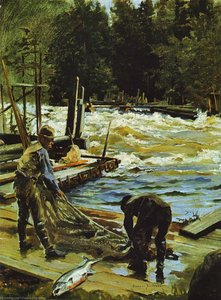
Salmon Fishers at the Langinkoski Rapid (1892) του Γκουνάρ Μπερντσον

Salmon Fishers at the Langinkoski Rapid

1892 · Oil

In Salmon Fishers at the Langinkoski Rapid, the artist Gunnar Berndtson captures a moment of strenuous manual labor set against the wild, rushing waters of a natural river. Painted about 1892, the scene pulls the viewer directly onto a wooden dock where the air feels heavy with the spray of the rapids. Two fishermen work in unison, their bodies engaged in the heavy task of managing a large net amidst…

Πάينτα του Γκουνάρ Μπερντσον, κατάταξη από 11 έως 42

Τα διάσημα έργα του Γκουνάρ Μπερντσον, ανά περίοδο

Τα θέματα που κίνησαν το ενδιαφέρον του Γκουνάρ Μπερντσον

Τα τέσσερα θέματα που εμφανίζονται πιο συχνά σε αυτά τα πρωτότυπα έργα, το καθένα με το εξαιρετικό του παράδειγμα.

Τα μουσεία που διατηρούν τα πρωτότυπα έργα του Γκουνάρ Μπερντσον

Τα 5 μουσεία που φιλοξενούν το μεγαλύτερο μέρος των έργων σε αυτήν τη σελίδα.

Μουσείο Πόλη Έργα του Γκουνάρ Μπερντσον Πάτρια από αυτή τη λίστα
Finnish National Gallery, HelsinkiFinnish National Gallery Helsinki 17 Portrait of a Jewish Man, Self-Portrait in 17th-Century Costume, Nude Female Model
Turku Art Museum, ΤούρκουTurku Art Museum Τούρκου 2 Kesä, Self-portrait
Μουσείο Τέχνης Ateneum, ΕλσίνκιΜουσείο Τέχνης Ateneum Ελσίνκι 2 Almée, an Egyptian Dancer, The Bride
Serlachius Manor, Mänttä-VilppulaSerlachius Manor Mänttä-Vilppula 2 Taiteentuntijoita Louvressa, Sakkia
National Portrait Gallery of Sweden, SträngnäsNational Portrait Gallery of Sweden Strängnäs 1 Gustaf Cederström, 1845-1933

Γκουνάρ Μπερντσον, ένα χαρακτηριστικό έργο ανά δεκαετία

Έργα ανά δεκαετία

Επιλέξτε μια δεκαετία για να δείτε το πρωτότυπο έργο που την χαρακτηρίζει.

Οι πίνακες του Γκουνάρ Μπερντσον: οι απαντήσεις της γκαλερί

Ποιο έργο του Γκουνάρ Μπερντσον είναι το πιο διάσημο από όλα;Αποκαλύψτε την απάντηση

Portrait of a Jewish Man (1873), Finnish National Gallery, Helsinki. Στη συνέχεια ακολουθούν το Self-Portrait in 17th-Century Costume (1884) και το Nude Female Model (1883).

Πόσο είχε ηλικία ο Γκουνάρ Μπερντσον όταν ολοκλήρωσε το Portrait of a Jewish Man;Αποκαλύψτε την απάντηση

19 ετών: το έργο Portrait of a Jewish Man είναι του 1873, και ο/η Γκουνάρ Μπερντσον γεννήθηκε το 1854.

Ποιες είναι τα 10 κορυφαία έργα του Γκουνάρ Μπερντσον;Αποκαλύψτε την απάντηση

Portrait of a Jewish Man, Self-Portrait in 17th-Century Costume, Nude Female Model, Woman with a Bird at the Castle of Maison Laffitte, Portrait of Zacharias Topelius, Portrait of Baron Delort de Gléon, The Mirror ; The Toilet, Portrait of Counsellor of State Maria von Wahlberg (b. Sinebrychoff), Head of a Girl, Study for the Family Portrait of Baron Magnus von Born και Salmon Fishers at the Langinkoski Rapid. Η κατάταξη παραπάνω αναγράφει το έτος και το μουσείο για το κάθε έργο.

Πόσα έργα δημιούργησε ο/η Γκουνάρ Μπερντσον;Αποκαλύψτε την απάντηση

Ο κατάλογός μας περιλαμβάνει 42 έργα του Γκουνάρ Μπερντσον, με ημερομηνίες από 1873 έως 1894.

Πού εκτίθενται τα πιο διάσημα πρωτότυπα του Γκουνάρ Μπερντσον;Αποκαλύψτε την απάντηση

Κυρίως σε Finnish National Gallery (Helsinki), Turku Art Museum (Τούρκου) και Μουσείο Τέχνης Ateneum (Ελσίνκι). Ο πίνακας μουσείου παραπάνω τους περιλαμβάνει όλους.

Πότε δημιούργησε ο/η Γκουνάρ Μπερντσον τα πιο διάσημα έργα του/της;Αποκαλύψτε την απάντηση

Κατά την περίοδο 1880s: 8 από τα 42 έργα σε αυτήν τη σελίδα δημιουργήθηκαν τότε, με Self-Portrait in 17th-Century Costume από αυτά να είναι μοναδικά.

Ποια είναι τα πρώτα και τα τελευταία διάσημα έργα του Γκουνάρ Μπερντσον;Αποκαλύψτε την απάντηση

Σε αυτήν τη σελίδα, το παλαιότερο είναι Portrait of a Jewish Man (1873) και το νεότερο Miniature Portrait of Baroness Delort de Gléon the Younger (1894).

Ποια θέματα επέλεξε πιο συχνά ο Γκουνάρ Μπερντσον;Αποκαλύψτε την απάντηση

Portraits (7), Woman (6) και Man (5), σε συνολικά 42 έργα σε αυτήν τη σελίδα.

Με ποια τεχνική εργάστηκε περισσότερο ο Γκουνάρ Μπερντσον;Αποκαλύψτε την απάντηση

Oil, για 8 από τα 42 έργα σε αυτήν τη σελίδα.

Με ποιο καλλιτεχνικό κίνημα σχετίζεται ο/η Γκουνάρ Μπερντσον;Αποκαλύψτε την απάντηση

Realism, όπως προκύπτει από τα πρωτότυπα σε αυτήν τη σελίδα.

Ποια πρωτότυπα έργα του Γκουνάρ Μπερντσον διαθέτει το Finnish National Gallery;Αποκαλύψτε την απάντηση

Portrait of a Jewish Man, Self-Portrait in 17th-Century Costume και Nude Female Model: το Finnish National Gallery, Helsinki διαθέτει 17 από τα έργα σε αυτήν τη σελίδα.

Γκουνάρ Μπερντσον: ο καλλιτέχνης

Gunnar Berndtson: A Finnish Master of Realistic Portraiture

Gunnar Fredrik Berndtson (1854-1895) stands as a significant, yet often overlooked, figure in the history of Finnish art. Born into an intellectual family – his father was the renowned author, journalist, and poet Fredrik Berndtson – Gunnar’s artistic journey began with formal studies at the Polytechnic Institute in Helsinki, later transitioning to auditing classes at the University of Helsinki under esteemed instructors like Erik Johan Löfgren. However, by 1876, he decisively chose a path as an artist, embarking on a transformative period in Paris where he enrolled at the École des Beaux-Arts and studied under the influential Jean-Léon Gérôme. This Parisian sojourn proved pivotal, exposing him to the Salon style of painting and fostering connections with artists like Albert Edelfelt, a relationship that would profoundly shape his artistic sensibilities.

Early Influences and the Salon Style

Berndtson’s early work demonstrates a clear absorption of the Salon’s emphasis on historical subjects and idealized beauty. His initial exhibits at the Salon in 1878 showcased this influence, characterized by meticulous detail and a polished aesthetic. Yet, he wasn't merely a mimic; his time with Edelfelt introduced him to a more nuanced approach – one that retained realism while subtly incorporating elements of Finnish identity and a burgeoning sense of modernism. The Salon’s popularity provided Berndtson with crucial exposure and established a foundation for his subsequent career.

Egypt and the Dawn of a New Vision

A pivotal chapter in Berndtson's artistic development unfolded between 1882 and 1883 when he traveled to Egypt as a guest of Alphonse, Baron Delort de Gléon, a French mining engineer. This experience proved profoundly influential, shifting his focus towards portraiture and documentary illustration for *Le Monde Illustré*. The stark light, vibrant colors, and diverse subjects of Egypt ignited a new passion within him, moving beyond the formal constraints of the Salon and laying the groundwork for a more personal and expressive style. He captured the essence of Egyptian life with remarkable accuracy and sensitivity, documenting both its grandeur and its everyday realities.

Return to Finland and Artistic Recognition

Upon his return to Finland in 1883, Berndtson established himself as a respected portrait painter, quickly gaining recognition for his ability to capture the character and dignity of his subjects. He received considerable acclaim, culminating in the State Prize for Portrait Painting in 1889 – a testament to his growing reputation. His portraits were not merely likenesses; they possessed an undeniable psychological depth, revealing subtle nuances of emotion and personality. He continued to exhibit at the Salon throughout the 1890s, maintaining a consistent level of success and solidifying his position as one of Finland’s leading artists.

Legacy and Artistic Significance

Gunnar Berndtson's legacy extends beyond his individual works; he played a role in shaping the development of Finnish art. He served as a teacher at the Academy of Fine Arts from 1890 to 1892, mentoring talented students like Magnus Enckell and Ellen Thesleff, who would go on to make significant contributions to the artistic landscape. His untimely death in 1895, attributed to a “degenerative ailment” (possibly syphilis), cut short a promising career but left behind a body of work characterized by meticulous realism, psychological insight, and a subtle yet unmistakable Finnish sensibility. Works such as *The Bride’s Song* (1881), *Portrait of Dentistry Professor Matti Äyräpää* (1889), *His Name* (1890) and *Almée, an Egyptian Dancer* (1883) offer poignant glimpses into the fin-de-siècle world he inhabited – a world grappling with modernity while retaining deep roots in tradition. Berndtson’s art continues to be studied and appreciated for its technical skill, emotional resonance, and its contribution to the rich tapestry of Finnish artistic history.