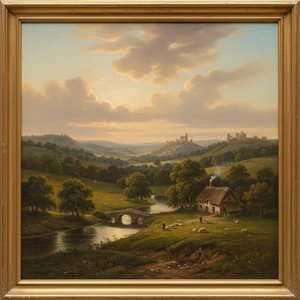
A Legacy of Light and Landscape: The Life of George Barret the Younger
The story of George Barret the Younger is one of profound artistic inheritance intertwined with a poignant struggle for survival. Born in London in 1767, he was the son of the esteemed Irish landscape painter George Barret Sr., an artist whose presence in the English art scene helped shape the very foundations of British pastoral painting. While his lineage provided him with an early and likely rigorous education under his father's watchful eye, it also brought a heavy burden of responsibility. Following the untimely death of his father in 1767, the young Barret found himself thrust into a world of financial uncertainty. Alongside his siblings, he had to navigate the hardships of life, yet it was within this crucible of necessity that his extraordinary talent began to outshine even those of his talented brothers and sisters, marking him as a singular visionary in the annals of English art.
In his early years, Barret’s brush was primarily focused on the tangible beauty of his immediate surroundings. His works were often topographical, capturing the serene and pastoral charm of the Thames Valley and the surrounding Home Counties. These early oil paintings possessed a certain realism, documenting the lush greenery and soft light of the English countryside with a meticulous eye. However, as his mastery grew, so too did his ambition to transcend mere documentation. He began to move away from specific locales, seeking instead to capture the eternal essence of nature. This transition marked his entry into the Romantic movement, where the artist’s role shifted from that of an observer to that of a poet of the landscape.
The Pursuit of the Sublime and the Claudian Ideal
As Barret’s artistic maturity blossomed, he found deep inspiration in the works of classical masters such as Claude Lorrain and Nicolas Poussin. This influence fundamentally altered his approach to composition and light. He moved toward a Claudian style, characterized by idealized landscapes that prioritized atmospheric perspective and emotional resonance over geographical accuracy. His canvases became windows into a dreamlike realm, where breathtaking sunrises and sunsets were staged with a sense of divine drama. By stripping away specific landmarks, Barret allowed the viewer to engage with the spiritual dimension of the natural world, finding the sublime in the interplay of shadow and radiance.
This evolution was not limited to his oil paintings; Barret became a pivotal figure in the development of watercolor as a serious medium. As a founding member of the Society of Painters in Watercolours in 1804, he helped elevate the technique from a secondary sketching tool to a sophisticated vehicle for large-scale expression. His dedication to the craft was unparalleled; he was a constant presence in the art world, exhibiting at the Royal Academy and never missing an exhibition for an astounding thirty-eight years. Even as he published his influential treatise, The Theory and Practice of Water-Colour Painting, in 1840, his commitment to the aesthetic truth of the medium remained his guiding light.
A Life of Artistic Triumph Amidst Personal Struggle
Despite the brilliance of his compositions and his significant contributions to British art, Barret’s personal life was often shadowed by the specter of poverty. He lived much of his life in Paddington, enduring a long and difficult struggle against financial ruin that mirrored the hardships of his youth. There is a profound irony in his biography: while he could paint scenes of immense peace, pastoral abundance, and classical grandeur, his own existence was marked by the relentless pressure of economic instability. Like his father before him, he eventually passed away in a state of destitution, leaving behind a legacy that far outweighed his earthly possessions.
The historical significance of George Barret the Younger lies in his ability to bridge the gap between the topographical traditions of the eighteenth century and the emotive, atmospheric heights of Romanticism. His work serves as a vital link in the evolution of English landscape art, demonstrating how an artist can transform the local into the universal. Through his mastery of light, his devotion to the watercolor medium, and his pursuit of the sublime, Barret ensured that his vision of the natural world would endure long after the struggles of his own life had faded into history.