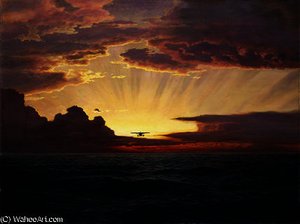
A Life Immersed in the Sea: The World of Frederick Judd Waugh
Born in Bordentown, New Jersey, in 1861, Frederick Judd Waugh embarked on a journey that would inextricably link his name to the raw power and captivating beauty of the ocean. Coming from an artistic lineage – his father, Samuel Waugh, was a respected Philadelphia portrait painter – young Frederick received foundational training at the Pennsylvania Academy of Fine Arts under the discerning eye of
Thomas Eakins. This early education instilled in him a commitment to
realism, a meticulous observation of form and light that would remain a hallmark of his work even as his style evolved. He further refined his skills with studies at the prestigious Académie Julian in Paris, learning from Adolphe-William Bouguereau, yet ultimately diverging from the strict academic conventions favored there, seeking a more personal expression.
From Coastal Realism to Expressive Seascapes
A pivotal moment arrived when Waugh relocated to England, settling on the island of
Sark in the English Channel. This move wasn’t merely geographical; it was a profound shift in artistic focus. He dedicated himself wholeheartedly to capturing the essence of the sea – its moods, its fury, and its serene moments of tranquility. His early work focused on realistic depictions of coastal scenes, immediately recognizable for their dramatic use of
light and shadow. Waugh possessed an exceptional ability to convey the untamed energy of waves crashing against cliffs, the turbulent drama of
stormy weather, and the subtle interplay of sunlight on water. Over time, his style blossomed, incorporating elements of
Impressionism and a more expressive brushstroke. His seascapes began to breathe with movement and atmosphere, inviting viewers not just to observe but to *feel* the ocean’s presence. He wasn't simply painting what he saw; he was conveying an emotional experience.
Beyond the Canvas: Art in Service of Nation
In 1908, Waugh returned to the United States, eventually finding a creative haven in Montclair Heights, New Jersey, thanks to the patronage of
art collector William T. Evans, who provided him with studio space in exchange for an annual painting. However, his artistic path took an unexpected turn with the outbreak of World War I. Recruited by the U.S. Navy under the direction of Everett L. Warner, Waugh lent his considerable artistic talent to a critical wartime effort: designing ship camouflage. This wasn’t merely about aesthetics; it was about deception and survival. His designs, implemented on numerous vessels including the massive Leviathan, aimed to disrupt enemy targeting and protect American ships from submarine attacks. It's a testament to Waugh’s versatility that he could seamlessly transition between capturing the beauty of nature and applying his artistic skills to the demands of military strategy. Following this service, he continued to seek inspiration along the American coastline, residing on Bailey Island, Maine, and Provincetown, Massachusetts, each location offering unique perspectives for his ever-evolving seascapes. His standing within the art community was further solidified when he served as a judge at an art exhibit on Monhegan Island in 1914.
Legacy of a Marine Master
Frederick Judd Waugh’s artistic journey was profoundly shaped by those who came before him. The emphasis on
realism and anatomical accuracy instilled by
Thomas Eakins remained a foundational element of his work, while the technical training received from Adolphe-William Bouguereau in Paris provided an initial framework that he later transcended. Yet, Waugh wasn’t simply imitating his mentors; he was forging his own path, driven by a deep connection to the sea and a desire to capture its essence on canvas. His contributions during World War I highlight the often-overlooked intersection of art and military innovation. Today, his dynamic seascapes and powerful surf paintings continue to captivate audiences, solidifying his place as a significant figure in American marine art.
Waugh’s work isn't just about depicting the ocean; it’s about conveying its power, its mystery, and its enduring allure. His legacy endures through the numerous public and private collections that house his paintings, ensuring that future generations can experience the captivating world he created – a world forever immersed in the sea.
Influences and Artistic Kinship
- Thomas Eakins: The foundation of Waugh’s realism and dedication to accurate observation.
- Adolphe-William Bouguereau: Provided early technical training, though Waugh ultimately developed a more independent style.
- The Sea Itself: Waugh's most profound influence; his life was dedicated to capturing its ever-changing moods and power.
His paintings serve as a reminder of the enduring connection between humanity and the natural world, and the transformative power of art to capture that relationship.