The Versatile Vision of Ferdinand Massignon
Ferdinand Massignon (1883 – 1962) emerged from the vibrant Parisian artistic milieu as a remarkably multifaceted talent—a sculptor, painter, ceramist, and medallist whose contributions spanned diverse mediums and reflected a profound engagement with both classical tradition and avant-garde experimentation. Born in Nogent-sur-Marne, France, Massignon’s early life was marked by an inclination towards scientific pursuits; he initially studied medicine and chemistry before recognizing his true vocation lay within the realm of artistic creation. This pivotal decision led him to enroll at the Académie Julian, where he honed his painting skills under the tutelage of Jules Dalou, arguably one of France's most influential sculptors of the Belle Époque.
Dalou’s influence profoundly shaped Massignon’s sculptural style, which became characterized by a meticulous attention to detail and an unwavering commitment to capturing human emotion through form. This stylistic approach would become synonymous with his oeuvre as he established himself as a respected artist capable of undertaking significant commissions. His monumental sculptures for public spaces, such as the “L’Effort” in the Jardin du Luxembourg, serve as enduring testaments to his ability to translate conceptual ideas—specifically the spirit of perseverance and dedication—into tangible, breathtaking artistic expressions.
A Symphony of Mediums and Collaborations
Massignon’s artistic journey extended far beyond the permanence of stone and bronze; he embraced painting with considerable enthusiasm, exploring themes deeply rooted in mythology and symbolism. His creative spirit was often ignited by the intersection of different art forms, most notably seen in his captivating collaboration with the celebrated dancer Loïe Fuller. Known for her innovative use of silk scarves to create ethereal shapes, Fuller provided the perfect muse for Massignon’s exploration of movement and light. This partnership resulted in the mesmerizing tableau vivant titled “Loie Fuller as Comédie,” a project that showcased his ability to push the boundaries of visual arts through a fusion of performance and static art.
During this period, Massignon also worked under the name Pierre Roche, a facet of his career that revealed his experimental nature. In 1896, he was tasked with creating two medallions for the façade of the Théâtre de Tulle in Corréze, France. Drawing inspiration from the dancer’s grace, he modeled the faces in the manner of Greek theater masks—representing Comedy and Drama—which were later exhibited at the Salon de la Société Nationale des Beaux-Arts in 1901. This period of his life highlights a fascinating duality:
- The precision of a medallist capturing classical archetypes.
- The fluidity of a painter inspired by the ephemeral nature of dance.
- The structural mastery of a sculptor defining physical space.
Legacy and Artistic Significance
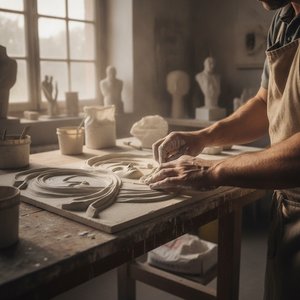
As a pioneer of bas-relief, Massignon left an indelible mark on the landscape of French art. His ability to navigate between the scientific rigor of his early training and the poetic abstraction of his later works allowed him to bridge the gap between the classical past and the modern era. Whether through the delicate textures of his ceramics or the commanding presence of his public monuments, Massignon’s work remains a testament to the power of multidisciplinary mastery. His legacy continues to resonate as a study in how an artist can inhabit multiple identities—sculptor, painter, and dreamer—to capture the multifaceted essence of the human experience.