Carolus-Duran: Life and Legacy
Early Life and Education
- Born: Charles Auguste Émile Durand on July 4, 1837, in Lille, France.
- His early artistic training began with lessons from local sculptor Augustin-Phidias Cadet de Beaupré at the Académie de Lille.
- He furthered his education under François Souchon, a student of Jacques-Louis David, focusing on painting techniques.
- In 1853, he moved to Paris and adopted the name “Carolus-Duran,” marking a pivotal moment in his artistic identity.
Artistic Development and Influences
- Initially influenced by the Realism of Gustave Courbet, Carolus-Duran’s style evolved significantly after a scholarship allowed him to travel to Rome and Spain (1862-1866).
- Diego Velázquez became a crucial influence during his time in Spain. He admired Velázquez's mastery of light, color, and psychological insight.
- He moved away from the stark realism of Courbet towards a more refined and elegant style, characterized by sophisticated brushwork and attention to detail.
Career and Notable Works
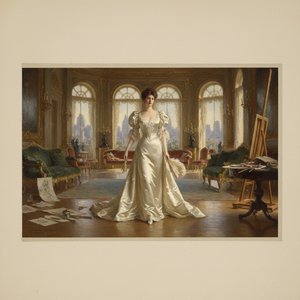
- Carolus-Duran gained recognition for his portraits of wealthy members of Third Republic France’s high society. He captured their elegance and status with remarkable skill.
- Notable works include:
- Lady with a Glove (1869) – exemplifies his refined portrait style.
- Mrs. William Astor (1890) – a striking depiction of a prominent socialite.
- After the Swimming (1899) – showcases his ability to capture movement and atmosphere.
- The Artist's Daughter, Marie-Anne (1874) - A more intimate portrait demonstrating a softer side of his style.
- He also painted portraits that contrasted with his usual subjects, such as his gardener, employing looser strokes and earth tones.
Teaching and Legacy
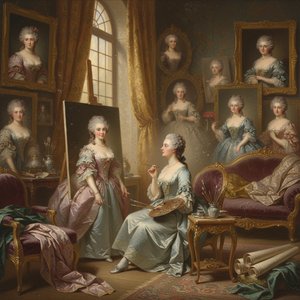
- Carolus-Duran was a highly respected teacher. His studio on the Boulevard du Montparnasse became a center for artistic training.
- Among his most famous pupils were:
- He served on juries at the Expositions Universelles in 1889 and 1900, demonstrating his standing within the art world.
- In 1890, he co-founded the second Société Nationale des Beaux-Arts and was elected to the Académie des Beaux-Arts in 1904.
Honors and Final Years
- He received numerous honors throughout his career, including being named a Knight of the Légion d'honneur (1872) and progressing through its ranks to Grand Officer (1900).
- Carolus-Duran was a frequent visitor to Fréjus, where he owned a villa. After his death in 1917, the resort named a plaza and beach in his honor.
- Historical Significance: Carolus-Duran bridged the gap between Realism and Impressionism, influencing a generation of artists with his elegant style and technical skill. His emphasis on capturing personality and social status made him a significant figure in 19th-century French art.
Ερωτήσεις και Απαντήσεις
Πού και πότε γεννήθηκε ο/η Κάρολος-Ντουράν;
Ο/Η Κάρολος-Ντουράν γεννήθηκε στην/στη Λιλ το 1837.
Πού μπορώ να βρω τα έργα του καλλιτέχνη Κάρολος-Ντουράν ομαδοποιημένα ανά καλλιτεχνικό ρεύμα;
Η σελίδα Όλα τα Ρευmatά ομαδοποιεί τα έργα του/της Κάρολος-Ντουράν ανά καλλιτεχνικό κίνημα.
Με τι άλλα ονόματα είναι γνωστός/η ο/η Κάρολος-Ντουράν;
Ο/Η Κάρολος-Ντουράν αναγνωρίζεται και με τα εναλλακτικά ονόματα Charles Auguste Émile Durand, Charles-Emile-Auguste Durand, Emile-Auguste Carolus-Duran, Charles Emile Auguste Duran Carolus-Duran, Charles Durand.