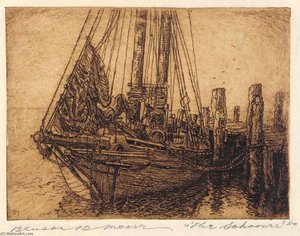
A Life Woven in Shadows and Light: The World of Benson B. Moore
Benson Bond Moore, a name perhaps less familiar than some of his contemporaries, nevertheless holds a significant place within the pantheon of American wildlife artists of the early to mid-20th century. Born in Washington D.C. in 1882, Moore’s artistic journey was deeply intertwined with the city's cultural landscape and a surprisingly diverse range of experiences – from assisting in the restoration of iconic paintings at the Capitol Building to meticulously documenting the animal kingdom for newspapers. His work, characterized by an almost obsessive attention to detail and a profound respect for the natural world, offers a captivating glimpse into a bygone era of American art and conservation.
Moore’s early life provided him with an unusual foundation for his future career. Rather than formal artistic training initially, he learned the craft of painting restoration from his father, a respected professional who worked on numerous pieces within the White House. This apprenticeship instilled in him a deep understanding of materials, techniques, and the inherent value of preserving artistic heritage. Later, he studied at the Corcoran School of Art, absorbing influences from prominent landscape painters like Edmund Messer and Richard Brooke – figures associated with the Barbizon School movement, known for its emphasis on plein air painting and capturing the essence of nature. However, Moore’s style quickly evolved beyond a simple imitation of these traditions, developing into a distinctly personal and evocative approach.
The Rise of a Wildlife Observer
Moore's artistic trajectory took an unexpected turn when he began working for the Maurice Joyce Photo-Engraving Company in Washington D.C., assisting Dr. Alexander Graham Bell in developing hearing aids for the deaf. This experience honed his observational skills and attention to detail, qualities that would later prove invaluable in his wildlife paintings. Simultaneously, he contributed illustrations to “The Evening Star,” a prominent newspaper, producing over 3700 drawings of animals – a remarkable undertaking that showcased his ability to capture the nuances of animal behavior and form. This period cemented his reputation as a skilled naturalist-artist, blending scientific observation with artistic expression.
His work for the Smithsonian Institution further solidified his standing within the art world. He created numerous illustrations for their “Scientific Series,” demonstrating his commitment to both artistic excellence and scientific accuracy. The influence of this period is evident in his later paintings – a meticulous rendering of animal anatomy combined with an intuitive understanding of light, shadow, and texture. Moore’s dedication to portraying animals in their natural habitats was not merely aesthetic; it reflected a growing awareness of the importance of conservation during a time when America's wilderness was rapidly being transformed.
Technique and Style: A Master of Detail
Moore’s paintings are immediately recognizable for their extraordinary level of detail. He employed a combination of techniques – including drypoint etching, watercolor, and oil painting – to achieve this remarkable realism. His use of light was particularly masterful, creating a sense of atmosphere and depth that brought his subjects to life. He wasn't simply copying what he saw; he was striving to capture the *feeling* of being immersed in nature.
- Drypoint Etchings: These prints allowed for intricate details and tonal variations, particularly effective for depicting textures like fur and feathers.
- Watercolor Paintings: Moore’s watercolor work showcased his ability to capture the fleeting effects of light and atmosphere in natural settings.
- Oil Paintings: His oil paintings were characterized by a rich, layered application of paint, creating a sense of depth and luminosity.
His subjects – deer, owls, yellow perch, and other wildlife – were rendered with an almost photographic precision, yet imbued with a palpable sense of life and movement. Moore’s work stands as a testament to his dedication to observation, skill, and artistic vision.
Legacy and Recognition
Benson Bond Moore continued to paint until his death in 1974, leaving behind a substantial body of work that is now recognized for its exceptional quality and historical significance. His paintings are held in prominent collections across the United States, including the Smithsonian American Art Museum, the Maryland Center for History and Culture, and the Washington County Museum of Fine Arts. His legacy extends beyond his individual artistic achievements; he represents a pivotal moment in American art history – a time when artists were increasingly engaged with the natural world and committed to documenting its beauty and fragility.
Moore’s work serves as a reminder that true artistry lies not only in technical skill but also in a deep connection to the subject matter. He was, in essence, an artist of observation, translating his profound respect for nature into paintings that continue to captivate and inspire viewers today.