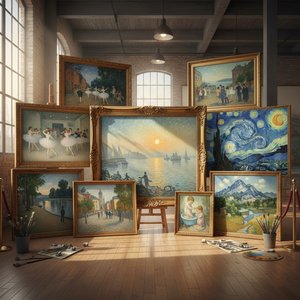
Was Turner an Impressionist?
 J.M.W. Turner
Explore the captivating world of J.M.W. Turner (1775-1851), a pioneer of Romantic painting. Discover his expressive landscapes, turbulent seascapes & influence on Impressionism. View artworks and learn about this British master.
Turner was not an Impressionist, but he is widely regarded as a vital forerunner of the movement. While he worked within the Romantic tradition, his revolutionary focus on light, atmosphere, and the dissolution of form provided the essential groundwork that later allowed Impressionists to prioritize sensory perception over rigid representation.
Born in London in 1775, Turner’s career spanned the height of the Romantic era. He was a master of light, often referred to as "the painter of light" for his ability to capture the ephemeral qualities of sunlight, fog, and storms. His later works moved toward a level of abstraction that anticipated both Impressionism and modern Abstract Art.
His experimentation with medium and technique was constant. In works like Fall of the Rhine, Schaffhausen, he used a palette knife to scrape in water, creating a tactile, visceral energy. This willingness to sacrifice precise detail for the sake of capturing a fleeting sensation is what connects his vision to the later French masters.
What art movement did J.M.W. Turner belong to?
J.M.W. Turner was a preeminent master of the English Romantic movement. His work focused on the sublime power of nature, using dramatic landscapes, turbulent seas, and expressive light to reflect the emotional state of humanity, often emphasizing the overwhelming and awe-inspiring scale of the natural world.
Turner’s Romanticism was defined by several key characteristics:
- The Sublime: A focus on the terrifying and magnificent power of nature, such as storms and shipwrecks.
- Atmospheric Perspective: Using color and light to create depth, where distant objects appear paler and less detailed.
- Emotional Subjectivity: Prioritizing the mood and sensation of a scene over topographical accuracy.
His prolific output included approximately 550 oil paintings and over 2,000 watercolours. Many of these works, such as Shipwreck (1805), demonstrate the Romantic obsession with the struggle between man and the elements. He bequeathed a massive collection to the nation, including 300 paintings and 20,000 drawings, much of which is now held by the Tate Britain and the National Gallery in London.
How did Turner's style influence the Impressionist movement?
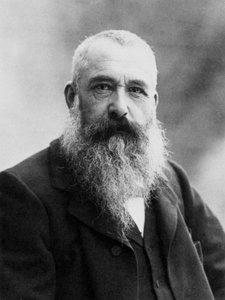 Claude Monet
Claude Monet was an Impressionist master known for his Water Lilies series. Discover the beauty of his light-filled landscapes today.
Turner influenced the Impressionist movement by placing color and light at the center of artistic research. His emphasis on capturing atmospheric effects and his use of loose, expressive brushwork provided a direct blueprint for artists like Claude Monet and Camille Pissarro to explore subjective perception and light.
The connection between Turner and the Impressionists is found in the treatment of the "impression" itself. Rather than focusing on the hard outlines of objects, Turner focused on how light interacts with the environment. This is evident in his ability to render the shimmering effects of sunlight on water or the hazy atmosphere of a harbor.
His influence can be seen in several technical areas:
- Color as Mood: Using bold, non-literal color to evoke emotion rather than just mimicking reality.
- Dissolution of Form: Allowing shapes to blur into light and atmosphere, a technique seen in his later, more abstract landscapes.
- En Plein Air Roots: His habit of using extensive sketches from his travels across Europe in notebooks to capture immediate natural phenomena.
What are the key stylistic differences between Romanticism and Impressionism?
 J.M.W. Turner
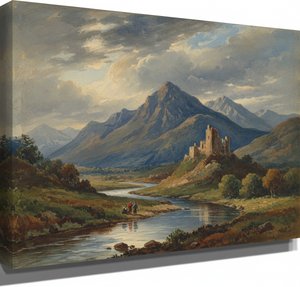
A leading figure of the Romantic movement, J.M.W. Turner captivated audiences with his atmospheric landscapes and seascapes like 'The Fighting Temeraire' and pioneered expressive painting techniques – discover the beauty and drama within his timeless...
The primary difference lies in intent: Romanticism seeks to evoke the sublime and intense emotion through dramatic, often turbulent subjects, while Impressionism seeks to capture the objective, fleeting visual reality of a moment through the scientific observation of light and color in everyday life.
While Turner’s Romanticism and the Impressionist style share a fascination with light, their execution differs significantly:
- Subject Matter: Romanticism often deals with dramatic, mythic, or monumental natural events (e.g., Undine Giving the Ring to Massaniello, Fisherman of Naples). Impressionism focuses on the mundane, the contemporary, and the casual.
- Emotional Tone: Romanticism is often high-drama and visceral, aiming for awe or terror. Impressionism is typically more observational and concerned with the optical sensation of a specific time of day.
- Brushwork: Romanticism can use heavy impasto and swirling, energetic strokes to convey movement, whereas Impressionism utilizes shorter, broken brushstrokes to capture the vibration of light.
Turner’s work remains a bridge between these worlds, using the dramatic tools of the Romantic era to explore the very atmospheric truths that the Impressionists would later formalize.
Frequently asked questions
Where was Turner born?
Turner was born in Covent Garden, London, on 23 April 1775.
How many paintings did Turner produce?
He produced approximately 550 oil paintings and over 2,000 watercolours.
Where is A Single Figure located?
A Single Figure is located in Tate Britain, London.
When was Fishermen at Sea painted?
Fishermen at Sea was painted in 1796.
Learn more
- 1775 – 1851J.M.W. Turner Artist PageExplore the luminous legacy of a master who paved the way for the Impressionist movement.
- J.M.W. Turner BiographyDelve into the life and profound achievements of this Romantic era visionary.
- All J.M.W. Turner ArtworksDiscover our exquisite collection of Turner's masterpieces, available as hand-painted oils or archival prints.