Defining the Abstract: Moving Beyond the Visible World
To understand abstraction, one must first understand what it is not. It is not a failed attempt at realism, nor is it a lack of skill. Instead, abstraction is a deliberate choice to move away from the literal depiction of objects. When an artist stops trying to paint a tree as a trunk and leaves, and instead focuses on the way the light hits a leaf or the curve of a branch, they are entering the realm of the abstract. This process involves stripping away the recognizable details of the physical world to focus on the fundamental elements of visual language: line, shape, and color.
This shift in focus mirrors the historical transition seen in the 19th century, as technology and science began to change how humans perceived reality. Just as early photographers began to handle the task of literal documentation, painters felt a new freedom to explore a continuum of abstraction. They moved from slight alterations of color to total abstraction, where a shape derives its meaning entirely from its own presence rather than from a reference in nature.
In this space, a shape is no longer a "thing" you can name, such as a chair or a flower. It becomes a tool for expressing movement or feeling. By removing the distraction of recognizable subject matter, the viewer is invited to engage with the work on a more direct, sensory level.
Expressionism: Translating Emotion into Color and Form
 Colorful Flowers (aka Abstract Forms)
, Franz Marc
Expressionism emerged as a way to prioritize inner emotional realities over the objective depiction of the external world. Rather than painting a landscape as it appeared to the eye, Expressionists sought to paint how that landscape felt to the soul. This often meant using non-naturalistic colors and distorted forms to convey psychological states like anxiety, joy, or spiritual fervor. The goal was to make the invisible—human emotion—visible on the canvas.
We see an early echo of this in the works of Franz Marc. His approach, particularly in pieces like Colorful Flowers (aka Abstract Forms), moved toward the realm of pure feeling. While his work often retained a connection to nature, such as floral or animal imagery, he used geometric forms and symbolic color to reach a deeper emotional truth. He was not interested in the botanical accuracy of a flower, but in the essence of its life force.
This movement laid the groundwork for everything that followed. By proving that color could carry its own emotional weight, independent of the object it colored, Expressionism opened the door for artists to abandon the subject matter entirely.
Geometric vs. Organic: The Early Language of Abstraction
 Abstract forms
, August Macke
As artists moved further from representation, they began to organize their compositions using two primary types of shapes: geometric and organic. Geometric abstraction relies on the precision of circles, squares, and triangles, often creating a sense of order, stability, and mathematical logic. Organic abstraction, conversely, uses fluid, wavy, or irregular lines that mimic the curves found in nature, even if they do not depict a specific natural object.
August Macke’s 1913 work, Abstract Forms, provides a clear example of this tension. Held in the Kunstmuseum, Bonn, this piece utilizes both geometric and organic shapes, employing bold strokes of red, blue, and yellow. It demonstrates how an artist can use non-representational, dynamic shapes to create a sense of rhythm without needing to draw a recognizable figure.
This duality is a recurring theme in modernism. Whether an artist chooses the rigid structure of a square or the soft, blurred lines of a fluid shape, they are using these forms to dictate how the viewer experiences the energy of the painting. It is a choice between the structured and the spontaneous.
The Post-War Shift: The Rise of Abstract Expressionism
Following the devastation of the Second World War, the center of the art world shifted from Paris to New York City. This era saw the birth of Abstract Expressionism, a movement that became the dominant trend in Western painting during the 1950s. These artists were often influenced by the arrival of Surrealists fleeing Europe, who brought with them a fascination with the subconscious and the act of spontaneous creation.
The movement was not a single style, but a collection of diverse approaches. Some artists focused on the physical act of painting, while others focused on the meditative power of color. Despite these differences, they were united by a shared belief: the canvas was an arena in which to act, and the painting was a record of that action or a vessel for existential contemplation.
This period marked a definitive break from the past. The focus was no longer on the "what" of the painting, but on the "how" and the "why." The artist's presence was felt in every mark, making the work a direct extension of their psyche.
Action Painting: The Raw Energy of the Spontaneous Gesture
 Jackson Pollock
. A sudden, violent end in East Hampton, New York, on August 11, 1956: notice the rhythmic, all-over compositions of his drip paintings.
One of the most recognizable branches of Abstract Expressionism is Action Painting. This style is characterized by a loose, rapid, and often forceful handling of paint. Instead of carefully controlled brushstrokes, Action painters used sweeping, slashing movements. Some, like Jackson Pollock, practiced a technique of dripping or spilling commercial paint directly onto a raw, unprimed canvas. This created complex, tangled skeins of paint that formed suggestive linear patterns, where chance played a significant role in the final composition.
This intensity is also seen in the work of Willem de Kooning, who used extremely vigorous brushstrokes to build up richly colored and textured images. Even Franz Kline, known for his powerful, sweeping black strokes on white canvases, utilized a sense of monumental force that felt immediate and unmediated.
In Action Painting, the process is as important as the result. The painting becomes a map of the artist's physical movement through space, capturing a moment of high-energy creation that can never be exactly repeated.
Color Field Painting: The Quiet Power of Large-Scale Pigment
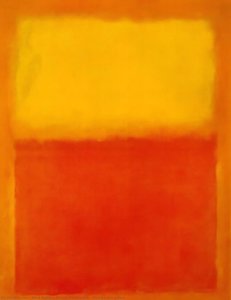 Orange and yellow
, Mark Rothko
While Action Painting was loud and energetic, another side of Abstract Expressionism sought a more meditative, quiet experience through Color Field painting. These artists moved away from the frantic gesture and instead focused on large areas of a single color or subtle gradations of hue. The goal was to create a sense of vastness and to envelop the viewer in a purely visual, emotional atmosphere.
Mark Rothko is perhaps the most significant figure in this vein. His work, such as Orange and Yellow (1956), uses layered, rectangular forms of color that seem to hover on the canvas. This technique creates a sense of depth and luminosity, inviting the viewer into a state of existential contemplation. Similarly, artists like Helen Frankenthaler and Philip Guston produced more lyrical, delicate imagery with fluid shapes, offering a softer alternative to the aggression of Action Painting.
Color Field painting proves that abstraction does not always need to be loud to be powerful. Sometimes, the most profound impact comes from the stillness of a color held in perfect balance.
Interpreting the Unseen: How to Read Abstract Art Today
 Composition
, Arshile Gorky
When standing before an abstract work, the question "What is it?" can often lead to frustration. To truly understand abstraction, it is more helpful to ask, "How does this make me feel?" or "How does the artist move my eye across the surface?" Understanding the relationship between color, form, and texture allows you to participate in the visual language the artist has constructed.
Whether you are drawn to the organic, biomorphic shapes of Arshile Gorky or the structured, calligraphic lines of Robert Motherwell, you are engaging with a history of human expression that seeks to touch the intangible. Abstraction is a tool for exploring the parts of the human experience that words often fail to capture.
For those who wish to bring these powerful visual experiences into their own homes, we offer a range of high-quality options. From 100% hand-painted oil reproductions on 320 gsm linen canvas to archival Giclée prints, our collection allows you to own a piece of this profound history. If you require a specific size or wish to customize a piece—such as changing the color palette or extending the edges of a composition—our artists and Project Coordinators are here to assist you. You can explore our full collection and find the work that resonates with your own inner landscape at OriginalUniqueArt.com.