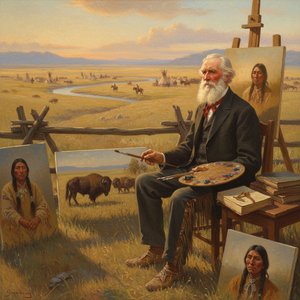
Early Life & Academic Foundations: A European Training
 Wikipedia: E. Irving Couse
Eanger Irving Couse (September 3, 1866 – April 26, 1936) was an American artist and a founding member and first president of the Taos Society of Artists. Born and reared in Saginaw, Michigan, he went to New York City and Paris to study art. While spe...
Eanger Irving Couse, born in Saginaw, Michigan, in 1866, embarked on a journey that would indelibly shape the landscape of American art. While his early life was rooted in the Midwest, it was his pursuit of formal training—first at the Art Institute of Chicago and then, crucially, in Paris—that laid the foundation for his distinctive style and ultimately, his profound connection to the American Southwest. The decade Couse spent immersed in the European artistic milieu proved transformative. He studied at the prestigious École des Beaux-Arts and Académie Julian, absorbing the techniques and traditions of academic painting under masters like William-Adolphe Bouguereau. This rigorous training instilled in him a mastery of form, anatomy, and composition—skills that would later serve as a powerful counterpoint to the more spontaneous brushwork he adopted during his time in New Mexico.
However, Couse’s Parisian experience wasn't merely about technical proficiency; it was also a period of artistic awakening. He painted scenes of Normandy’s coastline, honing his observational skills and developing an appreciation for light and atmosphere. Yet, even amidst the beauty of France, a yearning for something more—a distinctly American subject matter—began to take root. This nascent desire would ultimately lead him westward, towards a landscape and culture that resonated deeply with his artistic sensibilities.
The Allure of New Mexico: Embracing Native American Culture
 The Chief
Experience Eanger Irving Couse's 'The Chief,' a captivating portrait of Native American leadership and spirituality. A hand-painted reproduction of this iconic Taos Society of Artists masterpiece.
The turn of the 20th century witnessed an increasing fascination with the American West—a region perceived as untamed, authentic, and brimming with cultural richness. Artists and writers flocked to places like New Mexico, seeking to capture a vanishing way of life before it succumbed to the forces of modernization. Couse was among them, drawn by the allure of the Taos Pueblo and the surrounding landscapes. Unlike many of his contemporaries who approached Native American culture from a distance, often romanticizing or exoticizing their subjects, Couse sought genuine connection and understanding.
His summers in New Mexico were dedicated to observing and documenting the lives of the Taos Indians with respect and sensitivity. He wasn’t interested in portraying grand historical narratives but rather in capturing quiet moments of everyday existence—the pottery maker at work, children playing, or a chief lost in contemplation. This focus on dignity and authenticity set his work apart, earning him both critical acclaim and a loyal following. Paintings like “The Chief”, with its arresting portraiture, exemplify this approach, conveying not just the physical likeness of the subject but also a sense of inner strength and spiritual depth.
Founding the Taos Society of Artists: A Collaborative Vision
The Taos Society of Artists was an organization of visual arts founded in Taos, New Mexico. Established in 1915, it was disbanded in 1927. The Society was essentially a commercial cooperative, as opposed to a stylistic collective, and its foundation ...
Couse’s commitment to New Mexico extended beyond his personal artistic pursuits. In 1915, he played a pivotal role in establishing the Taos Society of Artists, alongside five other pioneering painters—Joseph H. Sharp, Ernest Blumenschein, Bert G. Phillips, Oscar E. Berninghaus, and W. Herbert Dunton. This wasn’t simply an artistic collective; it was a commercial cooperative designed to promote the work of artists working in Taos and establish the region as a significant art center.
As the Society's first president, Couse provided leadership and vision, fostering a collaborative environment where artists could share ideas, exhibit their work, and build relationships with collectors. The Taos Society quickly gained national recognition, attracting attention from major galleries and museums. This success not only benefited its members but also helped to elevate the profile of Southwestern art as a whole. It was a testament to Couse’s belief in the power of collective action and his dedication to nurturing a thriving artistic community.
Couse’s Artistic Style: Impressionism and Beyond
American Impressionism was a style of painting related to European Impressionism and practiced by American artists in the United States from the mid-nineteenth century through the beginning of the twentieth. The style is characterized by loose brushw...
While deeply rooted in academic training, Couse's style evolved significantly during his time in New Mexico. He embraced elements of Impressionism, employing loose brushwork and vivid colors to capture the nuances of light and atmosphere. However, he never fully abandoned the meticulous detail that characterized his earlier work. Instead, he synthesized these seemingly disparate approaches, creating a unique aesthetic that blended realism with expressive freedom.
Paintings like “Nature And Soil” demonstrate this masterful balance—the landscape is rendered with a sense of immediacy and vibrancy, yet the forms remain clearly defined and grounded in reality. His palette favored warm, earthy tones that reflected the colors of the Southwestern desert, creating a harmonious and evocative atmosphere. Couse’s ability to capture both the physical beauty of the landscape and the spiritual essence of its inhabitants solidified his reputation as one of America's most important artists.
Legacy and Preservation: The Couse/Sharp Historic Site
Eanger Irving Couse’s impact on American art extends far beyond his paintings. His dedication to preserving the cultural heritage of New Mexico is evident in the enduring legacy of the Couse/Sharp Historic Site. This complex, comprising both Couse's house and studio and Joseph H. Sharp’s adjacent property, has been meticulously preserved as a testament to their lives and work.
Today, visitors can explore these historic buildings, gaining insights into the artistic process and the unique environment that inspired Couse and his contemporaries. The site serves as a powerful reminder of the importance of cultural preservation and the enduring power of art to connect us to the past. Through exhibitions, educational programs, and ongoing research, the Couse/Sharp Historic Site ensures that Couse’s legacy—as an artist, a collaborator, and a champion of Native American culture—will continue to inspire generations to come.
Discover the timeless beauty and profound artistry of Eanger Irving Couse with OriginalUniqueArt.com, where museum-quality reproductions bring his masterpieces into your home.