Portrait of N.C. Wyeth

The 100 Most Famous N.C. Wyeth Paintings, Each One of a Kind

Updated Oktober 2026 · ranked by our popularity score (searches, visits and orders for each work) · 280 works by N.C. Wyeth in our catalogue

In short

Der Riese is the N.C. Wyeth painting that draws the most eyes. After it, the eye goes to Der Gouverneur, erzürnt über den Angriff auf ihn, donnerte: Bleibt stehen, wo ihr seid, oder, bei meinem Eid, meine Männer werden euch niedermähen (1929) and heidi (1940). Among the 280 works of N.C. Wyeth in our catalog, these 100 are the most famous, each a unique original presented with its year, its museum and the reason it endures.

1882 – 1945, Needham Regionalism Most works: Brandywine Museum of Art

Top 10 paintings by N.C. Wyeth, through the gallery's eye

1
Der Riese by N.C. Wyeth

Der Riese

Ölfarbe

Das Gemälde Der Riese ist ein Meisterwerk des renommierten amerikanischen Künstlers N.C. Wyeth. Geboren im Jahr 1882, war N.C. Wyeth ein Illustrator und Maler, der durch seine Werke, die Szenen aus der klassischen Literatur und historische Ereignisse darstellen, weltweite Berühmtheit erlangte. Sein Stil zeichnet sich durch lebendige Farben, dramatische Lichtführung und eine ausgeprägte narrative Qualität aus. Der Hintergrund des Künstlers N.C. Wyeth war eine prägende Gestalt der amerikanischen Kunstszene zu…

2
Der Gouverneur, erzürnt über den Angriff auf ihn, donnerte: Bleibt stehen, wo ihr seid, oder, bei meinem Eid, meine Männer werden euch niedermähen (1929) by N.C. Wyeth

Der Gouverneur, erzürnt über den Angriff auf ihn, donnerte: Bleibt stehen, wo ihr seid, oder, bei meinem Eid, meine Männer werden euch niedermähen

1929 · Öl auf Leinwand

Die Luft im Raum wirkt schwer, erfüllt vom Duft alten Holzes und dem metallischen Beigeschmack gezogener Klingen. Ein langer Esstisch erstreckt sich durch die Mitte des Raumes, eine hölzerne Bühne für einen plötzlichen Ausbruch der Wut. Gestalten drängen sich in den Raum, ihre Körper neigen sich einem Sturm aus Worten und Gesten entgegen. Lange, tiefe Schatten ziehen sich über die Steinwände, geworfen vom flackernden Licht der Kronleuchter über den Köpfen.…

4
Wir müssen in den Verliesen sein, bemerkte Dick (1916) by N.C. Wyeth

Wir müssen in den Verliesen sein, bemerkte Dick

1916 · Öl auf Leinwand

"Wir müssen in den Verliesen sein, bemerkte Dick" ist ein im Jahr 1916 geschaffenes Ölgemälde auf Leinwand von N.C. Wyeth. Dieses Werk dient als narrative Illustration für den Roman The Black Arrow: A Tale of the Two Roses. Die Komposition fängt einen Moment höchster Spannung ein, während Dick Shelton über eine steile Steintreppe in ein Verlies hinabsteigt.

5
In der Rats-Hütte (1919) by N.C. Wyeth

In der Rats-Hütte

1919 · Ölfarbe

Die Szene entfaltet sich in den stillen, schattigen Räumen eines Versammlungsortes im Jahr 1919. In diesem Werk mit dem Titel In der Rats-Hütte fängt N.C. Wyeth einen Moment von tiefer Stille und gemeinschaftlicher Bestimmung ein. Die Luft scheint das Gewicht ungesprochener Worte in sich zu tragen, während Native American Männer die Hütte besetzen und ihre Präsenz den Raum mit einem Gefühl von Ernsthaftigkeit und Tradition erfüllen.

N.C. Wyeth's famous paintings, numbers 11 to 100

11Mending Traps, Martinsville, Maine (1934) by N.C. WyethMending Traps, Martinsville, Maine1934 12Thanksgiving with Indians (1940) by N.C. WyethThanksgiving with Indians1940 · Brandywine Museum of Art 13I had met my equal by N.C. WyethI had met my equal 14Beginning of the American Union Washington Salutes the Flag as He Takes Command of the Continental Army at Cambridge, 1775 by N.C. WyethBeginning of the American Union Washington Salutes the Flag as He Takes Command of the Continental Army at Cambridge, 1775 15The Great Blue Heron by N.C. WyethThe Great Blue Heron 16The Dance Of The Whooping Cranes by N.C. WyethThe Dance Of The Whooping Cranes 17Come, Live With Us, For I Think Thou Art Chosen by N.C. WyethCome, Live With Us, For I Think Thou Art Chosen 18Moving Camp (1908) by N.C. WyethMoving Camp1908 · Museum of Fine Arts 19"The eight miners followed the treacherous trail cautiously, the wind whipping the red and blue into their faces." (1906) by N.C. Wyeth"The eight miners followed the treacherous trail cautiously, the wind whipping the red and blue into their faces."1906 · Brandywine Museum of Art 20And Sarched For 'em Far And Near by N.C. WyethAnd Sarched For 'em Far And Near 21Attack On The Stockade by N.C. WyethAttack On The Stockade 22Think What Might Happen If It Was Not Protected By Those Hills by N.C. WyethThink What Might Happen If It Was Not Protected By Those Hills 23Illustration For Drums by N.C. WyethIllustration For Drums 24untitled (4813) by N.C. Wyethuntitled (4813) 25untitled (996) by N.C. Wyethuntitled (996) 26untitled (6365) by N.C. Wyethuntitled (6365) 27untitled (8618) by N.C. Wyethuntitled (8618) 28untitled (7516) by N.C. Wyethuntitled (7516) 29untitled (1699) by N.C. Wyethuntitled (1699) 30untitled (4393) by N.C. Wyethuntitled (4393) 31untitled (6855) by N.C. Wyethuntitled (6855) 32The Duck Hunt by N.C. WyethThe Duck Hunt 33Gavotte by N.C. WyethGavotte 34untitled (3048) by N.C. Wyethuntitled (3048) 35untitled (2963) by N.C. Wyethuntitled (2963) 36Rubber From The Jungle To The World by N.C. WyethRubber From The Jungle To The World 37The Youth. Master by N.C. WyethThe Youth. Master 38The Frontiersman by N.C. WyethThe Frontiersman 39The Husking Bee by N.C. WyethThe Husking Bee 40At First, For Some Time, I Was Not Able To Answer Him One Word by N.C. WyethAt First, For Some Time, I Was Not Able To Answer Him One Word 41And Thus I Every Now And Then Took A Little Voyage Upon The Sea by N.C. WyethAnd Thus I Every Now And Then Took A Little Voyage Upon The Sea 42I Thank Him For The Knowledge That- I Shall Not Tell by N.C. WyethI Thank Him For The Knowledge That- I Shall Not Tell 430 by N.C. Wyeth0 44sir launcelot by N.C. Wyethsir launcelot 45untitled (2201) by N.C. Wyethuntitled (2201) 46Ringing Out Liberty by N.C. WyethRinging Out Liberty 47untitled (9924) by N.C. Wyethuntitled (9924) 48Carvers Of The Sphinx by N.C. WyethCarvers Of The Sphinx 49untitled (2876) by N.C. Wyethuntitled (2876) 50And Then He Kneeled Down Again, Kissed The Ground, And Taking Me By The Foot, Set My Foot Upon His Head by N.C. WyethAnd Then He Kneeled Down Again, Kissed The Ground, And Taking Me By The Foot, Set My Foot Upon His Head 51One January Afternoon by N.C. WyethOne January Afternoon 52It Was Such A Warm Little House, There,' Said She, Huskily by N.C. WyethIt Was Such A Warm Little House, There,' Said She, Huskily 53The Moose Hunters by N.C. WyethThe Moose Hunters 54The Cowboy's Life by N.C. WyethThe Cowboy's Life 55Adventurers by N.C. WyethAdventurers 56Dawn Of The Open Season by N.C. WyethDawn Of The Open Season 57I Reaped It My Way, For I Cut Nothing Off But The Ears, And Carried It Away In A Great Basket Which I Had Made by N.C. WyethI Reaped It My Way, For I Cut Nothing Off But The Ears, And Carried It Away In A Great Basket Which I Had Made 58We're On Our Way by N.C. WyethWe're On Our Way 59Sure, It's Professor Grid To The Life! by N.C. WyethSure, It's Professor Grid To The Life! 60the white company by N.C. Wyeththe white company 61Odysseus And Calypso by N.C. WyethOdysseus And Calypso 62Sweet Land Of Liberty by N.C. WyethSweet Land Of Liberty 63They Took Their Wives With Them On Their Cruises by N.C. WyethThey Took Their Wives With Them On Their Cruises 64The Story Of Salt by N.C. WyethThe Story Of Salt 65Louise Loved To Climb To The Summit On One Of The Barren Hills Flanking The River, And Stand There While The Wind Blew by N.C. WyethLouise Loved To Climb To The Summit On One Of The Barren Hills Flanking The River, And Stand There While The Wind Blew 66Gathering Maple Sap by N.C. WyethGathering Maple Sap 67Pioneers - The Opening Of The Prairies by N.C. WyethPioneers - The Opening Of The Prairies 68Lumber by N.C. WyethLumber 69The Man of Wales by N.C. WyethThe Man of Wales 70Captain Smollet Defies the Mutineers (1911) by N.C. WyethCaptain Smollet Defies the Mutineers1911 71two knights dueling (1917) by N.C. Wyethtwo knights dueling1917 72The Boy Columbus on the Wharf at Genoa (The Vision of Columbus) (1917) by N.C. WyethThe Boy Columbus on the Wharf at Genoa (The Vision of Columbus)1917 73The Deacon and Parson Skeeters In the tail of a game of Draw (Draw Poker The Poker Players) (1912) by N.C. WyethThe Deacon and Parson Skeeters In the tail of a game of Draw (Draw Poker The Poker Players)1912 74pyles barn (1921) by N.C. Wyethpyles barn1921 75Elizabeth and Essex, untitled headpiece illustration (1928) by N.C. WyethElizabeth and Essex, untitled headpiece illustration1928 · Brandywine Museum of Art 76untitled (6592) by N.C. Wyethuntitled (6592) 77The Savage Gave the Yell (1927) by N.C. WyethThe Savage Gave the Yell1927 78The Hurricane (1935) by N.C. WyethThe Hurricane1935 79River of Sleep (1937) by N.C. WyethRiver of Sleep1937 80Ramona (Ramona and Alessandro on the narrow trail) (1939) by N.C. WyethRamona (Ramona and Alessandro on the narrow trail)1939 81The Lobsterman (The Doryman) (1944) by N.C. WyethThe Lobsterman (The Doryman)1944 · Metropolitan Museum of Art 82Buttonwood Farm (1920) by N.C. WyethButtonwood Farm1920 · Reading Public Museum 83Schwarzfichten-Gelände by N.C. WyethSchwarzfichten-Gelände 84Indian Love Call by N.C. WyethIndian Love Call 85Lebensmaske von John Keats by N.C. WyethLebensmaske von John Keats 86Smokey Face by N.C. WyethSmokey FaceBrigham Young University Museum of Art 87untitled (4675) by N.C. Wyethuntitled (4675) 88untitled (2617) by N.C. Wyethuntitled (2617) 89untitled (1164) by N.C. Wyethuntitled (1164) 90untitled (6464) by N.C. Wyethuntitled (6464) 91untitled (4059) by N.C. Wyethuntitled (4059) 92untitled (1855) by N.C. Wyethuntitled (1855) 93untitled (1734) by N.C. Wyethuntitled (1734) 94The Moose Call by N.C. WyethThe Moose Call 95untitled (5364) by N.C. Wyethuntitled (5364) 96untitled (8870) by N.C. Wyethuntitled (8870) 97untitled (3858) by N.C. Wyethuntitled (3858) 98untitled (6808) by N.C. Wyethuntitled (6808) 99untitled (894) by N.C. Wyethuntitled (894) 100untitled (8195) by N.C. Wyethuntitled (8195)

N.C. Wyeth's famous paintings, period by period

The subjects that held N.C. Wyeth's eye

The four subjects that come back most often in these originals, each with its finest example.

The museums that keep N.C. Wyeth's originals

The 6 museums that hold the most of the paintings on this page.

Museum City Works by N.C. Wyeth Paintings from this list
Brandywine Museum of Art, Delaware CountyBrandywine Museum of Art Delaware County 3 Thanksgiving with Indians, "The eight miners followed the treacherous trail cautiously, the wind whipping the red and blue into their faces.", Elizabeth and Essex, untitled headpiece illustration
Museum of Fine Arts, HoustonMuseum of Fine Arts Houston 2 Sheep Herder, Moving Camp
Delaware Art MuseumDelaware Art Museum 1 Stand away from that girl!
Metropolitan Museum of Art, New YorkMetropolitan Museum of Art New York 1 The Lobsterman (The Doryman)
Reading Public Museum, ReadingReading Public Museum Reading 1 Buttonwood Farm
Brigham Young University Museum of Art, ProvoBrigham Young University Museum of Art Provo 1 Smokey Face

N.C. Wyeth across the decades: one unique original for each

Works per decade

Pick a decade to see the original that defines it.

N.C. Wyeth's paintings: questions for the gallery

What is the single most famous work of N.C. Wyeth?Reveal the answer

Der Riese. Der Gouverneur, erzürnt über den Angriff auf ihn, donnerte: Bleibt stehen, wo ihr seid, oder, bei meinem Eid, meine Männer werden euch niedermähen (1929) and heidi (1940) come next.

Which ten paintings by N.C. Wyeth are the most famous?Reveal the answer

Der Riese, Der Gouverneur, erzürnt über den Angriff auf ihn, donnerte: Bleibt stehen, wo ihr seid, oder, bei meinem Eid, meine Männer werden euch niedermähen, heidi, Wir müssen in den Verliesen sein, bemerkte Dick, In der Rats-Hütte, The Cowboy's Life, Roping Horses in the Corral, Sheep Herder, Stand away from that girl! and Ayrton's Fight With The Pirates. The ranking above gives each one's year and museum.

How many works by N.C. Wyeth are known?Reveal the answer

Our catalog holds 280 works by N.C. Wyeth, dated from 1904 to 1944.

Where can the most famous N.C. Wyeth originals be seen?Reveal the answer

Mostly in Brandywine Museum of Art (Delaware County), Museum of Fine Arts (Houston) and Delaware Art Museum. The museum table above lists them all.

During which period did N.C. Wyeth create the best-known paintings?Reveal the answer

In 1910s: 8 of the 100 works on this page were made then, Wir müssen in den Verliesen sein, bemerkte Dick among them.

Which famous N.C. Wyeth painting is the earliest, and which the latest?Reveal the answer

On this page, the earliest is Roping Horses in the Corral (1904) and the latest The Lobsterman (The Doryman) (1944).

What subjects did N.C. Wyeth favour?Reveal the answer

American west (5), American art (5) and Landscape (5), across the 100 works on this page.

What materials did N.C. Wyeth paint with most?Reveal the answer

Öl auf Leinwand, for 3 of the 100 works on this page.

Which movement does the work of N.C. Wyeth belong to?Reveal the answer

Regionalism and Contemporary realism, judging by the originals on this page.

What N.C. Wyeth originals can I see at the Brandywine Museum of Art?Reveal the answer

Thanksgiving with Indians, "The eight miners followed the treacherous trail cautiously, the wind whipping the red and blue into their faces." and Elizabeth and Essex, untitled headpiece illustration: the Brandywine Museum of Art, Delaware County holds 3 of the works on this page.

Where can I order a hand-painted N.C. Wyeth reproduction?Reveal the answer

Yes, as a reproduction: the original stays in its museum, but any painting on this page can be painted by hand for you, made to order one at a time, from the painting's own page.

N.C. Wyeth: a portrait of the artist

Newell Convers Wyeth: Ein amerikanischer Illustratormeister und sein Erbe

Newell Convers Wyeth, besser bekannt als N.C. Wyeth, war eine Schlüsselfigur der amerikanischen Illustration des frühen 20. Jahrhunderts – ein Künstler, dessen Werke die Vorstellungskraft ganzer Generationen beflügelten und dessen Einfluss bis heute spürbar ist. Geboren am 22. Oktober 1882 in Needham, Massachusetts, wuchs Wyeth inmitten einer Familie auf, die seine künstlerischen Ambitionen förderte. Seine Kindheit verbrachte er oft im Freien, eine Erfahrung, die sich tiefgreifend in seinen späteren Werken widerspiegeln sollte, insbesondere in der detailreichen Darstellung ländlicher Szenen und der amerikanischen Landschaft. Schon früh zeigte Wyeth außergewöhnliches Talent, das ihn schließlich zur Massachusetts Normal Art School führte, wo er sein Handwerk verfeinerte und von Künstlern wie Richard Andrew lernte. Seine Ausbildung wurde durch ein Studium bei Howard Pyle an der Wilmington Art School in Delaware weiterentwickelt – eine entscheidende Phase, die seine Entwicklung als Illustrator maßgeblich prägte.

Der Aufstieg zum Illustratorenstar: Scribner's Classics und mehr

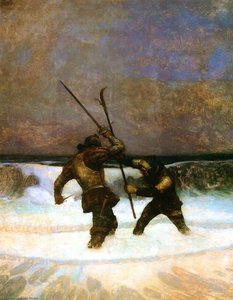
Wyeths Durchbruch kam mit seinen Illustrationen für Charles Scribners Sons, insbesondere seiner bahnbrechenden Arbeit an Robert Louis Stevensons "Die Schatzinsel" im Jahr 1911. Diese Serie von 17 Gemälden gilt weithin als Höhepunkt der amerikanischen Buchillustration und etablierte Wyeth sofort als eine führende Figur in seinem Fachgebiet. Seine Fähigkeit, Geschichten visuell zum Leben zu erwecken, war außergewöhnlich; er verstand es meisterhaft, die Atmosphäre, die Charaktere und die Spannung der literarischen Vorlagen einzufangen. Es folgten zahlreiche weitere Aufträge für Scribner's Classics, darunter Illustrationen für "Kidnapped", "The Black Arrow" und "The Boy’s King Arthur". Doch Wyeth beschränkte sich nicht nur auf klassische Literatur; er illustrierte auch Werke wie Robin Hood, Robinson Crusoe und Rip Van Winkle, wodurch sein Name in der amerikanischen Populärkultur fest verankert wurde. Seine Illustrationen für The Saturday Evening Post machten ihn einem breiten Publikum bekannt und trugen maßgeblich zu seinem Ruhm bei.

Ein vielseitiger Künstler: Wandmalerei, Porträts und Landschaftsdarstellungen

Obwohl Wyeth vor allem als Illustrator gefeiert wurde, war er auch ein talentierter Maler, der sich in verschiedenen Genres auszeichnete. Er schuf beeindruckende Wandmalereien für Hotels, Banken und Regierungsgebäude, darunter Arbeiten im Missouri State Capitol und der Federal Reserve Bank in Boston. Diese Aufträge zeigten seine Fähigkeit, großformatige Werke zu schaffen, die sowohl dekorativ als auch künstlerisch ansprechend waren. Darüber hinaus widmete sich Wyeth der Porträtmalerei und schuf eindrucksvolle Darstellungen von Persönlichkeiten seiner Zeit. Seine Landschaftsdarstellungen, oft geprägt von einer realistischen Darstellung der amerikanischen Natur, zeigten seine tiefe Verbundenheit mit seiner Heimat. Es ist wichtig zu betonen, dass Wyeths künstlerische Entwicklung nicht immer linear verlief; er kämpfte darum, als freier Maler Anerkennung zu finden, während seine Illustrationen ihn gleichzeitig berühmt machten.

Das Erbe und die Familie: Einfluss auf Andrew und Jamie Wyeth

N.C. Wyeth starb am 19. Oktober 1945 bei einem tragischen Autounfall in Chadds Ford, Pennsylvania. Sein Tod hinterließ eine Lücke in der amerikanischen Kunstwelt, doch sein Vermächtnis lebt fort – nicht zuletzt durch seine Söhne Andrew und Jamie Wyeth, die beide zu bedeutenden Künstlern wurden. Andrew Wyeths ikonische Gemälde wie "Wind from the Sea" und "Christina's World" zeugen von dem Einfluss seines Vaters auf seine künstlerische Entwicklung. Auch Jamie Wyeth setzte die Familientradition fort und etablierte sich als einer der wichtigsten amerikanischen Maler des 20. Jahrhunderts. Die Brandywine Museum of Art in Chadds Ford beherbergt die größte Sammlung seiner Werke und bietet einen umfassenden Einblick in sein Schaffen. N.C. Wyeths Bedeutung liegt nicht nur in seinen eigenen Werken, sondern auch darin, dass er eine künstlerische Dynastie begründete, deren Einfluss bis heute spürbar ist. Seine Fähigkeit, Geschichten zu erzählen und Emotionen durch seine Kunst auszudrücken, macht ihn zu einem der bedeutendsten amerikanischen Illustratoren aller Zeiten.

All 280 works by N.C. Wyeth →