Early Life and Training
Matsutani Shōun (山本昇雲), also known as Yamamoto Mosaburō, was born December 30, 1870, in Gomen-machi (後免町Japanese), Nagaoka District, Kōchi Prefecture (now Nankoku City). He descended from a samurai family with deep roots in the Edo period and possessed an innate fascination for artistic expression. His father operated a business dealing in antiques, fostering an appreciation for craftsmanship and cultural heritage within his upbringing. From childhood, Shōun demonstrated exceptional talent—a gift that would propel him toward a distinguished career as a print designer, painter, and illustrator.
His formal artistic education commenced at the age of six under Yanagimoto Keigo (柳本圭吾Japanese), also known by his art name Doso (洞素Japanese). Yanagimoto was a disciple of Kanō Dōhaku of the Surugadai Kanō family, who had previously served as an official painter for the Yamauchi clan. This early mentorship instilled in Shōun the foundational principles of Kanō-school painting—a style characterized by meticulous brushwork and idealized depictions of nature and Buddhist themes. By the age of nine, he continued his studies with Kawada Shoryū (河田小龍Japanese), a pupil of Kanō Eigaku, further refining his technique and broadening his artistic horizons.
At approximately 16 years old in 1886, Shōun relocated to Osaka, where he honed his skills through independent practice while simultaneously engaging in ceramic painting—a craft that demanded precision and attention to detail. Recognizing the importance of expanding his knowledge beyond traditional methods, he pursued studies at Tokyo Imperial University, delving into Western art history and aesthetics. This exposure broadened his perspective and prepared him for the challenges of navigating a rapidly changing artistic landscape.
At 19, in 1888, Shōun moved to Tokyo—a pivotal moment that would irrevocably alter the trajectory of his life and career. He enrolled at Taki Katei (滝和亭Japanese), a celebrated Nanga painter who championed a fusion of Chinese and Japanese artistic traditions. Under Katei’s guidance, Shōun immersed himself in the contemplative spirit of Nanga—a genre focused on landscape painting and calligraphy—and mastered techniques that emphasized subtlety and emotional resonance. He adopted the art names Shōun and Matsutani—symbols of his dedication to artistic excellence—solidifying his commitment to preserving and innovating upon Japan’s rich artistic heritage.
Career Highlights
Shōun's professional life unfolded during the Meiji, Taishō, and Shōwa eras—a period marked by transformative social and cultural shifts that profoundly influenced Japanese art. His initial foray into illustration began at a young age when he secured employment with Fugoku Gaho (風俗画報Pictorial Magazine of CustomsJapanese)—a groundbreaking publication that aimed to document the evolving traditions and lifestyles of modern Japan. This role provided him with invaluable experience in capturing the dynamism of urban life and conveying complex narratives through visual imagery—skills that would serve as cornerstones of his subsequent artistic endeavors.
His breakthrough came when he joined the staff of Tōyōdō (東陽堂Japanese)—a prominent department store renowned for its exhibitions and collaborations with artists—where he continued to produce stunning prints and paintings until 1912. During this period, Shōun cultivated relationships with fellow luminaries in Japanese art—including Kobayashi Eitaku, Kawasaki Chitora, Ogata Gekkō, Tomioka Eisen, and Kuboyama Hiroshi—inspiring mutual creativity and fostering a shared commitment to artistic innovation.
Shōun’s prolific output spanned across diverse mediums—from woodblock prints to watercolors to calligraphy—demonstrating his versatility as an artist and cementing his reputation as one of Japan's foremost masters of Shin-hanga (新版画New Prints)—a movement that sought to revitalize Ukiyo-e traditions while embracing Western influences. His meticulous attention to detail, combined with a profound understanding of color theory and compositional principles, resulted in artworks that captivated audiences and established Shōun’s enduring legacy as a visionary artist who bridged the gap between Eastern and Western artistic sensibilities.
Notable Works and Contributions
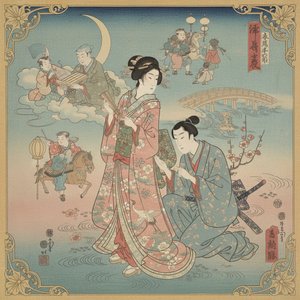
Shōun achieved particular renown for his exquisite woodblock prints—particularly those depicting beautiful women and humorous shikishiban (風景挿絵Picture Albums of LandscapesJapanese)—which captured the essence of Japanese aesthetics with unparalleled grace and precision. These prints showcased Shōun’s mastery of linework, color palettes, and printing techniques—skills honed through years of dedicated practice and informed by a deep appreciation for both Eastern and Western artistic traditions. His prints were celebrated for their lyrical beauty and evocative storytelling—qualities that resonated deeply with collectors and critics alike.
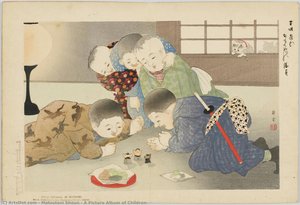
Among his most iconic creations are “Fashions of Today – Ima Sugata” (今姿), a series of prints exploring the changing roles and appearances of women in modern Japan, and “A Picture Album of Children” (子供のアルバム), which presented an idealized vision of childhood innocence—themes that reflected Shōun’s humanist sensibilities and his unwavering belief in the transformative power of art. These works stand as testament to Shōun's ability to convey complex emotions and ideas through subtle visual cues—a hallmark of Shin-hanga artistry that continues to inspire admiration today.
Legacy and Availability of His Works
Matsutani Shōun’s influence extended far beyond his own lifetime, shaping the course of Japanese art history and establishing him as a pivotal figure in the revival of Ukiyo-e traditions. His pioneering approach to Shin-hanga—characterized by its embrace of Western techniques while retaining core aesthetic principles—inspired generations of artists who followed—solidifying Shōun’s place among Japan's most revered masters.
A representative portion of Robert O. Muller’s celebrated collection—which comprised thousands of Shin-hanga prints—was bequeathed to the Smithsonian’s Arthur M. Sackler Gallery in 2003—providing invaluable insight into Shōun’s artistic vision and furthering scholarly understanding of his oeuvre. Furthermore, a selection of Shōun's artworks can be viewed at Shimane Art Museum (島根美術館Japanese)—a hidden gem for art enthusiasts eager to experience the beauty and sophistication of Shin-hanga artistry firsthand.
Shōun died peacefully in Lyon Collection on May 10, 1965—leaving behind a legacy that continues to inspire artists and scholars alike. His enduring influence can be seen in countless reproductions of his prints—which adorn galleries and private collections worldwide—serving as a timeless reminder of Shōun’s artistic genius and his unwavering devotion to preserving Japan's cultural heritage.