Porträt von Konstantin Fjodorowitsch Bogajewski

Die 100 berühmtesten Gemälde von Konstantin Fjodorowitsch Bogajewski, jedes ein Unikat

Aktualisiert im November 2026 · sortiert nach unserem Popularitätsindex (Suchanfragen, Aufrufe und Bestellungen für jedes Werk) · 128 Werke von Konstantin Fjodorowitsch Bogajewski in unserem Katalog

Kurz gesagt

Schiffe (1912) ist das Gemälde von Konstantin Fjodorowitsch Bogajewski, das die meiste Aufmerksamkeit auf sich zieht. Danach wandert der Blick zu Die Ölfelder von Baku (1935) und Star the Wormwood (1908). Von den 128 Werken von Konstantin Fjodorowitsch Bogajewski in unserem Katalog sind diese 100 die bekanntesten – jedes ein einzigartiges Original, präsentiert mit seinem Entstehungsjahr, dem Museum und dem Grund für seine zeitlose Bedeutung.

1872 – 1943, Feodossija Symbolism

Die 10 besten Gemälde von Konstantin Fjodorowitsch Bogajewski, aus der Sicht der Galerie

1
Schiffe (1912) von Konstantin Fjodorowitsch Bogajewski

Schiffe

1912 · Öl auf Leinwand

Die Leinwand, bekannt unter dem Titel Schiffe, oder gelegentlich Schiffe. Abendsonne, präsentiert einen stillen Moment, der in Öl festgehalten wurde. Konstantin Bogaevsky erweckt diese Szene durch das Medium der Ölmalerei auf Leinwand zum Leben – eine Wahl, die es dem Licht ermöglicht, sich tief in die Textur des Werkes einzuschmiegen. Das im Jahr 1912 geschaffene Gemälde fungiert als ein ganz spezifisches Fenster in die Vision des Künstlers von Meer und…

2
Die Ölfelder von Baku (1935) von Konstantin Fjodorowitsch Bogajewski

Die Ölfelder von Baku

1935 · Sanguine

Die Luft wirkt schwer vom Duft der Erde und des Treibstoffs, während sich die Szenerie über die Landschaft von Baku, Aserbaidschan, entfaltet. Hohe, skelettartige Ölbohrbrunnen durchstechen den Himmel, ihre Rohre ragen wie eiserne Finger empor, die nach dem Firmament greifen. Unter diesen Strukturen gleicht der Boden einem Ameisenhaufen menschlicher Betriebsamkeit. Arbeiter bewegen sich durch das Gelände, einige konzentriert an den Förderstellen, andere dem Horizont entgegendriftend, wobei ihre winzigen Gestalten das…

3
Star the Wormwood (1908) von Konstantin Fjodorowitsch Bogajewski

Star the Wormwood

1908 · Charcoal

Konstantin Bogaevsky created Star the Wormwood about 1908. This black and white drawing presents a landscape defined by a mountainous backdrop and a vast, starry night sky. A large, castle-like structure occupies a hillside in the background, acting as a primary focal point. To the left foreground, a smaller building sits amidst the terrain. A single figure is positioned near the center of the composition, providing a sense of scale…

4
The star (1908) von Konstantin Fjodorowitsch Bogajewski

The star

1908 · Print

The star emerges from the darkness of a night sky, a singular point of light that commands the viewer's attention. This work, titled The star, belongs to the hands of Konstantin Bogaevsky, an artist whose vision often drifts between the tangible world and the realms of dreams. He brings this nocturnal scene to life, capturing a moment where the celestial meets the urban landscape.

5
Frontispiece (1912) von Konstantin Fjodorowitsch Bogajewski

Frontispiece

1912 · Etching

In "Frontispiece" by Konstantin Bogaevsky, the eye is drawn upward by a vertical composition that emphasizes a central archway. This structure, a crumbling arched gateway, rises amidst weathered columns that have lost their original precision. These architectural remnants of ancient Roman ruins are being slowly overtaken by the landscape. The scene captures a quiet struggle where stone meets soil.

6
Night (1922) von Konstantin Fjodorowitsch Bogajewski

Night

1922 · Graphite

In this work from about 1922, Konstantin Bogaevsky presents a landscape caught in the quiet transition of twilight. The scene focuses on a mountainous range positioned beneath a setting sun, which casts a final, lingering light over the terrain. Below the jagged peaks, a body of water stretches across the lower portion of the composition, catching the subtle reflections of the sky above. The atmosphere is one of stillness, capturing…

Berühmte Gemälde von Konstantin Fjodorowitsch Bogajewski, Nummer 11 bis 100

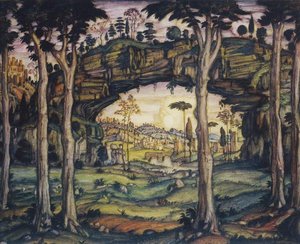
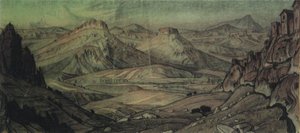
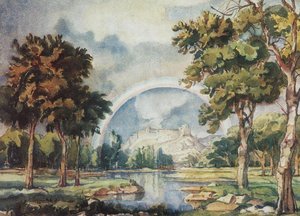
11The Crimean landscape (1898) von Konstantin Fjodorowitsch BogajewskiThe Crimean landscape1898 12Çufut Qale (1902) von Konstantin Fjodorowitsch BogajewskiÇufut Qale1902 13Walls and towers of Soldai (1904) von Konstantin Fjodorowitsch BogajewskiWalls and towers of Soldai1904 14Towers of Feodosiya (1905) von Konstantin Fjodorowitsch BogajewskiTowers of Feodosiya1905 15Gates in the tower (1902) von Konstantin Fjodorowitsch BogajewskiGates in the tower1902 16Desert. Tale. (1903) von Konstantin Fjodorowitsch BogajewskiDesert. Tale.1903 17Ancient fortress (1902) von Konstantin Fjodorowitsch BogajewskiAncient fortress1902 18Consular tower in Sudak (1903) von Konstantin Fjodorowitsch BogajewskiConsular tower in Sudak1903 19Koktebel. House of Maximilian Voloshin. (1905) von Konstantin Fjodorowitsch BogajewskiKoktebel. House of Maximilian Voloshin.1905 20Last Rays (1903) von Konstantin Fjodorowitsch BogajewskiLast Rays1903 21Stary Krym (1903) von Konstantin Fjodorowitsch BogajewskiStary Krym1903 22Night at the seaside (1903) von Konstantin Fjodorowitsch BogajewskiNight at the seaside1903 23Stary Krym (1902) von Konstantin Fjodorowitsch BogajewskiStary Krym1902 24Acropolis (1908) von Konstantin Fjodorowitsch BogajewskiAcropolis1908 25Trees in Baran-Eli (1906) von Konstantin Fjodorowitsch BogajewskiTrees in Baran-Eli1906 26The desert (1908) von Konstantin Fjodorowitsch BogajewskiThe desert1908 27Ruins of an old temple (1909) von Konstantin Fjodorowitsch BogajewskiRuins of an old temple1909 28View Of the ancient Greek Acropolis (1909) von Konstantin Fjodorowitsch BogajewskiView Of the ancient Greek Acropolis1909 29Ruins of a temple (1909) von Konstantin Fjodorowitsch BogajewskiRuins of a temple1909 30Estate in Kenegeze (1909) von Konstantin Fjodorowitsch BogajewskiEstate in Kenegeze1909 31Corona Astralis (1908) von Konstantin Fjodorowitsch BogajewskiCorona Astralis1908 32Altars in the desert (1908) von Konstantin Fjodorowitsch BogajewskiAltars in the desert1908 33The sun (1906) von Konstantin Fjodorowitsch BogajewskiThe sun1906 34Cimmerian region (1910) von Konstantin Fjodorowitsch BogajewskiCimmerian region1910 35Memories of Mantegna (1910) von Konstantin Fjodorowitsch BogajewskiMemories of Mantegna1910 36Flow. Fantastic landscape. (1908) von Konstantin Fjodorowitsch BogajewskiFlow. Fantastic landscape.1908 37Landscape (1908) von Konstantin Fjodorowitsch BogajewskiLandscape1908 38Memories of Mantegna (1910) von Konstantin Fjodorowitsch BogajewskiMemories of Mantegna1910 39Cimmerian twilight (1911) von Konstantin Fjodorowitsch BogajewskiCimmerian twilight1911 40Palm trees (1908) von Konstantin Fjodorowitsch BogajewskiPalm trees1908 41A cloud (1910) von Konstantin Fjodorowitsch BogajewskiA cloud1910 42Italian Landscape (1911) von Konstantin Fjodorowitsch BogajewskiItalian Landscape1911 43Romantic landscape (1908) von Konstantin Fjodorowitsch BogajewskiRomantic landscape1908 44Altars (1907) von Konstantin Fjodorowitsch BogajewskiAltars1907 45Genoese fortress (1907) von Konstantin Fjodorowitsch BogajewskiGenoese fortress1907 46Landscape with rocks. Stary Krym. (1908) von Konstantin Fjodorowitsch BogajewskiLandscape with rocks. Stary Krym.1908 47Morning. Pink gobelin. (1906) von Konstantin Fjodorowitsch BogajewskiMorning. Pink gobelin.1906 48Mount St. George (1911) von Konstantin Fjodorowitsch BogajewskiMount St. George1911 49Morning (1910) von Konstantin Fjodorowitsch BogajewskiMorning1910 50Southern Land. Cave Town. (1908) von Konstantin Fjodorowitsch BogajewskiSouthern Land. Cave Town.1908 51Evening landscape (1907) von Konstantin Fjodorowitsch BogajewskiEvening landscape1907 52Tropical landscape (1906) von Konstantin Fjodorowitsch BogajewskiTropical landscape1906 53Seashore (1907) von Konstantin Fjodorowitsch BogajewskiSeashore1907 54Landscape with castle (1912) von Konstantin Fjodorowitsch BogajewskiLandscape with castle1912 55Romantic landscape (1914) von Konstantin Fjodorowitsch BogajewskiRomantic landscape1914 56Ancient land (1922) von Konstantin Fjodorowitsch BogajewskiAncient land1922 57Stars (1922) von Konstantin Fjodorowitsch BogajewskiStars1922 58Atlantis (1922) von Konstantin Fjodorowitsch BogajewskiAtlantis1922 59Evening sun (1922) von Konstantin Fjodorowitsch BogajewskiEvening sun1922 60Old town (1922) von Konstantin Fjodorowitsch BogajewskiOld town1922 61Landscape with lake (1922) von Konstantin Fjodorowitsch BogajewskiLandscape with lake1922 62Sugdayya (1922) von Konstantin Fjodorowitsch BogajewskiSugdayya1922 63Sketch for a mural 'Crimea' (1921) von Konstantin Fjodorowitsch BogajewskiSketch for a mural 'Crimea'1921 64Eastern altar (1919) von Konstantin Fjodorowitsch BogajewskiEastern altar1919 65Rocky seashore (1926) von Konstantin Fjodorowitsch BogajewskiRocky seashore1926 66The village Kozy (1923) von Konstantin Fjodorowitsch BogajewskiThe village Kozy1923 67Landscape. Sun. (1923) von Konstantin Fjodorowitsch BogajewskiLandscape. Sun.1923 68Rocky seashore (1926) von Konstantin Fjodorowitsch BogajewskiRocky seashore1926 69Romantic landscape (1926) von Konstantin Fjodorowitsch BogajewskiRomantic landscape1926 70Romantic landscape (1925) von Konstantin Fjodorowitsch BogajewskiRomantic landscape1925 71The setting sun (1925) von Konstantin Fjodorowitsch BogajewskiThe setting sun1925 72Landscape with tall trees (1925) von Konstantin Fjodorowitsch BogajewskiLandscape with tall trees1925 73Star light (1925) von Konstantin Fjodorowitsch BogajewskiStar light1925 74Feodosia (1925) von Konstantin Fjodorowitsch BogajewskiFeodosia1925 75Landscape (1928) von Konstantin Fjodorowitsch BogajewskiLandscape1928 76Still life (1924) von Konstantin Fjodorowitsch BogajewskiStill life1924 77Mountain landscape (1925) von Konstantin Fjodorowitsch BogajewskiMountain landscape1925 78Kaffa (Old Feodosia) (1927) von Konstantin Fjodorowitsch BogajewskiKaffa (Old Feodosia)1927 79Landscape with trees (1927) von Konstantin Fjodorowitsch BogajewskiLandscape with trees1927 80Feodosia (1926) von Konstantin Fjodorowitsch BogajewskiFeodosia1926 81Alupka Park (1924) von Konstantin Fjodorowitsch BogajewskiAlupka Park1924 82Autumn evening (1925) von Konstantin Fjodorowitsch BogajewskiAutumn evening1925 83Landscape with trees (1924) von Konstantin Fjodorowitsch BogajewskiLandscape with trees1924 84Clock towers of Alupka Palace (1925) von Konstantin Fjodorowitsch BogajewskiClock towers of Alupka Palace1925 85A cloud (1925) von Konstantin Fjodorowitsch BogajewskiA cloud1925 86Valley (1929) von Konstantin Fjodorowitsch BogajewskiValley1929 87Old Harbor (1931) von Konstantin Fjodorowitsch BogajewskiOld Harbor1931 88Baku. Oil rigs. (1931) von Konstantin Fjodorowitsch BogajewskiBaku. Oil rigs.1931 89Sudak motif (1929) von Konstantin Fjodorowitsch BogajewskiSudak motif1929 90The Crimean landscape (1930) von Konstantin Fjodorowitsch BogajewskiThe Crimean landscape1930 91Rainbow (1931) von Konstantin Fjodorowitsch BogajewskiRainbow1931 92Port of imaginary city (1932) von Konstantin Fjodorowitsch BogajewskiPort of imaginary city1932 93Feodosia (1930) von Konstantin Fjodorowitsch BogajewskiFeodosia1930 94Bibi-Heybat (1932) von Konstantin Fjodorowitsch BogajewskiBibi-Heybat1932 95Romantic landscape. On the seashore. (1935) von Konstantin Fjodorowitsch BogajewskiRomantic landscape. On the seashore.1935 96View of Sudak (1935) von Konstantin Fjodorowitsch BogajewskiView of Sudak1935 97Crimean Campagna (1938) von Konstantin Fjodorowitsch BogajewskiCrimean Campagna1938 98The industrial landscape (1935) von Konstantin Fjodorowitsch BogajewskiThe industrial landscape1935 99Town in the valley (1935) von Konstantin Fjodorowitsch BogajewskiTown in the valley1935 100View of Sudak (1935) von Konstantin Fjodorowitsch BogajewskiView of Sudak1935

Die berühmten Gemälde von Konstantin Fjodorowitsch Bogajewski, Epoche für Epoche

Die Motive, die Konstantin Fjodorowitsch Bogajewski faszinierten

Die vier Motive, die in diesen Originalen am häufigsten vorkommen, jeweils mit ihrem herausragendsten Beispiel.

Konstantin Fjodorowitsch Bogajewski über die Jahrzehnte hinweg: ein einzigartiges Original für jedes

Werke nach Jahrzehnten

Wählen Sie ein Jahrzehnt aus, um das Original zu sehen, das es definiert.

Gemälde von Konstantin Fjodorowitsch Bogajewski: Fragen an die Galerie

Was ist das bekannteste Werk von Konstantin Fjodorowitsch Bogajewski?Die Antwort enthüllen

Schiffe (1912). Als Nächstes folgen Die Ölfelder von Baku (1935) und Star the Wormwood (1908).

In welchem Alter hat Konstantin Fjodorowitsch Bogajewski Schiffe geschaffen?Die Antwort enthüllen

40 Jahre alt: Schiffe stammt aus dem Jahr 1912, und Konstantin Fjodorowitsch Bogajewski wurde in 1872 geboren.

Welche zehn Gemälde von Konstantin Fjodorowitsch Bogajewski sind die bekanntesten?Die Antwort enthüllen

Schiffe, Die Ölfelder von Baku, Star the Wormwood, The star, Frontispiece, Night, Mill near the forest creek, Study of boats and cows, Trees und Old trunk. Die obige Rangliste gibt das jeweilige Jahr und das Museum an.

Wie viele Werke von Konstantin Fjodorowitsch Bogajewski sind bekannt?Die Antwort enthüllen

Unser Katalog umfasst 128 Werke von Konstantin Fjodorowitsch Bogajewski, datiert von 1884 bis 1938.

In welcher Zeitspanne schuf Konstantin Fjodorowitsch Bogajewski seine bekanntesten Gemälde?Die Antwort enthüllen

In 1900s: 36 der 100 Werke auf dieser Seite wurden damals geschaffen, darunter Star the Wormwood.

Welches berühmte Gemälde von Konstantin Fjodorowitsch Bogajewski ist das früheste und welches das jüngste?Die Antwort enthüllen

Auf dieser Seite ist das früheste Werk aus Mill near the forest creek (1884) und das neueste aus Crimean Campagna (1938).

Welche Motive bevorzugte Konstantin Fjodorowitsch Bogajewski?Die Antwort enthüllen

Mountains (35), Landscape (25) und Forests (19), verteilt auf die 100 Werke auf dieser Seite.

Welcher Stilrichtung gehört das Werk von Konstantin Fjodorowitsch Bogajewski an?Die Antwort enthüllen

Symbolism, wenn man die Originale auf dieser Seite beurteilt.

Konstantin Fjodorowitsch Bogajewski: ein Porträt des Künstlers

Frühes Leben und Ausbildung (1872-1897)

  • Geboren: 24. Januar 1872 in Feodosia, Krim, Ukraine.
  • Familiärer Hintergrund: Geboren in einer alten italienisch-deutschen Familie genuesischer Abstammung.
  • Frühe Ausbildung: Erhielt erste Kunstunterricht von Ivan Aivazovsky, einem renommierten krimtatarischen Landschaftsmaler.
  • Akademie der Künste (1891-1897): Studierte an der Akademie der Künste in St. Petersburg unter Arkhip Kuindzhi.
  • Schwierigkeiten an der Akademie: Erlebte Schwierigkeiten und wurde vorübergehend wegen "fehlenden Talents" ausgeschlossen, obwohl Kuindzhi ihn stets unterstützte.

Entwicklung des künstlerischen Stils und Einflüsse (1898-1911)

  • Europäische Erfahrung (1898): Reisen nach Italien und Frankreich, tief beeinflusst von den Werken Claude Lorrains, den er als seinen wahren Lehrer betrachtete.
  • Aufkommender Symbolismus: Begann einen unverwechselbaren symbolistischen Stil zu entwickeln, der durch traumhafte Landschaften gekennzeichnet ist.
  • "Bogaevia": Schuf imaginäre Landschaften namens "Bogaevia", die nur in seinen Träumen existierten und den Kern seiner künstlerischen Vision bildeten.
  • Einfluss von Mantegna (1911): Ein Besuch in Italien führte zu einem starken Einfluss von Andrea Mantegna, der seine späteren Werke beeinflusste.

Hauptwerke und Anerkennung (1906-1943)

  • Popularität durch Voloshin: Erlangte größere Anerkennung nach Essays von Maximilian Voloshin, die den Symbolismus in seinen Gemälden lobten.
  • Assoziation mit Mir Iskusstva & anderen Gruppen: Wurde Mitglied einflussreicher Kunstgruppen wie Mir iskusstva, dem Bund russischer Künstler und Zhar-tsvet.
  • Ausstellungen: Stellte auf renommierten Veranstaltungen aus, wie z.B. der Exposition de l'Art Russe, organisiert von Sergei Diaghilev im Jahr 1906.
  • Bemerkenswerte Werke: Schuf zahlreiche bedeutende Werke, darunter "Tropische Landschaft" (1906), "Meeresufer" (1907), "Südland. Eine Höhlenstadt" (1908), "Italienische Landschaft" (1911), "Wolke" (in den 1920er Jahren), "Regenbogen" (1931) und "Hafen einer imaginären Stadt" (1932).
  • Freundschaften: Pflegte enge Freundschaften mit anderen Künstlern und Intellektuellen wie Alexander Grin, Maximilian Voloshin, Marina Tsvetaeva, Osip Mandelstam und der Koktebel-Gruppe.

Spätere Jahre und Vermächtnis

  • Nachrevolutionäre Periode: Nach der Oktoberrevolution zog sich Bogaevsky in relative Obscurität zurück.
  • Einfluss des sozialistischen Realismus: Sein Werk "Hafen einer imaginären Stadt" (1932) wurde innerhalb der Schule des sozialistischen Realismus anerkannt.
  • Tod: Starb am 17. Februar 1943 in Feodosia während des Zweiten Weltkriegs.
  • Astronomische Anerkennung: Ein kleiner Planet, 3839 Bogaevskij, entdeckt im Jahr 1971, ist ihm zu Ehren benannt.
  • Künstlerische Bedeutung: Konstantin Fyodorovich Bogaevsky wird als ein bedeutender russischer Symbolist-Maler in Erinnerung behalten, der für seine stimmungsvollen Landschaften und seine einzigartige Vision von "Bogaevia" bekannt ist, die den Romantik mit frühen modernen künstlerischen Trends verbindet. Seine Arbeit spiegelt eine tiefe Verbindung zur krimtatarischen Landschaft und eine Faszination für traumhafte Bilder und historische Themen wider.