Porträt von John French Sloan

Gemälde von John French Sloan: Die 100 berühmtesten Werke, aus der Sicht einer Galerie

Aktualisiert im Oktober 2026 · sortiert nach unserem Popularitätsindex (Suchanfragen, Aufrufe und Bestellungen für jedes Werk) · 238 Werke von John French Sloan in unserem Katalog

Kurz gesagt

Aus Sicht der Galerie ist John French Sloans berühmtestes Gemälde McSorley's Bar (1912), dessen Original im Detroit Institute of Arts in Detroit hängt. The Lafayette (1927) und Das Kielwasser der Fähre (1907) vervollständigen das Trio, das jedes Auge sofort wiederkennt. Von den 238 Werken von John French Sloan in unserem Katalog präsentiert die Galerie unten die 100 berühmtesten; jedes Original mit seinem Entstehungsjahr, seinem Museum und dem, was es so einzigartig macht.

1871 – 1951, Lock Haven Ashcan school Meiste Werke: The Phillips Collection

Die 10 besten Gemälde von John French Sloan in der Galerie

1
McSorley's Bar (1912) von John French Sloan

McSorley's Bar

1912 · Öl auf Leinwand · Detroit Institute of Arts, Detroit

Der Künstler und sein Werk John Sloan, ein bedeutender amerikanischer Künstler, war ein Gründungsmitglied der „The Eight“, einer Gruppe von Malern, die für ihre realistischen Darstellungen des städtischen Lebens bekannt waren. Er spielte eine entscheidende Rolle innerhalb der Ashcan School der Realisten, deren Ziel es war, das Wesen von New York City und seiner Bewohner zu Beginn des 20. Jahrhunderts einzufangen. Das Gemälde: McSorley's Bar McSorley's Bar, gemalt im Jahr…

2
The Lafayette (1927) von John French Sloan

The Lafayette

1927 · Öl auf Leinwand

Um die Tiefe dieses Werkes zu verstehen, muss man den künstlerischen Kontext betrachten: John Sloan war eine herausragende Figur der Ashcan School, einer Gruppe amerikanischer Realisten, die sich der Darstellung des alltäglichen Lebens in urbanen Umgebungen verschrieben hatten. Der Begriff „Ashcan School“ wurde geprägt, da diese Künstler den Fokus darauf legten, die raue und ungeschönte Realität des Stadtlebens einzufangen – eine Perspektive, die von anderen Kunstbewegungen jener Zeit oft übersehen…

3
Das Kielwasser der Fähre (1907) von John French Sloan

Das Kielwasser der Fähre

1907 · Öl auf Leinwand · Detroit Institute of Arts, Detroit

Vor Das Kielwasser der Fähre zu stehen bedeutet, eine Schwelle zu überschreiten in einen Moment, der zwischen den Welten schwebt – ein stiller Atemzug auf der unermesslichen, gleichgültigen Weite des Wassers. Dieses Gemälde schreit sein Drama nicht heraus; vielmehr flüstert es Geheimnisse, die vom Nebel getragen werden. Die Szene, eingefangen vom Deck einer Fähre aus, hüllt den Betrachter sofort in eine Atmosphäre gedämpfter Kontemplation ein. Man spürt die kühle Feuchtigkeit,…

4
Mädchen mit Pelzhut (1909) von John French Sloan

Mädchen mit Pelzhut

1909 · Öl auf Leinwand · New Britain Museum of American Art, New Britain

Eine junge Frau tritt aus einer tiefen, samtigen Dunkelheit hervor, wobei ihre Präsenz vor allem durch die Art und Weise definiert wird, wie das Licht die weichen Texturen ihrer Kleidung einfängt. Sie verweilt in einem Moment der Stille, ihr Blick nach innen gerichtet, als wäre sie in einem privaten Gedanken verloren. Das Licht fällt mit einer sanften, gerichteten Berührung auf ihr Gesicht, beleuchtet die Wärme ihrer Haut und die blassen,…

5
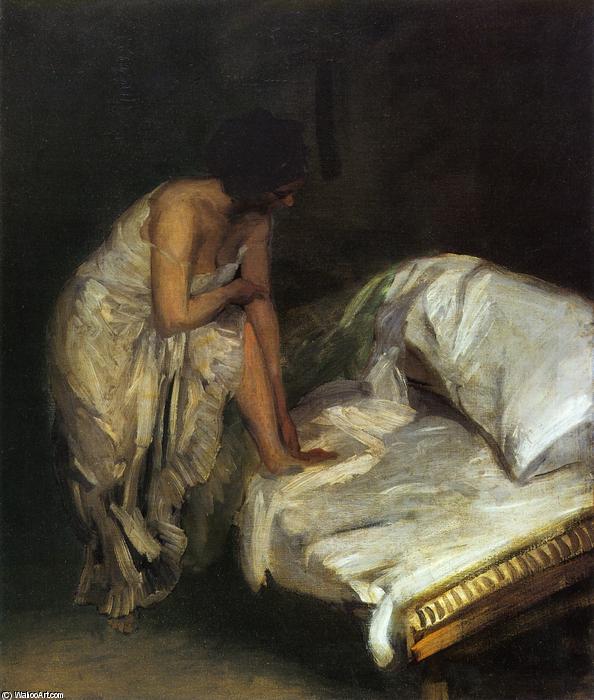
Das Kinderbett (1907) von John French Sloan

Das Kinderbett

1907 · Ölfarbe

In der stillen Intimität eines Schlafzimmers sitzt eine Frau in Das Kinderbett am Rand ihres Bettes. Gemalt von John Sloan um das Jahr 1907, fängt die Szene einen privaten Moment der Reglosigkeit ein. Sie blickt nach unten, ihre Aufmerksamkeit ist auf etwas Unsichtbares gerichtet, während die weichen Texturen weißer Laken und Kissen sie umhüllen. Die Atmosphäre wirkt schwer von der Präsenz eines bewohnten Raumes – ein Zimmer, in dem das…

6
Edgar Varèse (1924) von John French Sloan

Edgar Varèse

1924 · Öl auf Leinwand · National Portrait Gallery, Washington, D.C.

Die Luft im Raum wirkt schwer, erfüllt vom Duft des Öls und der Last ungesagter Gedanken. Ein Mann sitzt uns gegenüber, seine Präsenz beherrscht den Raum durch eine stille, intensive Gravitas. Dies ist Edgar Varèse, eingefangen in einem Moment tiefer Reglosigkeit, der förmlich von einem inneren Rhythmus vibriert. Sein dunkles, welliges Haar rahmt ein Gesicht ein, das von Ernsthaftigkeit gezeichnet ist – ein Antlitz, das sich weigert, oberflächlichen Trost zu…

7
Ein mechanisches Bä-Bä! (1906) von John French Sloan

Ein mechanisches Bä-Bä!

1906 · Acrylfarbe · Amon Carter Museum of American Art, Fort Worth

John French Sloans „Ein mechanisches Bä-Bä!“ ist weit mehr als nur die bloße Darstellung eines Antiquitätengeschäfts; es ist eine akribisch ausgearbeitete, in der Zeit eingefrorene Erzählung, die ein ergreifendes Fenster in die wachsende Faszination für industrielle Innovationen und die stillen Rhythmen des Alltags an der Schwelle zum 20. Jahrhundert öffnet. Das im Jahr 1906 entstandene Werk fiel in die Zeit, als Sloan als Schlüsselfigur der Ashcan School galt – einer…

John French Sloan-Gemälde, Platzierung 11 bis 100

11Dramatic Music (1897) von John French SloanDramatic Music1897 · Pennsylvania Academy of Fine Arts 12Henrietta with Red Book (1913) von John French SloanHenrietta with Red Book1913 · Reading Public Museum 13Evening, Rocky Neck (1916) von John French SloanEvening, Rocky Neck1916 14Nude At Piano (1928) von John French SloanNude At Piano1928 15Nude, Red Hair, Standing (1928) von John French SloanNude, Red Hair, Standing1928 16Nude, Terra Cotta (1933) von John French SloanNude, Terra Cotta1933 17Fishing Port, Gloucester von John French SloanFishing Port, Gloucester 18Nude with Red Hand Mirror (1950) von John French SloanNude with Red Hand Mirror1950 19Santa Fe Siesta (1949) von John French SloanSanta Fe Siesta1949 20Die Näherin (1901) von John French SloanDie Näherin1901 · Metropolitan Museum of Art 21Der Heumarkt (1907) von John French SloanDer Heumarkt1907 · Brooklyn Museum 22Drei Uhr morgens (1909) von John French SloanDrei Uhr morgens1909 · Philadelphia Museum of Art 23The Mountains, September von John French SloanThe Mountains, September 24Dust Storm, Fifth Avenue von John French SloanDust Storm, Fifth Avenue 25East Entrance, City Hall, Philadelphia von John French SloanEast Entrance, City Hall, Philadelphia 26Passing Schooner (1917) von John French SloanPassing Schooner1917 27The Rathskeller von John French SloanThe RathskellerCleveland Museum of Art 28Gwendolyn von John French SloanGwendolynSmithsonian American Art Museum 29Election Night von John French SloanElection Night 30Pulsierender Brunnen, Madison Square (1907) von John French SloanPulsierender Brunnen, Madison Square1907 · Thyssen-Bornemisza Museum 31Chinesisches Restaurant (1909) von John French SloanChinesisches Restaurant1909 32Clown schminkt sich (1910) von John French SloanClown schminkt sich1910 · The Phillips Collection 33Stein und Presse (1906) von John French SloanStein und Presse1906 · Kunstgalerie von Hamilton 34Daisy (1905) von John French SloanDaisy1905 35Green's Cat (1900) von John French SloanGreen's Cat1900 36Young Woman in Black and White (Mary Kerr) (1902) von John French SloanYoung Woman in Black and White (Mary Kerr)1902 37The Wake of the Ferry II (1907) von John French SloanThe Wake of the Ferry II1907 · The Phillips Collection 38Prone Nude von John French SloanProne Nude 39Woman brushing her hair von John French SloanWoman brushing her hair 40Sketch for the Lafayette von John French SloanSketch for the Lafayette 41Reading in the Subway von John French SloanReading in the Subway 42Seated Woman von John French SloanSeated Woman 43Nude and Arch von John French SloanNude and Arch 44Atlantic City Beach von John French SloanAtlantic City Beach 45The Day on the Roof von John French SloanThe Day on the Roof 46Portrait of Paul de Kock von John French SloanPortrait of Paul de Kock 47Robert Henri, Painter von John French SloanRobert Henri, Painter 48Picture Racks At The Macbeth Gallery von John French SloanPicture Racks At The Macbeth Gallery 49Fun, One Cent, from the series New York City Life von John French SloanFun, One Cent, from the series New York City Life 50Nude On Blanket von John French SloanNude On Blanket 51Rendezvous (Angna Enters in ''Rendezvous'') von John French SloanRendezvous (Angna Enters in ''Rendezvous'') 526th Avenue and 30th Street von John French Sloan6th Avenue and 30th Street 53Nude von John French SloanNude 54Nude at Piano von John French SloanNude at Piano 5514th Street, The Wigwam von John French Sloan14th Street, The Wigwam 56Mother von John French SloanMother 57untitled (3863) von John French Sloanuntitled (3863) 58untitled (6051) von John French Sloanuntitled (6051) 59untitled (6892) von John French Sloanuntitled (6892) 60untitled (3766) von John French Sloanuntitled (3766) 61Coytesville, New Jersey von John French SloanCoytesville, New Jersey 62Rainy Night von John French SloanRainy Night 63Anshutz on Anatomy von John French SloanAnshutz on Anatomy 64Nude on Stairs von John French SloanNude on Stairs 65Fifth Avenue Critics 1 von John French SloanFifth Avenue Critics 1 66Shine, Washington Square, New York City von John French SloanShine, Washington Square, New York City 67untitled (6941) von John French Sloanuntitled (6941) 68untitled (5375) von John French Sloanuntitled (5375) 69untitled (746) von John French Sloanuntitled (746) 70The Picture Buyer von John French SloanThe Picture Buyer 71Back to Market, Santa Fe von John French SloanBack to Market, Santa Fe 72back room von John French Sloanback room 73Woman Hanging Clothes von John French SloanWoman Hanging Clothes 74Easter Eve (1907) von John French SloanEaster Eve1907 75the ferrys wake (1907) von John French Sloanthe ferrys wake1907 76Movies, Five Cents von John French SloanMovies, Five Cents 77Gray and Brass (1907) von John French SloanGray and Brass1907 78Hairdresser's Window (1907) von John French SloanHairdresser's Window1907 79Poster and cover for February 15, 1896, The Echo von John French SloanPoster and cover for February 15, 1896, The Echo 80Country Road (1908) von John French SloanCountry Road1908 81South Beach Bathers (1907) von John French SloanSouth Beach Bathers1907 82Ferry Slip, Winter (1906) von John French SloanFerry Slip, Winter1906 83Movies (1913) von John French SloanMovies1913 · Toledo Museum of Art 84Pile Driver (1916) von John French SloanPile Driver1916 · Brauer Museum of Art 85Six O'Clock, Winter (1912) von John French SloanSix O'Clock, Winter1912 · The Phillips Collection 86Seacoast, Gloucester (1915) von John French SloanSeacoast, Gloucester1915 · Birmingham Museum of Art 87Main Street, Gloucester (1917) von John French SloanMain Street, Gloucester1917 · New Britain Museum of American Art 88Pink and Blue (1915) von John French SloanPink and Blue1915 89Wonson's Rocks and Ten Pound Island (1915) von John French SloanWonson's Rocks and Ten Pound Island1915 90A Gloucester Day (1915) von John French SloanA Gloucester Day1915 91Humoresque (1915) von John French SloanHumoresque1915 92A Woman's Work (1912) von John French SloanA Woman's Work1912 · Cleveland Museum of Art 93Gloucester Inlet (1914) von John French SloanGloucester Inlet1914 94Carol with Red Curls (1913) von John French SloanCarol with Red Curls1913 95Rain, Rooftops, West 4th Street (1913) von John French SloanRain, Rooftops, West 4th Street1913 96The New Blue Dress (1913) von John French SloanThe New Blue Dress1913 97Carmine Theater (1912) von John French SloanCarmine Theater1912 98Evening Arroyo (1919) von John French SloanEvening Arroyo1919 99Cornelia Street (1920) von John French SloanCornelia Street1920 100Travelling Carnival, Santa Fe (1924) von John French SloanTravelling Carnival, Santa Fe1924 · Smithsonian American Art Museum

Die berühmten Gemälde von John French Sloan, Epoche für Epoche

Die Motive, die John French Sloan faszinierten

Die vier Motive, die in diesen Originalen am häufigsten vorkommen, jeweils mit ihrem herausragendsten Beispiel.

Die Museen, die die Originale von John French Sloan beherbergen

Die 8 Museen, in denen sich die meisten der auf dieser Seite aufgeführten Gemälde befinden.

Museum Stadt Werke von John French Sloan Gemälde aus dieser Liste
The Phillips Collection, Washington, D.C.The Phillips Collection Washington, D.C. 4 Clown schminkt sich, The Wake of the Ferry II, Six O'Clock, Winter
Detroit Institute of Arts, DetroitDetroit Institute of Arts Detroit 3 McSorley's Bar, Das Kielwasser der Fähre
New Britain Museum of American Art, New BritainNew Britain Museum of American Art New Britain 2 Mädchen mit Pelzhut, Main Street, Gloucester
Cleveland Museum of Art, ClevelandCleveland Museum of Art Cleveland 2 The Rathskeller, A Woman's Work
Smithsonian American Art Museum, Washington, D.C.Smithsonian American Art Museum Washington, D.C. 2 Gwendolyn, Travelling Carnival, Santa Fe
National Gallery of Art, WashingtonNational Gallery of Art Washington 2 Yeats at Petitpas
National Portrait Gallery, Washington, D.C.National Portrait Gallery Washington, D.C. 1 Edgar Varèse
Amon Carter Museum of American Art, Fort WorthAmon Carter Museum of American Art Fort Worth 1 Ein mechanisches Bä-Bä!

John French Sloan, ein charakteristisches Gemälde pro Jahrzehnt

Werke nach Jahrzehnten

Wählen Sie ein Jahrzehnt aus, um das Original zu sehen, das es definiert.

Gemälde von John French Sloan: die Galerie antwortet

Welches Gemälde von John French Sloan ist das berühmteste von allen?Die Antwort enthüllen

McSorley's Bar (1912), Detroit Institute of Arts, Detroit. Als Nächstes folgen The Lafayette (1927) und Das Kielwasser der Fähre (1907).

Wie alt war John French Sloan, als McSorley's Bar vollendet wurde?Die Antwort enthüllen

41 Jahre alt: McSorley's Bar stammt aus dem Jahr 1912, und John French Sloan wurde in 1871 geboren.

Was sind die 10 besten Gemälde von John French Sloan?Die Antwort enthüllen

McSorley's Bar, The Lafayette, Das Kielwasser der Fähre, Mädchen mit Pelzhut, Das Kinderbett, Edgar Varèse, Ein mechanisches Bä-Bä!, Yeats at Petitpas, Bleecker Street, Samstagabend und Self-portrait. Die obige Rangliste gibt das jeweilige Jahr und das Museum an.

Wie viele Werke hat John French Sloan geschaffen?Die Antwort enthüllen

Unser Katalog umfasst 238 Werke von John French Sloan, datiert von 1890 bis 1950.

Wo hängen die berühmtesten Originale von John French Sloan?Die Antwort enthüllen

Meistens in The Phillips Collection (Washington, D.C.), Detroit Institute of Arts (Detroit) und New Britain Museum of American Art (New Britain). Die obige Museumstabelle listet alle auf.

Wann schuf John French Sloan seine berühmtesten Gemälde?Die Antwort enthüllen

In 1910s: 22 der 100 Werke auf dieser Seite wurden damals geschaffen, darunter McSorley's Bar.

Was sind die frühesten und spätesten berühmten Werke von John French Sloan?Die Antwort enthüllen

Auf dieser Seite ist das früheste Werk aus Self-portrait (1890) und das neueste aus Nude with Red Hand Mirror (1950).

Welchen Motiven hat John French Sloan sich am häufigsten gewidmet?Die Antwort enthüllen

American art (6), People (6) und Urban scene (6), verteilt auf die 100 Werke auf dieser Seite.

In welchem Medium war John French Sloan am meisten tätig?Die Antwort enthüllen

Öl auf Leinwand, für 13 von insgesamt 100 Werken auf dieser Seite.

Welcher Stilrichtung wird John French Sloan zugeordnet?Die Antwort enthüllen

Ashcan school, wenn man die Originale auf dieser Seite beurteilt.

Welche Originalwerke von John French Sloan befinden sich in der Sammlung des The Phillips Collection?Die Antwort enthüllen

Clown schminkt sich, The Wake of the Ferry II und Six O'Clock, Winter: Das The Phillips Collection, Washington, D.C. beherbergt 3 der Werke auf dieser Seite.

John French Sloan: der Künstler

Early Life and Artistic Awakening

John French Sloan, born August 2, 1871, in Lock Haven, Pennsylvania, emerged from humble beginnings that profoundly shaped his artistic vision. His childhood was marked by a familial need for support; his father’s struggles with mental health necessitated young John taking on responsibilities beyond his years. This early exposure to the realities of working-class life—a world often overlooked by the established art circles—would become a defining characteristic of his oeuvre. He moved with his family to Philadelphia, where he honed his skills initially not through formal academic training, but as an assistant cashier at Porter and Coates, a bookstore brimming with prints and illustrations. This environment proved formative; it allowed him to study masters like Dürer and Rembrandt, fostering a deep appreciation for draftsmanship and etching techniques. It was here, amidst the commerce of printed images, that Sloan began creating his own art, quietly developing a style rooted in observation and meticulous detail. His early work wasn’t born from privilege or leisure, but from necessity and a keen eye for the world around him—a foundation upon which he would build a remarkable career.

The Ashcan School and Urban Realism

Sloan's trajectory shifted dramatically with his encounter with Robert Henri, a charismatic painter who championed artistic independence and a commitment to portraying everyday life. This connection led Sloan to the heart of what became known as the Ashcan School—a group of artists dedicated to depicting the gritty realities of turn-of-the-century New York City. Alongside William Glackens, George Luks, Everett Shinn, and others, Sloan rejected the idealized landscapes and portraits favored by many of their contemporaries, instead turning their attention to the bustling streets, crowded tenements, and vibrant social life of the city’s poorer neighborhoods. His work became a visual chronicle of this often-ignored world—capturing scenes from McSorley’s Bar to women drying their hair on rooftops. Sloan wasn’t merely documenting; he was imbuing these scenes with a sense of empathy and dignity, elevating the lives of ordinary people onto the canvas. He possessed an uncanny ability to capture the *essence* of neighborhood life, the subtle gestures and fleeting moments that revealed the character of a place and its inhabitants. This commitment to realism wasn’t simply aesthetic; it was also informed by his socialist leanings, though he always maintained a distinction between his art and his political beliefs.

Style and Influences

Sloan's artistic style is characterized by a distinctive blend of influences. While rooted in realism, his work wasn’t devoid of stylistic nuance. He employed dark, rich hues—often emphasizing the contrast between light and shadow—to create a sense of drama and atmosphere. His compositions were carefully constructed, often utilizing strong diagonals to draw the viewer's eye into the scene. The influence of etching is evident in his precise linework and attention to detail, even in his paintings. Beyond Henri, Sloan drew inspiration from European masters like Edgar Degas and Honoré Daumier, admiring their ability to capture movement and social commentary. However, he forged a uniquely American voice, one that resonated with the energy and dynamism of New York City. His work wasn’t about grand narratives or historical events; it was about the small moments, the everyday experiences that constituted the fabric of urban life. He found beauty in the mundane, transforming ordinary scenes into compelling works of art. Wake of the Ferry exemplifies his ability to imbue a seemingly simple scene with emotional depth and symbolic resonance.

Major Achievements

Sloan’s career as a commercial newspaper artist began while he was still in his teens. As a young man, he was forced to leave the prestigious Central High School to help support his family. One of his early jobs was at A. Edward Newton, where he produced cards, gift books, and other novelties. Many of these items were produced as etchings, a medium he taught himself in the late 1880s. For Newton, Sloan depicted the homes of famous poets, designed pretty calendars, and etched booklets like *Thoughts* *from Tennyson*. His delicate, precise renderings reveal a flair for decoration, which helped him earn a position on the staff of the *Philadelphia Inquirer *in 1892. He continued at the *Inquirer*, until he received a better offer from the competing *Philadelphia Press*. At the newspapers, Sloan produced a wide range of illustrations including on-the-spot news pictures, though it quickly became apparent that this was not his strength, unlike his friends William Glackens, George Luks, and Everett Shinn who excelled at rapid sketches. He specialized in decorative work, like headings, puzzles, and illustrations for fiction and the society pages. His later paintings explored themes of solitude and melancholy, reflecting a profound sensitivity to human emotion. ## Legacy and Lasting Impact Sloan’s influence can be seen in the works of subsequent realist painters and continues to inspire artists who seek to find beauty and meaning in the everyday world. He was a dedicated teacher, sharing his knowledge and passion with countless students throughout his career. His paintings are not merely historical documents; they are timeless portraits of life, love, and loss. Sloan’s legacy extends far beyond his contributions to the Ashcan School.