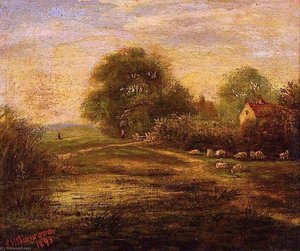
The Soul of the Suffolk Coast: The Life and Art of George Vemply Burwood
Born in 1844 amidst the historic surroundings of Bury St Edmunds, Essex, George Vemply Burwood emerged as a profound chronicler of the British landscape, specifically capturing the salt-sprayed essence of the Suffolk coastline. His life and work serve as a window into the Belle Époque period of East Anglia, a time when the rugged beauty of the English coast was being reimagined through the lens of both Romanticism and an emerging scientific precision. While his name may not resonate with the global fame of contemporaries like Turner or Constable, Burwood’s legacy is etched into the very textures of the landscapes he painted, offering a meticulous and deeply felt record of a bygone era of maritime and rural life.
Burwood’s artistic journey was shaped significantly by his formal training at the Ipswich School of Art between 1865 and 1867. It was here that he studied under the guidance of William Strachey, a master of the Suffolk landscape who instilled in him the vital practice of plein air painting. This method—working directly from nature to capture the fleeting nuances of light, atmosphere, and weather—became the heartbeat of Burwood’s technique. By stepping out of the studio and into the wind-swept coastal reaches, he learned to translate the ephemeral movement of clouds and the rhythmic pulse of the tide onto canvas, a skill that would later define his reputation as a premier marine and landscape painter.
Romantic Realism and the Mastery of Light
The aesthetic language of Burwood is best described as Romantic Realism. This delicate balance allowed him to embrace the grand, often dramatic scale of nature while maintaining an unwavering commitment to topographical accuracy. He did not merely seek to paint a scene; he sought to capture its physical weight and atmospheric truth. Utilizing oil on canvas, Burwood achieved a remarkable luminosity, particularly in his seascapes where the play of light upon churning waters creates a sense of profound depth and motion. His brushwork, though deliberate, possesses a fluid energy that mirrors the very elements he depicted—from the gentle ripples of a sheltered harbor to the formidable power of a storm-tossed sea.
His technical prowess is perhaps most evident in his ability to render diverse textures with startling clarity. Whether it was the weathered wood of a fishing vessel, the soft undulations of a pastoral field, or the translucent quality of sea foam, Burwood’s work invites the viewer into a tactile experience. This attention to detail extended to his compositions, which often featured:
- Maritime Narratives: Capturing the industrious life of Lowestoft and Woodbridge through depictions of fishing boats, such as the evocative 'Wildflower', navigating both calm and turbulent waters.
- Coastal Atmosphere: Using tonal gradations to evoke the misty, salt-laden air characteristic of the East Anglian coast.
- Rural Serenity: Transitioning from the sea to the shore with tranquil depictions of Suffolk’s interior, including pastoral scenes featuring livestock and the quiet dignity of the English countryside.
A Lasting Legacy in British Art
As Burwood established himself, primarily based in Woodbridge, his work became a vital part of the regional artistic identity. His paintings, such as the 1889 depiction of Lowestoft Inner Harbour, serve as historical documents that preserve the bustling maritime energy of the late 19th century. Through his eyes, we see the intricate dance of rowing boats and sailing vessels nestled against a backdrop of windmills and bridges, capturing a way of life that was soon to be transformed by the industrial age.
Though he passed away in 1917, the historical significance of George Vemply Burwood remains anchored in his ability to bridge the gap between emotion and observation. He did not rely on mere sentimentality; instead, he used the truth of the landscape to evoke a sense of wonder. Today, his works held in collections such as the Lowestoft and East Suffolk Maritime Museum continue to resonate, offering modern viewers a profound connection to the enduring spirit of the Suffolk coast and the masterful hand of an artist who truly understood its soul.