Early Life and Education
Charles Herbert Woodbury, born July 14, 1864, in Lynn, Massachusetts, demonstrated an early aptitude for the arts—a passion that would define his lifelong career. His formative years were spent immersed in the vibrant artistic milieu of Lynn Beach Painters, a group dedicated to capturing the essence of New England’s coastal landscapes. At just sixteen, Woodbury joined the Boston Art Club, establishing himself as one of its youngest members and earning immediate recognition for his talent. This youthful ambition continued to propel him forward; he graduated from MIT in 1886 with a degree in mechanical engineering—a seemingly disparate field that nonetheless fostered his meticulous observation skills—and swiftly transitioned into pursuing art professionally.
Artistic Career and Influences
Woodbury’s artistic journey unfolded against the backdrop of Impressionism, where he sought to convey emotion and movement rather than simply depicting visual reality. He honed his craft through extensive studies at the Académie Julian in Paris from January to June 1891, absorbing techniques from luminaries like Claude Monet and Vincent van Gogh. Further enriching his artistic perspective was a residency in Holland during the same period, where he immersed himself in the traditions of Dutch landscape painting—a pivotal experience that instilled in him a profound understanding of tonal harmony and atmospheric perspective. Throughout his career, Woodbury maintained close friendships with fellow artists such as John Singer Sargent, whose influence can be discerned in Woodbury’s compositions and stylistic choices. The meticulous attention to detail characteristic of Sargent's work mirrored Woodbury's own dedication to capturing the subtleties of coastal scenes.
Notable Works and Style
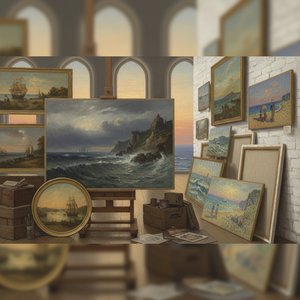
Woodbury’s artistic vision centered on portraying the dynamism of the sea and mountains—a pursuit he eloquently articulated with his famous maxim: “Paint in verbs, not nouns.” This philosophy guided his approach to artmaking, prioritizing expressive gesture and conveying a sense of immediacy rather than relying solely on descriptive accuracy. His oeuvre comprises over 500 etching plates, showcasing his mastery of printmaking techniques and demonstrating his ability to distill complex emotions into concise visual statements. Among his most celebrated achievements is *Mid Ocean*, which garnered the second prize at the Tennessee Centennial Exposition in 1897—a testament to his skill as a painter and his capacity for capturing the grandeur of nature. His watercolor studies of beaches and towns, often infused with dramatic mountain vistas and swirling clouds, continue to resonate with viewers today.
Museums and Collections
Woodbury’s artwork graces numerous museum collections across North America, offering visitors an opportunity to appreciate his enduring legacy as a marine painter. The Art Institute of Chicago houses a significant selection of his paintings and prints, alongside the Museum of Fine Arts in Boston, where a dedicated exhibition celebrates his artistic contributions. Furthermore, the Farnsworth Art Museum in Rockland, Maine, showcases Woodbury’s landscapes—a poignant reminder of his formative years spent honing his craft amidst the rugged beauty of New England's coastline. Finally, the Fogg Art Museum at Harvard University preserves several pieces from Woodbury’s oeuvre, ensuring that his artistic vision remains accessible to future generations.