Porträt von Augustus Vincent Tack

Die 72 berühmtesten Gemälde von Augustus Vincent Tack, eine Galerie-Auswahl

Aktualisiert im November 2026 · sortiert nach unserem Popularitätsindex (Suchanfragen, Aufrufe und Bestellungen für jedes Werk) · 76 Werke von Augustus Vincent Tack in unserem Katalog

Kurz gesagt

Von allen Originalen, die Augustus Vincent Tack hinterlassen hat, ist Selbstporträt (1897) in der Sammlung des The Phillips Collection in Washington, D.C. das bekannteste. Dicht darauf folgen Mountain Slopes (1914) und Elihu Root (1922). Unser Katalog umfasst 76 Werke von Augustus Vincent Tack; die Galerie bewahrt die 72 bedeutendsten Stücke auf, die die Welt bewundert, jedes mit seinem Entstehungsdatum, seinem Museum und seiner Geschichte.

1870 – 1949, Pittsburgh Meiste Werke: The Phillips Collection

Die 10 besten Gemälde von Augustus Vincent Tack: die Auswahl der Galerie

1
Selbstporträt (1897) von Augustus Vincent Tack

Selbstporträt

1897 · Fotografie · The Phillips Collection, Washington, D.C.

Dieses im Jahr 1897 geschaffene Werk spiegelt eine Übergangsphase in der Entwicklung des Künstlers wider. Während der Titel eine intime Studie suggeriert, konzentriert sich der visuelle Inhalt auf den Eingang eines gepflegten Anwesens oder Parks. Die Präzision der Landschaft deutet auf eine Fokussierung auf die physische Realität der Umgebung hin. Die Komposition betont die Ruhe und die strukturierte Organisation der Natur durch menschliches Eingreifen. Die Stille der Szene wird durch…

2
Mountain Slopes (1914) von Augustus Vincent Tack

Mountain Slopes

1914 · Photography · The Phillips Collection, Washington, D.C.

The painting titled Mountain Slopes was created by the American painter Augustus Vincent Tack. This specific work was executed about 1914. It offers a glimpse into the early development of an artist who would eventually become a significant figure in American art history.

3
Elihu Root (1922) von Augustus Vincent Tack

Elihu Root

1922 · Oil On Canvas · National Portrait Gallery, Washington, D.C.

The portrait depicts an older man seated in a dark suit against a muted brown background. He is positioned centrally, his posture creating a strong vertical line within the frame. The subject wears a formal dark jacket and a white shirt, with the fabric of his clothing rendered through visible brushstrokes that suggest a textured surface. His face is oval-shaped, illuminated by a directional light source originating from above and…

4
Rosa Mystica (1923) von Augustus Vincent Tack

Rosa Mystica

1923 · Oil · Cleveland Museum of Art, Cleveland

In Rosa Mystica, Augustus Vincent Tack organizes the pictorial space through a hierarchical perspective that separates the celestial from the mortal. The composition centers on a divine female figure, likely the Virgin Mary, who floats within a luminous blue mandorla. She is positioned in a higher plane above the earthly realm, surrounded by a sky of fragmented, pale clouds. Her arms are outstretched in a gesture of grace, draped in…

5
Benjamin Nathan Cardozo (1931) von Augustus Vincent Tack

Benjamin Nathan Cardozo

1931 · Oil On Canvas

In this formal portrait, Augustus Vincent Tack presents Benjamin Nathan Cardozo in a moment of quiet, judicial dignity. Painted about 1931, the work captures the subject in his capacity as a judge, a role that informs the entire gravity of the piece. There is a certain stillness here, a sense of the weight of responsibility that accompanies such a position. Tack avoids the superficiality of a mere likeness, focusing instead…

6
John Munro Woolsey (1934) von Augustus Vincent Tack

John Munro Woolsey

1934 · Oil · New York Historical Society, New York City

This oil portrait by Augustus Vincent Tack depicts John Munro Woolsey, a United States district judge. Painted about 1934, the work presents the subject in a formal setting that emphasizes his professional status. The composition focuses on the man seated behind a wooden desk, positioned in a medium close-up view that establishes a direct presence before the viewer.

7
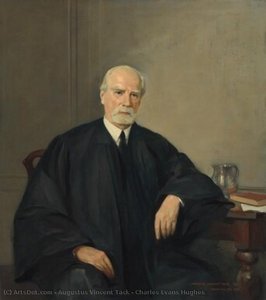
Charles Evans Hughes (1941) von Augustus Vincent Tack

Charles Evans Hughes

1941 · Oil On Canvas

This formal portrait of Charles Evans Hughes, executed by Augustus Vincent Tack, offers a quiet moment of reflection. Painted about 1941, the work captures the subject in a setting that suggests a private study or a professional office. There is a sense of stillness here, as if we have interrupted a moment of deep thought. The composition places Hughes at the center of the viewer's attention, establishing a presence that…

8
Harry S. Truman (1948) von Augustus Vincent Tack

Harry S. Truman

1948 · Oil On Canvas

In this formal portrait of Harry S. Truman, Augustus Vincent Tack captures the subject in a half-length composition that centers the viewer's attention on the man's face and upper body. The figure sits slightly off-center to the right, creating a subtle tension within the frame. A strong light source emerges from the upper left, casting deep shadows that define the contours of the face and the heavy folds of the…

9
Harlan F. Stone (1944) von Augustus Vincent Tack

Harlan F. Stone

1944 · Oil On Canvas

In this formal portrait, Augustus Vincent Tack presents Harlan F. Stone in a moment of quiet, seated dignity. Painted in 1944, the work captures the subject in a three-quarter view, a composition that emphasizes his presence and the weight of his position. There is a certain stillness to the figure, which is likely intended to reflect Stone's role as Chief Justice of the United States Supreme Court. The subject's expression…

10
The High Command Right Panel (1949) von Augustus Vincent Tack

The High Command Right Panel

1949 · Oil On Canvas · National Portrait Gallery, Washington, D.C.

The High Command Right Panel is a work by Augustus Vincent Tack, executed in 1949. The painting captures two men seated within the quiet confines of an office setting. Their presence is anchored by the weight of their surroundings, suggesting a moment of professional stillness. The subject matter centers on naval officers or individuals tied to maritime affairs, a theme reflected in the nautical elements that populate the scene.

Die Auswahl von Augustus Vincent Tack geht weiter, von 11 bis 72

11Gethsemane von Augustus Vincent TackGethsemaneThe Phillips Collection 12Canyon von Augustus Vincent TackCanyonThe Phillips Collection 13Rising Wind and Tide (1905) von Augustus Vincent TackRising Wind and Tide1905 · Reading Public Museum 14Windswept (Snow Picture, Leyden) von Augustus Vincent TackWindswept (Snow Picture, Leyden)The Phillips Collection 15Passacaglia von Augustus Vincent TackPassacagliaThe Phillips Collection 16Ideal Figure in Rose von Augustus Vincent TackIdeal Figure in RoseThe Phillips Collection 17Court of Romance (Garden of Romance) von Augustus Vincent TackCourt of Romance (Garden of Romance)The Phillips Collection 18Allegro Giocoso von Augustus Vincent TackAllegro GiocosoThe Phillips Collection 19Canyon (The Valley) (1914) von Augustus Vincent TackCanyon (The Valley)1914 · The Phillips Collection 20The Entombment (1922) von Augustus Vincent TackThe Entombment1922 · The Phillips Collection 21Spring Night (1931) von Augustus Vincent TackSpring Night1931 · The Phillips Collection 22Outposts of Time II (1929) von Augustus Vincent TackOutposts of Time II1929 · The Phillips Collection 23Liberation (1929) von Augustus Vincent TackLiberation1929 · The Phillips Collection 24Flight (Fugue) (1930) von Augustus Vincent TackFlight (Fugue)1930 · The Phillips Collection 25Far Reaches (1930) von Augustus Vincent TackFar Reaches1930 · The Phillips Collection 26Ecstasy (1929) von Augustus Vincent TackEcstasy1929 · The Phillips Collection 27Christmas Night (1931) von Augustus Vincent TackChristmas Night1931 · The Phillips Collection 28Balance (1929) von Augustus Vincent TackBalance1929 · The Phillips Collection 29Night, Amargosa Desert (1935) von Augustus Vincent TackNight, Amargosa Desert1935 · The Phillips Collection 30Reverend Cornelius Clifford (1937) von Augustus Vincent TackReverend Cornelius Clifford1937 · Campion Hall 31The High Command Left Panel (1949) von Augustus Vincent TackThe High Command Left Panel1949 · National Portrait Gallery 32Truman and his Military Advisors (1949) von Augustus Vincent TackTruman and his Military Advisors1949 · National Portrait Gallery 33Dwight D. Eisenhower (1949) von Augustus Vincent TackDwight D. Eisenhower1949 34Winter (1934) von Augustus Vincent TackWinter1934 · The Phillips Collection 35John La Farge (1897) von Augustus Vincent TackJohn La Farge1897 · Metropolitan Museum of Art 36Die Stimme vieler Wasser von Augustus Vincent TackDie Stimme vieler WasserThe Phillips Collection 37Nachtwolken und Sternenstaub von Augustus Vincent TackNachtwolken und SternenstaubMetropolitan Museum of Art 38Study for Mr. Winthrop's Portrait von Augustus Vincent TackStudy for Mr. Winthrop's PortraitThe Phillips Collection 39Self-Portrait von Augustus Vincent TackSelf-PortraitThe Phillips Collection 40Self-Portrait von Augustus Vincent TackSelf-PortraitThe Phillips Collection 41Sea of Hills von Augustus Vincent TackSea of HillsThe Phillips Collection 42Sketch for Portrait of Nicholas Murray Butler von Augustus Vincent TackSketch for Portrait of Nicholas Murray ButlerThe Phillips Collection 43Portrait of Nicholas Murray Butler von Augustus Vincent TackPortrait of Nicholas Murray ButlerThe Phillips Collection 44Portrait of Man with Dog von Augustus Vincent TackPortrait of Man with DogThe Phillips Collection 45Elizabeth Hudson von Augustus Vincent TackElizabeth HudsonThe Phillips Collection 46Palace of Enchantment von Augustus Vincent TackPalace of EnchantmentThe Phillips Collection 47Ox Cart von Augustus Vincent TackOx CartThe Phillips Collection 48Winter (New York in Snow) von Augustus Vincent TackWinter (New York in Snow)The Phillips Collection 49Allegory - Love and Life (Mother and Child) von Augustus Vincent TackAllegory - Love and Life (Mother and Child)The Phillips Collection 50Magi's Journey von Augustus Vincent TackMagi's JourneyThe Phillips Collection 51Largo von Augustus Vincent TackLargoThe Phillips Collection 52Hill and Sky (Hilltop?) von Augustus Vincent TackHill and Sky (Hilltop?)The Phillips Collection 53Head of Model, Profile von Augustus Vincent TackHead of Model, ProfileThe Phillips Collection 54The Glacier von Augustus Vincent TackThe GlacierThe Phillips Collection 55Forgotten Poem von Augustus Vincent TackForgotten PoemThe Phillips Collection 56Figure in Red with Beads von Augustus Vincent TackFigure in Red with BeadsThe Phillips Collection 57Evening von Augustus Vincent TackEveningThe Phillips Collection 58Deerfield in Twilight (The Dance) von Augustus Vincent TackDeerfield in Twilight (The Dance)The Phillips Collection 59Study of Sister Death for Death of St. Francis von Augustus Vincent TackStudy of Sister Death for Death of St. FrancisThe Phillips Collection 60Death of St. Francis von Augustus Vincent TackDeath of St. FrancisThe Phillips Collection 61Daybreak von Augustus Vincent TackDaybreakThe Phillips Collection 62Dawn von Augustus Vincent TackDawnThe Phillips Collection 63The Crowd von Augustus Vincent TackThe CrowdThe Phillips Collection 64Cloud Wrack von Augustus Vincent TackCloud WrackThe Phillips Collection 65Christ Bearing the Cross von Augustus Vincent TackChrist Bearing the CrossThe Phillips Collection 66Blue Oval von Augustus Vincent TackBlue OvalThe Phillips Collection 67Twilight von Augustus Vincent TackTwilightThe Phillips Collection 68Above the Treetops von Augustus Vincent TackAbove the TreetopsThe Phillips Collection 69David E. Finley von Augustus Vincent TackDavid E. Finley 70John Russell Pope von Augustus Vincent TackJohn Russell Pope 71Großer Innenhof von Augustus Vincent TackGroßer InnenhofThe Phillips Collection 72Madonna der ewigen Hügel von Augustus Vincent TackMadonna der ewigen HügelThe Phillips Collection

Die Motive, die Augustus Vincent Tack faszinierten

Die vier Motive, die in diesen Originalen am häufigsten vorkommen, jeweils mit ihrem herausragendsten Beispiel.

Die Museen, die die Originale von Augustus Vincent Tack beherbergen

Die 7 Museen, in denen sich die meisten der auf dieser Seite aufgeführten Gemälde befinden.

Museum Stadt Werke von Augustus Vincent Tack Gemälde aus dieser Liste
The Phillips Collection, Washington, D.C.The Phillips Collection Washington, D.C. 55 Selbstporträt, Mountain Slopes, Gethsemane
National Portrait Gallery, Washington, D.C.National Portrait Gallery Washington, D.C. 4 Elihu Root, The High Command Right Panel, The High Command Left Panel
Metropolitan Museum of Art, New YorkMetropolitan Museum of Art New York 2 John La Farge, Nachtwolken und Sternenstaub
Cleveland Museum of Art, ClevelandCleveland Museum of Art Cleveland 1 Rosa Mystica
New York Historical Society, New York CityNew York Historical Society New York City 1 John Munro Woolsey
Reading Public Museum, ReadingReading Public Museum Reading 1 Rising Wind and Tide
Campion Hall, OxfordCampion Hall Oxford 1 Reverend Cornelius Clifford

Augustus Vincent Tack Jahrzehnt für Jahrzehnt: das Original, das jedes definiert

Werke nach Jahrzehnten

Wählen Sie ein Jahrzehnt aus, um das Original zu sehen, das es definiert.

Fragen von Sammlern zu den Gemälden von Augustus Vincent Tack

Für welches Werk ist Augustus Vincent Tack am bekanntesten?Die Antwort enthüllen

Selbstporträt (1897), The Phillips Collection, Washington, D.C.. Als Nächstes folgen Mountain Slopes (1914) und Elihu Root (1922).

In welchem Alter war Augustus Vincent Tack, als Selbstporträt geschaffen wurde?Die Antwort enthüllen

27 Jahre alt: Selbstporträt stammt aus dem Jahr 1897, und Augustus Vincent Tack wurde in 1870 geboren.

Was sind die zehn berühmtesten Gemälde von Augustus Vincent Tack?Die Antwort enthüllen

Selbstporträt, Mountain Slopes, Elihu Root, Rosa Mystica, Benjamin Nathan Cardozo, John Munro Woolsey, Charles Evans Hughes, Harry S. Truman, Harlan F. Stone und The High Command Right Panel. Die obige Rangliste gibt das jeweilige Jahr und das Museum an.

Wie viele Gemälde hat Augustus Vincent Tack hinterlassen?Die Antwort enthüllen

Unser Katalog umfasst 76 Werke von Augustus Vincent Tack, datiert von 1897 bis 1949.

In welchen Museen hängen die Meisterwerke von Augustus Vincent Tack?Die Antwort enthüllen

Meistens in The Phillips Collection (Washington, D.C.), National Portrait Gallery (Washington, D.C.) und Metropolitan Museum of Art (New York). Die obige Museumstabelle listet alle auf.

In welchen Jahren hat Augustus Vincent Tack seine berühmtesten Werke gemalt?Die Antwort enthüllen

In 1930s: 9 der 72 Werke auf dieser Seite wurden damals geschaffen, darunter Benjamin Nathan Cardozo.

Was sind die ersten und die letzten berühmten Originale von Augustus Vincent Tack?Die Antwort enthüllen

Auf dieser Seite ist das früheste Werk aus Selbstporträt (1897) und das neueste aus The High Command Right Panel (1949).

Welche Motive hat Augustus Vincent Tack am häufigsten gewählt?Die Antwort enthüllen

Man (4), Bäume (3) und Portraiture (3), verteilt auf die 72 Werke auf dieser Seite.

Welche Technik hat Augustus Vincent Tack am häufigsten angewendet?Die Antwort enthüllen

Oil On Canvas, für 6 von insgesamt 72 Werken auf dieser Seite.

Welche Werke von Augustus Vincent Tack hängen im The Phillips Collection?Die Antwort enthüllen

Selbstporträt, Mountain Slopes und Gethsemane: Das The Phillips Collection, Washington, D.C. beherbergt 55 der Werke auf dieser Seite.

Augustus Vincent Tack: Leben und Werk

Augustus Vincent Tack: Pionier der spirituellen Landschaft

Augustus Vincent Tack (1870 – 1949) steht als eine singuläre Gestalt in der amerikanischen Kunstgeschichte, primär anerkannt für seine unverwechselbare Verschmelzung von Realismus und Abstraktion – ein stilistischer Ansatz, der die aufstrebende Bewegung des Abstrakten Expressionismus bereits vorwegnahm. Geboren in Pittsburgh, Pennsylvania, begann Tacks künstlerische Reise mit einer formellen Ausbildung am St. Francis Xavier College, bevor er seine Fähigkeiten an der Art Students League of New York perfektionierte und dabei Einflüsse von Größen wie John La Farge in sich aufnahm, dessen Atelier er regelmäßig besuchte. Diese prägende Phase legte den Grundstein für seine späteren Erkundungen der Landschaftsmalerei und, was noch entscheidender war, für die tiefgründig symbolischen Darstellungen der Natur – eine Obsession, die sein gesamtes Œuvre definieren sollte.
  • Frühe Karriere & Einflüsse:
  • Tacks Debütausstellung in den Kraushaar Galleries im Jahr 1896 markierte den Beginn einer produktiven künstlerischen Laufbahn, die durch eine beständige Verbindung zu bedeutenden Institutionen wie dem Worcester Art Museum, den Carnegie International Exhibitions und der Pennsylvania Academy of Fine Arts gekennzeichnet war. Seine Zusammenarbeit mit Duncan Phillips – insbesondere deren Mitwirkung am Allied War Salon von 1918 – demonstrierte nicht nur seine sozialen Verbindungen, sondern auch sein Engagement, drängende gesellschaftliche Anliegen durch künstlerischen Ausdruck zu thematisieren.
  • Deerfield-Kolonie & Ehe:
  • Auf der Suche nach Inspiration und Kameradschaft zog Tack nach Deerfield, Massachusetts, wo er eine Künstlerkolonie etablierte und Agnes Gordon Fuller heiratete, die Tochter des renommierten Malers George Fuller. Diese Verbindung schuf ein unterstützendes Umfeld, das förderlich für seine kreativen Bestrebungen war, und festigte seine Position innerhalb der Kunstgemeinschaft.
  • Lehrtätigkeit & Yale University:
  • Tacks pädagogische Rolle reichte weit über Deerfield hinaus; er lehrte zwischen 1906 und 1910 an der Art Students League of New York und war anschließend von 1910 bis 1913 als Dozent an der Yale University tätig, wo er seine künstlerische Vision an eine neue Generation von Künstlern weitergab.

Ein unverwechselbarer Stil: Realismus durchdrungen von Mystik

Tacks künstlerischer Stil zeichnete sich durch ein sorgfältiges Gleichgewicht zwischen traditionellem Realismus und evokativer Abstraktion aus. Während seine Porträts den akademischen Konventionen folgten – indem sie Ähnlichkeiten mit akribischem Detailreichtum und dramatischer Lichtführung einfingen –, transzendierten seine Landschaften die bloße Darstellung und tauchten in Sphären spiritueller Kontemplation ein. Gemälde wie „Time and Timelessness“ verdeutlichen diesen Ansatz, indem sie geometrische Formen mit figurativen Elementen kontrastieren, um ein Gefühl von dauerhafter Schönheit und tiefgründiger Symbolik zu vermitteln. Kritiker bemerkten, dass Tacks Werk „eine zeitgenössische Neuinterpretation des heroischen Idealismus des neunzehnten Jahrhunderts“ darstellte, was seinen Ehrgeiz unterstrich, den Betrachter über das Alltägliche hinaus zu erheben.
  • Bedeutende Werke:
  • Zu seinen am meisten gefeierten Stücken gehören „The High Command Right Panel“ (1949), das Marineoffiziere mit meisterhaftem Realismus und kompositorischer Komplexität darstellt; die Porträts von Harry S. Truman und Elihu Root – entstanden in den Jahren 1948 bzw. 1922 –, die Tacks Fähigkeit demonstrieren, Charakter und Emotion durch nuancierte Pinselführung zu vermitteln; sowie „Time and Timelessness“, ein Meisterwerk der Landschaftsmalerei, das seine Faszination für spirituelle Themen widerspiegelt.

Vermächtnis & Anerkennung

Trotz kommerzieller Rückschläge bleibt Tacks künstlerisches Erbe als Vorläufer des Abstrakten Expressionismus bestehen – einer Bewegung, die die Landschaft der amerikanischen Kunst in den Jahrzehnten nach seinem Tod neu gestalten sollte. Seine Gemälde sind in bedeutenden Sammlungen untergebracht und inspirieren bis heute Künstler und Wissenschaftler gleichermaßen. Augustus Vincent Tacks Beitrag zur amerikanischen Kunst liegt nicht nur in seinen stilistischen Innovationen, sondern auch in seinem unerschütterlichen Streben nach künstlerischer Wahrheit – ein Zeugnis für die dauerhafte Kraft von Vorstellungskraft und Vision.