Porträt von Antonio Ligabue

Die 43 berühmtesten Gemälde von Antonio Ligabue, jedes ein Unikat

Aktualisiert im November 2026 · sortiert nach unserem Popularitätsindex (Suchanfragen, Aufrufe und Bestellungen für jedes Werk) · 43 Werke von Antonio Ligabue in unserem Katalog

Kurz gesagt

Gekauerte Löwin (1940) ist das von Antonio Ligabue geschaffene Gemälde, das die meiste Aufmerksamkeit auf sich zieht; das Original befindet sich im Fondazione - Archivio Antonio Ligabue di Parma, Parma. Danach wandert der Blick zu Panther (1956) und Löwe und Löwin (1935). Von den 43 Werken von Antonio Ligabue in unserem Katalog sind diese 43 die bekanntesten – jedes ein einzigartiges Original, präsentiert mit seinem Entstehungsjahr, dem Museum und dem Grund für seine zeitlose Bedeutung.

1899 – 1965, Zürich Naive kunst Meiste Werke: Fondazione - Archivio Antonio Ligabue di Parma

Die 10 besten Gemälde von Antonio Ligabue, aus der Sicht der Galerie

1
Gekauerte Löwin (1940) von Antonio Ligabue

Gekauerte Löwin

Die Gekauerte Löwin ist eine Bronzeskulptur, die im Jahr 1940 von Antonio Laccabue geschaffen wurde. Dieses Werk präsentiert sich in einem Panoramamformat mit den Maßen 5,0 x 18,0 cm. Die Skulptur fängt eine realistische Darstellung einer Löwin in einer entspannten Körperhaltung ein und betont die physische Stärke sowie die Anmut des Tieres durch eine detailgetreue anatomische Ausarbeitung.
2
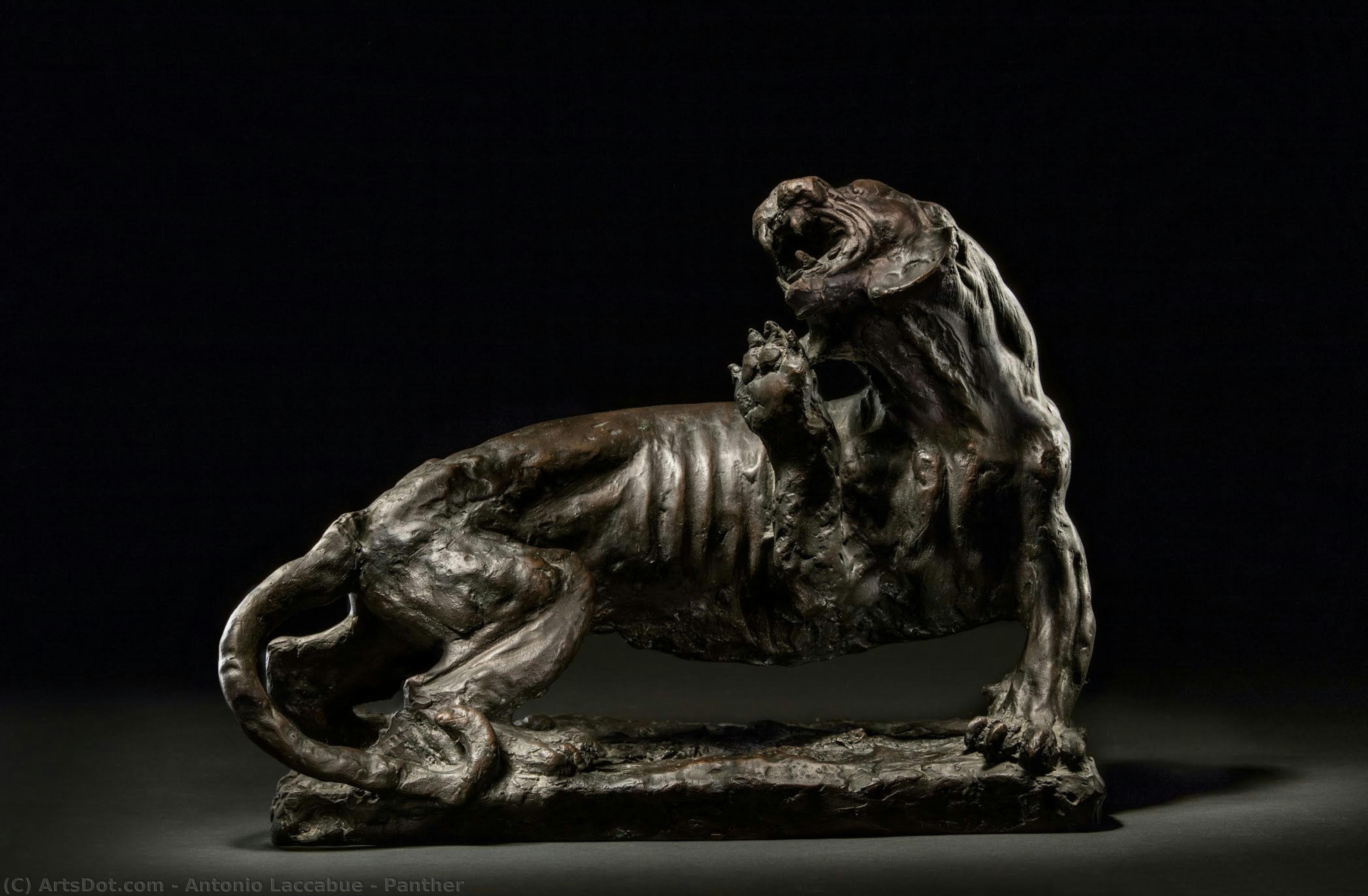
Panther (1956) von Antonio Ligabue

Panther

Die Bronzeskulptur mit dem Titel Panther ist ein Ausdruck roher tierischer Urgewalt des Künstlers Antonio Laccabue. Dieses Werk fängt einen Raubvogel in einem Moment plötzlicher, gewaltiger Bewegung ein. Das Motiv, ein Panther oder Löwe, ist in einer dynamischen Pose erstarrt. Sein Maul ist zu einem weiten Brüllen aufgerissen, was die Intensität des Instinkts der Kreatur offenbart. Das Metall bewahrt die Spannung eines Körpers, der durch die plötzliche Bewegung in sich…

3
Löwe und Löwin (1935) von Antonio Ligabue

Löwe und Löwin

In dieser Bronzeskulptur aus dem Jahr 1935 beobachten wir einen Moment von tiefer Stille und plötzlicher Bewegung. Das Werk stellt zwei felinen Gestalten dar: einen Löwen, der in einer brüllenden Pose aufrecht steht, und eine liegende Löwin. Sie sind so positioniert, als würden sie einem gemeinsamen, unsichtbaren Beutetier gegenüberstehen, wodurch ein geteilter Fokus entsteht, der den Betrachter direkt in ihre räuberische Absicht hineinzieht. Es herrscht eine spürbare, gemeinsame Aggressivität, eine…

5
Baboon (1953) von Antonio Ligabue

Baboon

The gesture of the animal with which it scratches its head accentuates the expressionist character of the sculpture and the imbalance of the ungainly forms, but precisely for this very reason effective in restoring the nature of the subject. The shaggy quality of the hair is reconstructed with deep furrows and with a harsh modeling which accentuates, despite the resting position, the possible aggression and violence, here retained but certainly…

7
Self-portrait (1951) von Antonio Ligabue

Self-portrait

Antonio Laccabue meets the viewer through a gaze that refuses to turn away. In this 1951 self-portrait, the artist presents himself in a half-length pose, his face marked by hollowed cheeks and a quiet, heavy dignity. A light, checked handkerchief is knotted at his neck, resting against a jacket fastened at the chest. There is a physical truth in his features, including a subtle hematoma at his right temple, a…

8
Porträt einer Frau (1960) von Antonio Ligabue

Porträt einer Frau

1960 · Öl auf Leinwand · Fondazione - Archivio Antonio Ligabue di Parma, Parma

In seinem evokativen Meisterwerk aus dem Jahr 1960, dem Porträt einer Frau, fängt Antonio Laccabue weit mehr als nur eine Ähnlichkeit ein; er bewahrt einen flüchtigen Moment tiefer Verbundenheit. Das Motiv, eine Nachtclubtänzerin, der der Künstler in Reggio Emilia begegnet ist, dient als emotionaler Anker dieser eindrucksvollen Komposition. Ihre Präsenz ist geprägt von einer schlichten Eleganz, charakterisiert durch große, ausdrucksstarke Augen und einen hohen, schlanken Hals, der die Aufmerksamkeit auf…

10
Stable with horses and donkey (1960) von Antonio Ligabue

Stable with horses and donkey

Inside a strictly geometric stable, a quiet assembly of animals gathers around a central manger. Three horses and a donkey occupy the space, their forms defined by the structured architecture of the enclosure. A rooster and three hens move through the legs of the larger animals, adding a layer of restless life to the stillness. In the immediate foreground, a small black insect provides a minute detail against the floor.…

Berühmte Gemälde von Antonio Ligabue, Nummer 11 bis 43

11Pflügen (1961) von Antonio LigabuePflügen1961 · Fondazione - Archivio Antonio Ligabue di Parma 12Amme (1949) von Antonio LigabueAmme1949 · Fondazione - Archivio Antonio Ligabue di Parma 13Kämpfende Tiere (1953) von Antonio LigabueKämpfende Tiere1953 · Fondazione - Archivio Antonio Ligabue di Parma 14Selbstporträt (1960) von Antonio LigabueSelbstporträt1960 · Fondazione - Archivio Antonio Ligabue di Parma 15Selbstporträt (1954) von Antonio LigabueSelbstporträt1954 · Fondazione - Archivio Antonio Ligabue di Parma 16Ziege (1952) von Antonio LigabueZiege1952 · Fondazione - Archivio Antonio Ligabue di Parma 17Wildkatze mit Milan (1960) von Antonio LigabueWildkatze mit Milan1960 · Fondazione - Archivio Antonio Ligabue di Parma 18Leopard (1957) von Antonio LigabueLeopard1957 · Fondazione - Archivio Antonio Ligabue di Parma 19Selbstporträt mit einer Fliege (1960) von Antonio LigabueSelbstporträt mit einer Fliege1960 · Fondazione - Archivio Antonio Ligabue di Parma 20Ozelot mit Totenkopf (1933) von Antonio LigabueOzelot mit Totenkopf1933 · Fondazione - Archivio Antonio Ligabue di Parma 21Fuchs mit Henne (1959) von Antonio LigabueFuchs mit Henne1959 · Fondazione - Archivio Antonio Ligabue di Parma 22Cow with calf (1960) von Antonio LigabueCow with calf1960 · Fondazione - Archivio Antonio Ligabue di Parma 23Greyhound in Ruhe (1957) von Antonio LigabueGreyhound in Ruhe1957 · Fondazione - Archivio Antonio Ligabue di Parma 24Napoleon zu Pferd (1961) von Antonio LigabueNapoleon zu Pferd1961 · Fondazione - Archivio Antonio Ligabue di Parma 25Hahnenkampf (1956) von Antonio LigabueHahnenkampf1956 · Fondazione - Archivio Antonio Ligabue di Parma 26Mountain pasture (1928) von Antonio LigabueMountain pasture1928 · Fondazione - Archivio Antonio Ligabue di Parma 27Löwe auf seiner Beute (1931) von Antonio LigabueLöwe auf seiner Beute1931 · Fondazione - Archivio Antonio Ligabue di Parma 28Löwe (1935) von Antonio LigabueLöwe1935 · Fondazione - Archivio Antonio Ligabue di Parma 29Horse with saddle (1940) von Antonio LigabueHorse with saddle1940 · Fondazione - Archivio Antonio Ligabue di Parma 30Horse in love (1950) von Antonio LigabueHorse in love1950 · Fondazione - Archivio Antonio Ligabue di Parma 31Schloss (1954) von Antonio LigabueSchloss1954 · Fondazione - Archivio Antonio Ligabue di Parma 32Self-portrait (1955) von Antonio LigabueSelf-portrait1955 · Fondazione - Archivio Antonio Ligabue di Parma 33Self-portrait (1955) von Antonio LigabueSelf-portrait1955 · Fondazione - Archivio Antonio Ligabue di Parma 34Hawk with prey (1957) von Antonio LigabueHawk with prey1957 · Fondazione - Archivio Antonio Ligabue di Parma 35Cow with calf (1956) von Antonio LigabueCow with calf1956 · Fondazione - Archivio Antonio Ligabue di Parma 36Self-portrait with hat (1961) von Antonio LigabueSelf-portrait with hat1961 · Fondazione - Archivio Antonio Ligabue di Parma 37Setter dog (1959) von Antonio LigabueSetter dog1959 · Fondazione - Archivio Antonio Ligabue di Parma 38Eagle with fox (1961) von Antonio LigabueEagle with fox1961 · Fondazione - Archivio Antonio Ligabue di Parma 39Self-portrait (1962) von Antonio LigabueSelf-portrait1962 · Fondazione - Archivio Antonio Ligabue di Parma 40Schwarze Witwe (1955) von Antonio LigabueSchwarze Witwe1955 · Fondazione - Archivio Antonio Ligabue di Parma 41Hund (1959) von Antonio LigabueHund1959 · Fondazione - Archivio Antonio Ligabue di Parma 42Panther von Antonio LigabuePantherFondazione - Archivio Antonio Ligabue di Parma 43Horse after work (1952) von Antonio LigabueHorse after work1952 · Fondazione - Archivio Antonio Ligabue di Parma

Die berühmten Gemälde von Antonio Ligabue, Epoche für Epoche

Die Motive, die Antonio Ligabue faszinierten

Die vier Motive, die in diesen Originalen am häufigsten vorkommen, jeweils mit ihrem herausragendsten Beispiel.

Die Museen, die die Originale von Antonio Ligabue beherbergen

Das Museum, in dem sich die meisten der auf dieser Seite aufgeführten Gemälde befinden.

Museum Stadt Werke von Antonio Ligabue Gemälde aus dieser Liste
Fondazione - Archivio Antonio Ligabue di Parma, ParmaFondazione - Archivio Antonio Ligabue di Parma Parma 43 Gekauerte Löwin, Panther, Löwe und Löwin

Antonio Ligabue über die Jahrzehnte hinweg: ein einzigartiges Original für jedes

Werke nach Jahrzehnten

Wählen Sie ein Jahrzehnt aus, um das Original zu sehen, das es definiert.

Gemälde von Antonio Ligabue: Fragen an die Galerie

Was ist das bekannteste Werk von Antonio Ligabue?Die Antwort enthüllen

Gekauerte Löwin (1940), Fondazione - Archivio Antonio Ligabue di Parma, Parma. Als Nächstes folgen Panther (1956) und Löwe und Löwin (1935).

In welchem Alter hat Antonio Ligabue Gekauerte Löwin geschaffen?Die Antwort enthüllen

41 Jahre alt: Gekauerte Löwin stammt aus dem Jahr 1940, und Antonio Ligabue wurde in 1899 geboren.

Welche zehn Gemälde von Antonio Ligabue sind die bekanntesten?Die Antwort enthüllen

Gekauerte Löwin, Panther, Löwe und Löwin, Selbstporträt, Baboon, Gorilla bust, Self-portrait, Porträt einer Frau, Tiger und Stable with horses and donkey. Die obige Rangliste gibt das jeweilige Jahr und das Museum an.

Wie viele Werke von Antonio Ligabue sind bekannt?Die Antwort enthüllen

Unser Katalog umfasst 43 Werke von Antonio Ligabue, datiert von 1928 bis 1962.

Wo kann man die berühmtesten Originale von Antonio Ligabue sehen?Die Antwort enthüllen

Meistens in Fondazione - Archivio Antonio Ligabue di Parma (Parma). Die obige Museumstabelle listet alle auf.

In welcher Zeitspanne schuf Antonio Ligabue seine bekanntesten Gemälde?Die Antwort enthüllen

In 1950s: 23 der 43 Werke auf dieser Seite wurden damals geschaffen, darunter Panther.

Welches berühmte Gemälde von Antonio Ligabue ist das früheste und welches das jüngste?Die Antwort enthüllen

Auf dieser Seite ist das früheste Werk aus Mountain pasture (1928) und das neueste aus Self-portrait (1962).

Welche Motive bevorzugte Antonio Ligabue?Die Antwort enthüllen

Tiere (10), Landschaft (9) und Natur (8), verteilt auf die 43 Werke auf dieser Seite.

Mit welchen Materialien hat Antonio Ligabue am häufigsten gemalt?Die Antwort enthüllen

Ölfarbe, für 12 von insgesamt 43 Werken auf dieser Seite.

Welcher Stilrichtung gehört das Werk von Antonio Ligabue an?Die Antwort enthüllen

Naive kunst, wenn man die Originale auf dieser Seite beurteilt.

Welche Originale von Antonio Ligabue kann ich im Fondazione - Archivio Antonio Ligabue di Parma sehen?Die Antwort enthüllen

Gekauerte Löwin, Panther und Löwe und Löwin: Das Fondazione - Archivio Antonio Ligabue di Parma, Parma beherbergt 43 der Werke auf dieser Seite.

Antonio Ligabue: ein Porträt des Künstlers

Early Life and Struggles

Antonio Ligabue, also known as Antonio Laccabue, was born in Zurich, Switzerland, on December 18, 1899. His formative years were profoundly shaped by tragedy; his mother and three brothers succumbed to food poisoning in 1913 – a devastating event that irrevocably altered the trajectory of his life. Consequently, he was forcibly expelled from Switzerland and subsequently admitted to a psychiatric clinic, experiences which undoubtedly instilled within him an enduring sensitivity to human suffering and fueled his artistic vision.

Artistic Journey

Ligabue’s foray into painting commenced in 1920, where he received invaluable instruction from Renato Marino Mazzacurati, who championed the expressive potential of oil painting techniques. This mentorship proved instrumental in shaping his distinctive style – characterized by vibrant hues and meticulous depictions of animals and landscapes. His artwork embodies a remarkable fusion of realism and naive aesthetic principles, earning him recognition as one of Switzerland’s foremost representatives of naïve art during the 20th century. Mazzacurati's guidance instilled in Ligabue a profound appreciation for capturing raw emotion and conveying visual narratives with uncompromising honesty.

Notable Works and Museums

Ligabue’s artistic legacy rests upon several iconic pieces that exemplify his singular approach to representation. Among these are “Eagles with Fox” (1944), a masterful illustration demonstrating his ability to harmonize meticulous detail with childlike spontaneity; "The Roar," which powerfully communicates the primal energy of wildlife; and “Self-Portrait with Dog” (1957), an introspective exploration of identity marked by subtle experimentation. These artworks are proudly displayed in prestigious institutions such as Kunsthaus Zürich, where visitors can immerse themselves in the breadth and depth of Ligabue’s oeuvre. The Kunsthaus Zürich houses a comprehensive collection showcasing his artistic evolution and cementing his place within Swiss art history.

Influences and Artistic Style

Ligabue's distinctive style owes considerable debt to Expressionism, albeit filtered through the lens of naïve observation. Artists like Renato Marino Mazzacurati recognized and nurtured his talent for conveying emotion through color and form—a stylistic hallmark that distinguishes him from many contemporaries. His unwavering commitment to portraying animals with palpable vitality reflects a deep connection to the natural world and underscores his artistic conviction in capturing authentic human experience.

Historical Significance

Antonio Ligabue stands as a pivotal figure in Swiss art history, representing a unique confluence of psychological insight and visual artistry. His contribution to naïve art transcends mere stylistic convention; it embodies a profound empathy for humanity’s vulnerability and resilience—themes that resonate powerfully across generations. He remains an enduring inspiration for artists striving to communicate emotion with uncompromising sincerity and unwavering conviction.