Introduction
Close your eyes for a moment and imagine the world not as it is seen by the eye, but as it is felt by the soul. Imagine a sky bruised with deep purples and burning oranges at twilight, or a mountain peak shrouded in a mist so thick you can almost feel its damp chill against your skin. This is the heartbeat of Romantic landscape painting—a movement that sought to move beyond mere documentation and instead capture the profound, often overwhelming, emotional resonance of the natural world.
\Emerging in the late 18th and early 19th centuries, Romanticism arose as a passionate rebellion against the rigid order of Neoclassicism and the cold logic of the Industrial Revolution. It was an era where artists turned their gaze away from structured geometry and toward the sublime. They found divinity in the untamed forest, tragedy in the crashing wave, and a sense of eternal mystery in the vast, lonely horizon. Through their brushes, the landscape became a mirror for the human psyche, reflecting our deepest fears, our wildest joys, and our quietest contemplations.
\These masterpieces remain as vital today as they were centuries ago because they speak a universal language of emotion. In our modern, often hyper-connected and digital age, there is a profound hunger to reconnect with the raw, unscripted power of nature. When we stand before these canvases, we are reminded of our own smallness within the grandeur of the universe, yet we feel an intimate connection to the very breath of the earth.
\As we wander through this curated selection, I invite you to let your heart lead the way. We shall journey through mist-covered valleys and storm-tossed seas, exploring ten definitive works that do more than just depict scenery—they capture the very essence of the human spirit in motion. Let us begin our pilgrimage through the most evocative landscapes ever committed to canvas.
Helmingham Dell - John Constable
 Helmingham Dell - John Constable
To encounter Helmingham Dell by John Constable is to step into a private, sun-drenched sanctuary, as if stumbling upon a hidden jewel within the English countryside. This masterpiece stands among the world's top ten Romantic landscape paintings not merely for its beauty, but for its revolutionary soul; it abandoned the stiff, idealized vistas of the past to embrace the raw, breathing truth of nature.
Constable captures a profound sense of intimacy through the way light filters through lush foliage, illuminating a wooden bridge that spans a serene ravine. His use of thick impasto lends a sculptural vitality to the tree trunks, inviting you to feel the very texture of the bark and the dampness of the woodland air. For the discerning collector, this work offers more than just historical significance; it brings a timeless, tranquil elegance to a refined interior. It is a symphony of light and shadow that resonates with modern luxury, offering a window into an era where emotion and atmosphere reigned supreme, making it an eternal cornerstone of the Romantic movement.
Casa Bartholdy Hall in the Alte Nationalgalerie during the retouching - Caspar David Friedrich
 Casa Bartholdy Hall in the Alte Nationalgalerie during the retouching - Caspar David Friedrich
To witness the 2015 photograph of the Casa Bartholdy Hall during its retouching at the Alte Nationalgalerie is to step behind the velvet curtain of history. In this evocative black-and-white moment, we do not merely see a painting; we feel the very breath of the Romantic movement. The image captures the profound labor behind Caspar David Friedrich’s vision, revealing a workspace alive with the quiet intensity of creation. Amidst the tools of the trade—scattered cups, bottles, and the delicate presence of scissors—we glimpse the meticulous process required to conjure the sublime.
The light in this scene does not simply illuminate the canvas; it whispers of the shadows and spiritual depths Friedrich sought to master. As we observe the figures gathered around the work, we are reminded that these landscapes were not just captured, but carefully composed to evoke a sense of infinite longing. This glimpse into the artist's sanctuary allows us to connect with the soul of Romantic landscape painting, where every brushstroke serves as a bridge between our earthly existence and the vast, mysterious horizon of the human spirit.
The Hay-Wain - John Constable
 The Hay-Wain - John Constable
To possess a tribute to The Hay-Wain by John Constable is to invest in a profound legacy of taste and an enduring connection to the soul of the Romantic landscape painting movement. As one of the most significant works within the top ten masterpieces of this era, its provenance and immense influence on the evolution of British landscape art secure its status as a cornerstone for any discerning collector. This 1821 triumph captures the River Stour with a luminous, atmospheric depth, where the soft, misty morning light dances across the water, reflecting a period of deep emotional resonance amidst the onset of industrial change.
Constable’s innovative use of the 'wet-on-wet' technique creates a textured, vibrant surface that breathes life into the heavy barge and the tranquil figures of the Dedham Vale. The painting offers more than mere scenery; it provides a sensory journey through a verdant, pastoral idyll. Today, bringing the aesthetic authority of such a masterpiece into a modern luxury interior offers a timeless anchor of prestige. A high-quality, hand-painted reproduction carries this same commanding presence, infusing contemporary spaces with the quiet grandeur and historical weight of the Romantic spirit.
Boat-building near Flatford Mill - John Constable
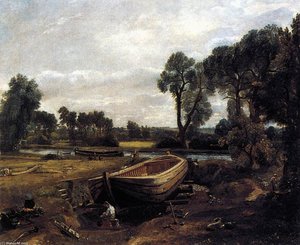 Boat-building near Flatford Mill - John Constable
To stand before John Constable’s Boat-building near Flatford Mill is to step into a quiet, breathing moment of English history. This masterpiece does not merely depict a scene; it captures the very soul of the Romantic landscape painting movement through its profound celebration of harmony. Within this 1815 canvas, we find a narrative of gentle coexistence, where the rhythmic labor of the craftsman becomes a sacred dialogue with the River Stour.
Constable utilizes a luminous, atmospheric technique that predates Impressionism, using dappled light and textured brushstrokes to animate the verdant Dedham Vale. The way sunlight filters through soft, cloud-swept skies creates a sense of sublime tranquility that remains deeply resonant today. In our modern, fast-paced world, this painting serves as a vital cultural touchstone for those seeking aesthetic peace and a reconnection with nature’s slow, enduring cycles. It stands as a definitive pillar among the top 10 masterpieces of Romanticism , reminding us that true beauty is found in the dignity of the everyday and the quiet strength of the natural world.
The Admiral's House (The Grove) - John Constable
 The Admiral's House (The Grove) - John Constable
To stand before a landscape is to encounter a memory of the earth itself, a feeling captured with profound intimacy in The Admiral's House (The Grove) by John Constable . In this 1820 masterpiece, we find one of the most vital pillars of the Romantic landscape painting movement. Constable does not merely paint a structure; he captures the very breath of the Suffolk countryside. The scene is a delicate dance of light and shadow, where a modest red-roofed house seems to dissolve into a lush, verdant grove, blurring the line between human habitation and the wild, enduring spirit of nature.
His technique marks a revolutionary breakthrough in Romanticism; through loose, expressive brushstrokes and a masterful use of white highlights, he achieves an atmospheric haze that feels almost tactile. The light is diffused and golden, evoking a sense of quiet dignity and nostalgia. This work earns its place among the top 10 masterpieces by demonstrating how emotion can be woven into the texture of paint. Even today, such a painting possesses the power to transform a modern room into a sanctuary of peace, reminding us of our eternal connection to the natural world.
Flatford Lock - John Constable
 Flatford Lock - John Constable
To stand before a landscape is to encounter a memory of the earth itself, a quiet breath held between the sky and the soil. In Flatford Lock by John Constable , we find this very essence captured with a profound, soulful intimacy. Painted in 1811, this masterpiece serves as a cornerstone of the Romantic landscape painting movement, moving beyond mere topography to offer a meditation on the fleeting nature of light and time.
Constable invites us into the lush, verdant heart of Suffolk, where the River Stour meanders through a world of dappled sunlight and soft, atmospheric shadows. Through his revolutionary use of 'optical mixing,' he layers delicate washes of color that seem to vibrate with life, creating a luminous depth that feels almost tactile. The scene—featuring quiet figures, drifting boats, and the gentle movement of water—transcends its pastoral subject to evoke a deep, emotional connection to the natural world. It remains a definitive work because it does not just show us a place; it teaches us how to feel the pulse of the landscape, a timeless resonance that continues to transform our homes and spirits today.
East Bergholt - John Constable
 East Bergholt - John Constable
Imagine standing amidst the quiet, dew-drenched fields of Suffolk, where the air carries the scent of damp earth and the sky hums with a soft, silver light. In East Bergholt , John Constable does more than paint a landscape; he captures a heartbeat. This 1813 masterpiece is a profound meditation on the intimacy of home, reflecting the artist's deep, soulful connection to his birthplace. Through a revolutionary use of broken brushstrokes and optical mixing, Constable renders the fleeting, melancholic beauty of an overcast day, where sunlight filters through branches to create a delicate, dappled dance upon the grass.
As one of the top 10 masterpieces that defined the Romantic landscape painting movement , this work transcends mere scenery to explore the symbiotic relationship between humanity and the natural world. The subtle presence of figures and grazing horses breathes life into the pastoral stillness, reminding us of our shared rhythm with the earth. Bringing such a piece into your home offers more than decoration; it invites a sense of timeless serenity and contemplative depth, allowing the emotive power of the Romantic era to enrich the quiet moments of modern life.
Autumn – Evening – Maturity (from the seasons, times of day, and ages of man cycle of 1803) - Caspar David Friedrich
 Autumn – Evening – Maturity (from the seasons, times of day, and ages of man cycle of 1803) - Caspar David Friedrich
In the quietude of Caspar David Friedrich’s Autumn – Evening – Maturity , we find a profound meditation on the human condition. As part of his evocative 1803 cycle, this masterpiece transcends mere landscape painting to become a mirror for the soul. The scene is steeped in a melancholic, autumnal atmosphere, where the muted palette of ochre, deep violet, and dusky grey whispers of life’s twilight. Friedrich masterfully employs light and shadow to guide our gaze toward a rugged mountain range, where a solitary castle clings to a distant peak—a poignant symbol of human ambition fading against the eternal rhythm of nature.
The composition breathes with a spiritual weight; the skeletal branches of foreground trees reach upward like silent prayers, while a small, resting boat suggests a journey nearing its end. To possess such a work is to invite the sublime into your home. It is not mere decoration, but a transformative experience that turns a private room into a gallery of the soul, allowing you to dwell within the beautiful, haunting mystery of time itself.
Landscape with the Rosenberg in the Bohemian Mountains - Caspar David Friedrich
 Landscape with the Rosenberg in the Bohemian Mountains - Caspar David Friedrich
In Landscape with the Rosenberg in the Bohemian Mountains by Caspar David Friedrich, there is a gaze that follows you—not with judgment, but with a profound, quiet understanding . This 1835 masterpiece does not merely present a mountain scene; it acts as a mirror for the soul, reflecting our own place within the vast, indifferent beauty of the natural world. As you stand before this work, the cool blues and misty greys of the snow-shrouded peaks pull you into a meditative state, where the boundary between the viewer and the sublime begins to dissolve.
Friedrich, a pioneer of the Romantic landscape painting movement, uses delicate sfumato to create an ethereal atmosphere that feels both intimate and infinite. The meticulous textures of frozen branches and distant, hazy ridges remind us of the fleeting nature of life against the geological permanence of the mountains. To bring this piece into your home is to invite a gentle reminder: you are seen, you are part of this grand, eternal story, and even in solitude, there is a breathtaking serenity.
two men contemplating the moon - Caspar David Friedrich
 two men contemplating the moon - Caspar David Friedrich
Before the world knew him as the master of the German Romantic landscape, Caspar David Friedrich lived a life shadowed by profound loss, a melancholy that would eventually find its voice in the silvered, nocturnal depths of “Two Men Contemplating the Moon.” In this hauntingly beautiful work, Friedrich achieves a conceptual leap that transcends traditional landscape painting; by populating the heavens with multiple moons and delicate, scattered birds, he breaks the boundaries of reality to touch the surreal. The technical brilliance lies in his restrained, monochromatic palette, using subtle tonal gradations of gray to sculpt light from an infinite darkness, creating a sense of the sublime that is both breathtaking and intimate.
As we trace the silhouettes of the two men beneath the skeletal tree, we feel the tension between human fragility and cosmic grandeur. This masterpiece does more than capture a night sky; it captures a state of soul. For the modern professional, hanging such a piece in a study or home office provides more than mere decoration—it invites a quiet, magnetic intensity and a space for deep, uninterrupted contemplation, fostering an atmosphere of profound intellectual focus.
Conclusion
As the light fades on our journey through these sweeping vistas and mist-covered peaks, we find that the true legacy of Romantic landscape painting lies not in the pigments or the canvas, but in the enduring echoes they leave within the human spirit. These masterpieces do more than merely document a moment in history; they serve as windows into the sublime, inviting us to pause, to breathe, and to reconnect with the profound emotional depths that nature evokes. They remind us that even in our modern, hurried lives, there remains an eternal, quiet dialogue between the soul and the horizon.
To bring these works into one's own sanctuary is to invite a living presence into the home—a piece of history that breathes with texture and light. Whether it is the dramatic tension of a storm-tossed sea or the soft, melancholic glow of a setting sun, these paintings transform a mere room into a space of reflection and wonder. They shape our interiors by adding layers of narrative and emotion, turning walls into gateways for the imagination.
We invite you to continue this exploration and find the piece that speaks to your own heart's landscape by wandering through our full collection . May you find a work that not only adorns your space but resonates with the timeless beauty of the world around us, keeping the flame of romantic wonder alive in your everyday life.