The Dawn of Subjectivity: Moving Beyond the Impressionist Lens
To truly appreciate the transition from Impressionism to Post-Impressionism, one must first remember the soft, flickering light that defined the era of Monet and Renoir. For decades, we have been enamored by those fleeting moments—the way sunlight dances upon a lily pond or the hazy warmth of a Parisian afternoon. Yet, as the nineteenth century drew to a close, a profound restlessness began to stir within the hearts of the avant-garde. The Impressionists had mastered the science of light, but they had left something vital untouched: the deeper, more turbulent currents of the human psyche.
This movement was not a rejection of their predecessors, but rather an evolution—a desire to move beyond the mere optical sensation of sight toward a more profound, subjective truth. Where the Impressionist sought to capture how the eye perceives a landscape, the Post-Impressionists sought to capture how the soul experiences it. It was a shift from the external world to the internal landscape, a transition from the ephemeral moment to the enduring emotion. This era marked the birth of modern subjectivity, where the artist’s personal vision became the primary lens through which reality was filtered and reimagined.
The Language of Color: How Post-Impressionists Painted Feeling
In the hands of the Post-Impressionist masters, color ceased to be a descriptive tool and became a symbolic language. We no longer see colors used simply to denote the shade of a leaf or the blue of a summer sky; instead, we encounter hues that vibrate with psychological intensity. Consider the way a deep, saturated cobalt might evoke a sense of profound melancholy, or how a sudden burst of cadmium yellow can radiate an almost spiritual joy. This was the liberation of color from the constraints of naturalism.
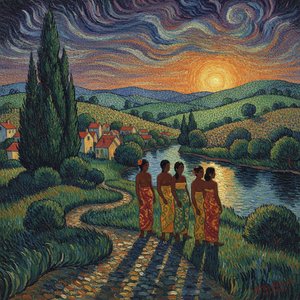
Artists like Gauguin utilized vast planes of non-naturalistic color to evoke a sense of the primordial and the exotic, stripping away the superficial details of reality to reach a more symbolic essence. By decoupling color from its literal subject, these painters invited the viewer into a dialogue with their emotions. To look upon such works is to participate in a sensory experience where a palette of ochre, crimson, and emerald serves as a direct conduit to the artist's temperament. It is a chromatic poetry that speaks much more loudly than words ever could.
Mastering the Stroke: Expressive Brushwork and the Texture of Emotion
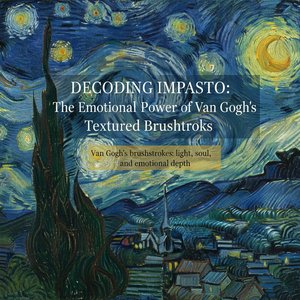
If color provided the vocabulary for this new movement, then the brushstroke provided its rhythm and pulse. The Post-Impressionists introduced a tactile dimension to the canvas that demanded attention. We move away from the delicate, almost invisible touches of the early Impressionists toward a more vigorous, impasto technique. Each stroke becomes a physical trace of the artist's movement, a rhythmic heartbeat captured in dried oil.
The swirling, turbulent eddies of Vincent van Gogh’s brushwork are perhaps the most iconic example of this expressive power. His strokes do not merely sit upon the canvas; they surge and rotate, creating a sense of kinetic energy that mirrors his own internal struggles. This thick application of paint—the visible texture of the medium itself—adds a sculptural quality to the work. When you run your eyes across such a surface, you are not just seeing a depiction of a cypress tree or a starry night; you are witnessing the very physical manifestation of passion, agitation, and profound human connection.
Architects of Form: Cézanne and the Structural Revolution
While some artists moved toward the emotional and the symbolic, others sought to find a new sense of permanence within the chaos of modern life. Paul Cézanne, often regarded as the bridge between Impressionism and Cubism, approached the canvas with the eye of an architect. He was dissatisfied with the perceived "formlessness" of the Impressionist style, which he felt lacked the structural integrity of the Old Masters.
Cézanne’s genius lay in his ability to deconstruct the natural world into fundamental geometric shapes—the sphere, the cone, and the cylinder. Through a meticulous application of color patches, he built up form and volume, creating landscapes that felt as solid and enduring as stone. His work taught us that beneath the fleeting play of light lies a permanent, underlying structure. This disciplined approach to composition provided a foundation for much of twentieth-century art, proving that even within the radical shifts of modernity, there remains a profound respect for the essential geometry of our existence.
A Legacy of Light and Shadow: The Enduring Emotional Resonance of the Masters
The legacy of Post-Impressionism is not found merely in museum archives, but in the way we continue to perceive the world around us. This movement fundamentally altered the DNA of art, teaching us that truth is not always found in a perfect photographic likeness, but often in the distorted, the exaggerated, and the intensely personal. The masters of this era—Van Gogh, Gauguin, Cézanne, and Seurat—each contributed a unique verse to this epic poem of human expression.
Their ability to infuse the canvas with meaning, texture, and symbolic weight continues to resonate with collectors and art lovers alike. When we stand before these works, we are reminded that art is a vessel for empathy. The shadows they cast are not just absences of light, but reservoirs of mystery; the bright colors are not just pigments, but echoes of life's most vibrant joys. Their work remains a testament to the enduring power of the human spirit to find beauty and meaning within the complexities of the soul.
Bringing the Masterpiece Home: Preserving the Soul of Post-Impressionism
For those of us who have spent a lifetime finding solace in these textures and tones, the desire to surround ourselves with such beauty is a natural extension of our passion. Bringing a piece of this history into one's personal sanctuary allows for a daily reconnection with the profound emotions of the masters. Whether it is the structured elegance of a Cézanne-inspired landscape or the emotive energy of a Van Gogh-style tribute, these works transform a house into a gallery of reflection.
At OriginalUniqueArt.com, we understand that true art is about more than decoration; it is about the preservation of a feeling. We specialize in the delicate art of hand-painted oil reproductions, ensuring that the visible brushstrokes and deep tonal ranges of these legends are captured with academic precision on fine cotton canvas. Our mission is to make the soul of Post-Impressionism accessible, allowing you to curate a collection that speaks to your own history and heart. We invite you to explore our curated selections and perhaps find that one piece which resonates with your own unique light.