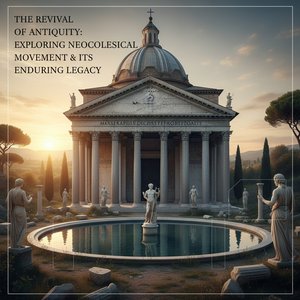
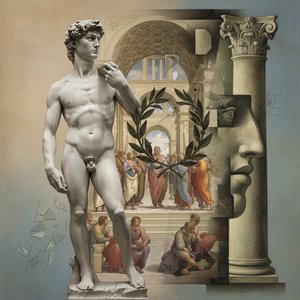
The Foundations of Classicism: Ancient Greece & Rome
Classicism, in the arts, refers generally to a high regard for a classical period, classical antiquity in the Western tradition, as setting standards for taste which the classicists seek to emulate. In its purest form, classicism is an aesthetic atti...
Classicism, as a pervasive force in Western art, isn’t merely a stylistic preference; it's a profound reverence for the achievements of ancient Greece and Rome. It represents a continuous dialogue with civilizations that first articulated ideals of beauty, proportion, and human reason—principles that would echo through millennia. The earliest manifestations weren’t simply imitation, but an aspirational reaching towards a perceived golden age. Greek sculpture, particularly from the Classical period (roughly 5th century BCE), established a canon of idealized forms. The pursuit wasn't photographic realism, but rather the embodiment of perfect physical and moral virtue. Figures like Polykleitos, with his treatise on ideal proportions—embodied in sculptures such as the Doryphoros (Spear-Bearer)—sought to define mathematical relationships that underpinned aesthetic harmony. This emphasis extended beyond sculpture; Greek architecture, exemplified by the Parthenon, demonstrated a mastery of balance and symmetry, utilizing Doric, Ionic, and Corinthian orders to create structures that resonated with order and clarity. The Roman contribution wasn’t simply replication, but adaptation and expansion. While deeply influenced by Greek artistry, Romans excelled in engineering and practicality, constructing monumental public works—aqueducts, amphitheaters like the Colosseum, and triumphal arches—that showcased their power and organizational prowess. The Roman arch itself was a revolutionary innovation, allowing for larger, more complex structures than previously imaginable. Crucially, both cultures imbued their art with narrative power, often drawing upon mythology to explore themes of heroism, fate, and the human condition. This foundational period established a visual vocabulary—a language of form and symbolism—that would be repeatedly revisited and reinterpreted throughout history.
Renaissance Revival: Reconnecting with Classical Ideals
 The Enduring Legacy of Renaissance Art: Innovation, Humanism & Mastery
Explore the enduring legacy of Renaissance art! Discover its historical context, humanist ideals, iconic masterpieces, and lasting influence on Western art with .
Following centuries where classical ideals were filtered through medieval interpretations, the Renaissance (roughly 14th-16th centuries) witnessed a deliberate and passionate rediscovery of antiquity. This wasn’t merely an archaeological pursuit; it was a philosophical shift—a humanist turn that placed human experience at the center of intellectual inquiry. The fall of Constantinople in 1453 led to an influx of Greek scholars and texts into Italy, sparking renewed interest in classical literature, rhetoric, and art. Artists like Donatello, inspired by rediscovered Roman sculptures, broke away from Gothic conventions, embracing naturalism and anatomical accuracy. Brunelleschi’s architectural innovations—most notably the dome of Florence Cathedral—demonstrated a masterful understanding of classical principles of perspective and symmetry. The rediscovery wasn't passive; Renaissance artists weren’t simply copying ancient works but actively reinterpreting them through their own lens. Leonardo da Vinci, Michelangelo, and Raphael exemplify this synthesis – they studied classical forms, but infused them with emotion, dynamism, and a distinctly Renaissance sensibility. The emphasis on proportion—rooted in the writings of Vitruvius—became central to artistic practice. This period also saw a revival of mythological subjects, not as religious icons, but as vehicles for exploring human psychology and philosophical themes. The patronage of wealthy families like the Medici played a crucial role, fostering an environment where classical learning and artistic innovation could flourish.
Neoclassicism's Rise: Enlightenment Values in Art & Architecture
 Paris and Helen
Jacques Louis David’s “Paris and Helen,” completed in 1788, embodies Neoclassicism’s revival of Greco-Roman ideals. This monumental oil on canvas portrays Homer's myth of Helen's abduction by Paris, showcasing David’s skill in depicting dramatic narr...
The 18th century witnessed the emergence of Neoclassicism, a movement deeply intertwined with the Age of Enlightenment. Reacting against the perceived frivolity of Rococo, artists and architects turned once more to classical antiquity—but this time, with a specific ideological agenda. Inspired by archaeological discoveries at Pompeii and Herculaneum, and fueled by the writings of Johann Joachim Winckelmann, Neoclassicism sought to embody Enlightenment values: reason, order, civic virtue, and restraint. Jacques-Louis David became the leading figure of French Neoclassicism, his paintings—such as “Paris and Helen” (1788) and “The Oath of the Horatii”—depicting dramatic narratives from Greek and Roman history with a stark clarity and moral seriousness. These weren’t simply historical recreations; they were intended to inspire patriotic fervor and civic responsibility. In architecture, Neoclassicism manifested in grand public buildings—museums, libraries, and government structures—designed to evoke the authority and stability of ancient Rome. The Pantheon in Paris, with its imposing dome and classical façade, exemplifies this aesthetic. The movement spread throughout Europe and America, influencing everything from furniture design to landscape architecture. Neoclassicism wasn’t simply about replicating forms; it was about embodying a specific set of ideals—a belief in the power of reason, the importance of civic duty, and the enduring legacy of classical civilization.
Key Characteristics of Classical Art: Form, Proportion & Harmony
Underlying all iterations of Classicism is a core set of aesthetic principles. Central to these is an unwavering emphasis on form—the careful consideration of shape, line, and composition. Classical artists weren’t interested in haphazard arrangements; they sought to create structures that were balanced, symmetrical, and harmonious. This pursuit was often guided by mathematical ratios—particularly the golden ratio—believed to be inherently pleasing to the eye. Proportion was equally crucial, ensuring that all elements of a work were appropriately scaled and related to one another. The human figure served as a fundamental model for proportion, with artists striving to depict idealized bodies that embodied physical perfection. Harmony emerged from the careful integration of these principles—a sense of unity and coherence that resonated with order and clarity. This wasn’t simply about visual appeal; it was believed that harmonious forms reflected an underlying cosmic order. Classical art often employed a restrained palette, favoring muted colors and subtle gradations of tone. Dramatic lighting was used to emphasize form and create a sense of depth. The use of mythology provided a rich source of subject matter, allowing artists to explore universal themes—love, loss, heroism, fate—through allegorical narratives. The goal wasn’t simply to depict these stories but to convey moral lessons and philosophical insights.
Influence and Legacy: From David to Contemporary Design
The influence of Classicism extends far beyond the historical periods in which it flourished. Jacques-Louis David's impact, for example, reverberated throughout 19th-century academic painting, shaping generations of artists. Even as Romanticism emerged as a counter-movement—emphasizing emotion and individualism—classical principles continued to exert a powerful influence. Nicolas Poussin’s work, completed in the 17th century, foreshadowed many Neoclassical ideals with its harmonious landscapes and luminous chiaroscuro technique. The 19th century saw a revival of classical motifs in sculpture and architecture, often used to convey notions of power, stability, and national identity. The Beaux-Arts style, prevalent in the late 19th and early 20th centuries, drew heavily upon classical precedents, creating grand public buildings that evoked the authority of ancient Rome and Greece. Even today, classical principles continue to inform contemporary design—from architecture and interior decoration to graphic design and fashion. The emphasis on balance, proportion, and clarity remains a cornerstone of good aesthetic practice. The enduring appeal of classical forms lies in their ability to convey timeless beauty and evoke a sense of order and harmony. Artists continue to reinterpret classical themes and techniques, demonstrating the ongoing relevance of this rich artistic tradition.
Classicism Today: Enduring Principles and Modern Interpretations
While overt imitation of classical styles may be less common in contemporary art, the underlying principles—the pursuit of form, proportion, and harmony—continue to resonate. Many modern artists, even those working in abstract or non-representational styles, demonstrate a sensitivity to these aesthetic values. The influence can be seen in minimalist architecture, which emphasizes clean lines, geometric forms, and a restrained palette. The enduring appeal of classical mythology also persists, providing a rich source of inspiration for contemporary literature, film, and visual art. OriginalUniqueArt.com offers a unique opportunity to connect with this legacy, providing high-quality reproductions of iconic classical masterpieces—allowing you to bring the beauty and wisdom of antiquity into your own home. Whether it’s a meticulously painted oil painting of David's “Paris and Helen” or a custom reproduction tailored to your specific preferences, we strive to honor the enduring spirit of Classicism. Beyond simply acquiring art, you are investing in a tradition—a continuous dialogue with civilizations that first articulated ideals of beauty and human reason. The ability to customize artwork – selecting size, framing, and even transforming personal photos into classical styles – allows for a deeply personal connection with this timeless aesthetic. Explore our collection today and discover the enduring power of Classicism.