Hudson River School · 1872
Tower Falls (Thomas Moran, 1872)
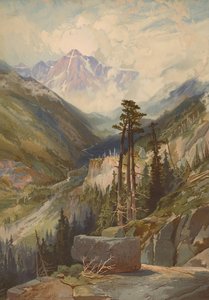
Thomas Moran (1837–1926) schuf Tower Falls. Es stammt aus dem Jahr 1872. Es gehört zur Hudson River School-Strömung. Es ist aus Watercolor gefertigt.
- 1872
- Watercolor

 Vorschau anzeigen

 Handgemaltes Ölgemälde
 Versenden
 Teilen
 Datenblatt


 Herunterladen
 Ähnliche Objekte
 Röntgenaufnahme
 Diashow
 Fragen & Antworten

 Statistiken
Tower Falls im Überblick
- Titel
- Tower Falls
- Künstler
- Thomas Moran (1837–1926)
- Geburtsjahr des Künstlers
- Bolton, Vereinigtes Königreich
- Datum
- 1872
- Medium
- Watercolor
- Bewegung
- Hudson River School
- Epoche
- 19th Century
- Motiv
- waterfall, mountains, river, trees, people, nature
Was stellt Tower Falls dar?
Identification of the Artwork and Artist
In this watercolor, we encounter Tower Falls, a work created by the American landscape painter Thomas Moran. Painted in 1872, the piece captures a specific moment of geological drama within the northeastern region of Yellowstone National Park, Wyoming. The scene focuses on the waterfall situated along Tower Creek, where the water descends through the rugged terrain.
Thomas Moran, born in Bolton, United Kingdom, developed a particular sensitivity to the atmosphere of the American West. His technical background in wood-engraving provided him with a meticulous eye for detail, which he later merged with the fluid, emotive power of watercolor. This specific work emerged from his time spent documenting the territories of the frontier, translating the raw physical reality of the mountains into a visual language of immense proportions.
The subject matter reflects the artist's deep engagement with the natural world. By focusing on the descent of the water over the volcanic pinnacles of Tower Creek, Moran provides a window into the specific character of the Wyoming landscape. It is a quiet, focused study of a singular natural feature, rendered with the precision and atmospheric depth that defined his approach to the American wilderness.
The Composition and Visual Elements
This watercolor presents a landscape of mountains through which a river flows. At the center of the composition, a large waterfall descends between the rugged peaks, framed by the presence of trees. The artist uses the medium to capture the specific textures of the terrain and the movement of the water within this picturesque setting.
To provide a sense of scale, several people are scattered throughout the scene. Some individuals appear in the foreground, while others are positioned further back in the distance, appearing as small figures against the vastness of the mountains. These figures suggest a quiet moment of exploration or observation within the natural environment. The arrangement of the landscape emphasizes the sheer verticality of the cliffs and the depth of the valley.
Related Works by the Same Artist
Moran’s exploration of the American West is deeply rooted in his fascination with geological scale and the interplay of light across rugged terrain. His commitment to documenting these territories is evident in his large-scale oil painting, The Grand Canyon of the Yellowstone (1872). This work, which captures the dramatic essence of the region, reflects the same interest in verticality and natural force seen in this watercolor. His ability to translate the immense proportions of the frontier into a visual language is a recurring theme throughout his career.
The artist continued to investigate the complexities of the Western landscape through various media and subjects. He produced Grand Canyon with Rainbows (1912) and also worked on Chasm of the Colorado (1873-74). These pieces demonstrate his capacity to handle the atmospheric perspective required to render vast, open spaces. His focus often shifted between the detailed observation of specific geological features and the broader, more emotive depictions of mountain ranges.
Other significant compositions include Mountain of the Saints, Jackson Hole, Wyoming (1895) and The Three Tetons (1895). In these works, the artist emphasizes the structural presence of the mountains, utilizing his technical precision to define the very air between the viewer and the horizon. His practice remained centered on the physical reality of the landscape, often moving from field sketches to more substantial, layered compositions in oil.
Hochauflösende Bilder von Tower Falls
Gemeinfrei: Der Künstler verstarb im Jahr 1926.
Thomas Moran, Tower Falls (1872). Gemeinfreiheit
Fragen zu Tower Falls, beantwortet
Wann wurde "Tower Falls" geschaffen?
"Tower Falls" von Thomas Moran entstand im Jahr 1872.
In welcher Technik wurde "Tower Falls" von Thomas Moran ausgeführt?
"Tower Falls" wurde in Watercolor ausgeführt.
Was stellt "Tower Falls" von Thomas Moran dar?
Die Motive von "Tower Falls" sind waterfall, mountains, river, trees, people, nature, landscape.
Ist "Tower Falls" gemeinfrei?
Was das Urheberrecht betrifft, so ist "Tower Falls" gemeinfrei – das Urheberrecht ist abgelaufen.
Wer ist der Künstler hinter "Tower Falls"?
"Tower Falls" wird Thomas Moran zugeschrieben.
Welcher Kunstrichtung lässt sich "Tower Falls" von Thomas Moran zuordnen?
„Tower Falls“ ist ein Werk der Hudson River School. Die Stilrichtung gibt die künstlerische Tradition an, der das Werk angehört.
In welche Phase von Thomas Morans Schaffen lässt sich "Tower Falls" einordnen?
„Tower Falls“ entstammt der Mature Period von Thomas Moran. Diese Einordnung setzt das Werk in Bezug zur künstlerischen Entwicklung des Künstlers.
In welchem Alter schuf Thomas Moran „Tower Falls"?
Als "Tower Falls" im Jahr 1872 entstand, war Thomas Moran – geboren 1837 – 35 Jahre alt.
Ist "Tower Falls" von Thomas Moran gemeinfrei, und warum?
"Tower Falls" von Thomas Moran ist gemeinfrei – das Urheberrecht ist abgelaufen. Die Urheberrechtsfristen werden ab dem Todesjahr des Künstlers berechnet, und Thomas Moran verstarb im Jahr 1926.
Über den Künstler, Thomas Moran

1837–1926, Vereinigtes Königreich
Thomas Moran
Frühe Jahre, Familie und künstlerische Ausbildung Bolton in Lancashire, England, bildet die Geburtsstätte von Thomas Moran, der am 12. Februar 1837 geboren wurde. Er entstammt dem Hause Thomas Moran Sr. und Mary Higson.
 Die Teton-Bergkette1897
 East Moriches1900
 Der Berg des Heiligen Kreuzes, Colorado1876
 Fingalhöhle, Insel Staffa, Schottland1884