American Impressionism · 1890
Summertime (John Ottis Adams, 1890)
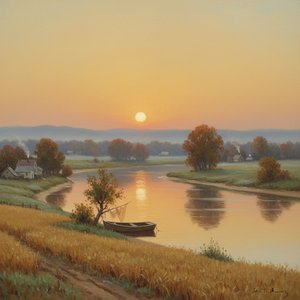
John Ottis Adams (1851–1927) schuf Summertime. Es stammt aus dem Jahr 1890. Es gehört zur American Impressionism-Strömung. Es ist aus Oil gefertigt.
- 1890
- Oil

 Vorschau anzeigen

 Handgemaltes Ölgemälde
 Versenden
 Teilen
 Datenblatt


 Herunterladen
 Ähnliche Objekte
 Röntgenaufnahme
 Diashow
 Fragen & Antworten

 Statistiken
Summertime im Überblick
- Titel
- Summertime
- Künstler
- John Ottis Adams (1851–1927)
- Geburtsjahr des Künstlers
- Indiana, Vereinigte Staaten
- Datum
- 1890
- Medium
- Oil
- Bewegung
- American Impressionism
- Epoche
- 19th Century
- Motiv
- woman, river, boat, people, landscape, water
Was stellt Summertime dar?
Identification of Summertime by J. Ottis Adams
We are looking at Summertime, a work by J. Ottis Adams. This piece was painted about 1890, a period when the artist was refining his approach to the American landscape. It is currently held within the collection of the Ball State University Art Gallery.
Adams, a significant figure in the Hoosier Group, developed a style that moved away from the muted tones of tonalism toward the brighter palettes of Impressionism. In this specific work, he captures a moment of quiet leisure. The painting reflects his ability to translate the atmosphere of the Indiana countryside onto the canvas, focusing on the subtle shifts of light that define a summer day.
Visual Composition and Subject Matter
In this work from about 1890, the viewer is placed within a quiet, sun-drenched countryside. The composition centers on a river bank where two women are positioned, appearing to share a moment of leisure. Their presence provides a focal point for the scene, grounding the landscape in a sense of human connection. The light suggests the warmth of a clear, bright day, casting a gentle glow over the rural setting.
Beyond the primary figures, the artist has scattered several other people throughout the environment. Some are situated in the foreground, while others recede into the background, creating a natural sense of depth and movement. A single boat floats upon the river, adding a layer of stillness to the water. This arrangement captures the quiet essence of rural life, where the rhythms of the day are dictated by the landscape and the gentle activities of those inhabiting it.
Related Works by J. Ottis Adams
To understand the breadth of Adams's landscape practice, one might look toward his explorations of light and water during the turn of the century. Around 1900, he produced Moonlight on the Whitewater, a work that captures the specific atmosphere of the Indiana river valley. This interest in the shifting qualities of light is further evident in The Closing of an Autumn Day, painted in 1901. These pieces reflect his ability to translate the quietude of the Midwestern landscape into a tangible sense of place.
His technical precision and sensitivity to movement are also visible in other compositions from this period. In 1902, he completed Iridescence of a Shallow Stream, a work that focuses on the subtle play of light across a moving surface. This study of water continues in The Ebb of Day (The Bank), which he worked on between 1903 and 1904. Each of these paintings demonstrates his commitment to the nuances of the natural world, moving through the seasons and the changing hours of the day.
Hochauflösende Bilder von Summertime

Gemeinfrei: Der Künstler verstarb im Jahr 1927.
Andere Formate, Ausschnitte und Zitierhinweise →John Ottis Adams, Summertime (1890). Gemeinfreiheit
Fragen zu Summertime, beantwortet
In welchem Jahr wurde "Summertime" von John Ottis Adams geschaffen?
"Summertime" von John Ottis Adams entstand im Jahr 1890.
In welcher Technik wurde "Summertime" von John Ottis Adams ausgeführt?
John Ottis Adams verwendete die Technik der Oil für „Summertime“. Die Technik bestimmt die materielle Beschaffenheit des Originalwerks.
Welche Motive sind in "Summertime" von John Ottis Adams zu sehen?
"Summertime" von John Ottis Adams zeigt: woman, river, boat, people, landscape, water, countryside.
Ist "Summertime" gemeinfrei?
Was das Urheberrecht betrifft, so ist "Summertime" gemeinfrei – das Urheberrecht ist abgelaufen.
Welchem Künstler wird "Summertime" zugeschrieben?
"Summertime" wurde von John Ottis Adams geschaffen. Die Informationen auf dieser Seite beschreiben das Originalwerk von John Ottis Adams.
Welcher Kunstrichtung lässt sich "Summertime" von John Ottis Adams zuordnen?
"Summertime" von John Ottis Adams lässt sich der Strömung des American Impressionism zuordnen. Diese Stilrichtung bildet den künstlerischen Kontext des Werkes.
Welcher Phase in der künstlerischen Entwicklung von John Ottis Adams lässt sich "Summertime" zuordnen?
„Summertime“ entstammt der Mature Period von John Ottis Adams. Diese Einordnung setzt das Werk in Bezug zur künstlerischen Entwicklung des Künstlers.
Wie alt war John Ottis Adams, als „Summertime“ geschaffen wurde?
Als "Summertime" im Jahr 1890 entstand, war John Ottis Adams – geboren 1851 – 39 Jahre alt.
Wie lässt sich der urheberrechtliche Status von "Summertime" von John Ottis Adams erklären?
"Summertime" von John Ottis Adams ist gemeinfrei – das Urheberrecht ist abgelaufen. Die Schutzfrist des Urheberrechts beginnt mit dem Tod des Künstlers im Jahr 1927.
Über den Künstler, John Ottis Adams

1851–1927, Vereinigte Staaten
John Ottis Adams
Ein vergessener Meister des amerikanischen Impressionismus John Ottis Adams, geboren 1851 in der ruhigen Landschaft von Indiana, nimmt eine etwas rätselhafte Position in der Erzählung der amerikanischen impressionistischen Maler ein. Obwohl er nicht die breite Anerkennung genoss, die Zeitgenossen wie T.C. Steele oder William Forsyth – mit denen er den Kern der berühmten Hoosier Group bildete – erlangten, verdient Adams’ Hingabe an die Darstellung der ruhigen Schönheit der amerikanischen Landschaft und die subtilen Nuancen des Alltagslebens eine erneute Aufmerksamkeit. Seine künstlerische Reise, geprägt von Phasen relativer Unbekanntheit, offenbart einen begabten Beobachter, der tief auf das wechselnde Licht und die Atmosphäre eingestimmt war, die das späte 19.
Über John Ottis Adams Bemerkenswerte Werke von John Ottis Adams
Ebenfalls von John Ottis Adams
 Waschtag, Bayern1885
 Das Ende eines Herbsttages1901
 Bäume am Ufer
 Thornberrys Weide, Brooklyn, Indiana1904
Essays zu Summertime
 Amerikanische Kunstwerke der 1890er JahreErleben Sie US-Meisterwerke von Mary Cassatt bis Winslow Homer. Entdecken Sie Kunstreproduktionen auf OriginalUniqueArt.com.
 John Ottis Adams: Capturing Rural Indiana's Luminist SpiritExplore the serene landscapes of John Ottis Adams, a key American Impressionist of the Hoosier Group. Discover his Luminist style & forgott…
 Französische Kunstwerke der 1890er JahreErleben Sie Meisterwerke von Monet und Gauguin aus den 1890ern. Entdecken Sie museale Reproduktionen auf OriginalUniqueArt.com.