Neoclassical
Voltaire (Jean-Antoine Houdon)
Jean-Antoine Houdon (1741–1828) schuf Voltaire. Es gehört zur Neoclassical-Strömung. Es befindet sich im Metropolitan Museum of Art in New York, Vereinigte Staaten von Amerika.

 Vorschau anzeigen

 Handgemaltes Ölgemälde
 Versenden
 Teilen
 Datenblatt


 Herunterladen
 Ähnliche Objekte
 Röntgenaufnahme
 Diashow
 Fragen & Antworten

 Statistiken
Voltaire im Überblick
- Titel
- Voltaire
- Künstler
- Jean-Antoine Houdon (1741–1828)
- Geburtsjahr des Künstlers
- Versailles, Frankreich
- Ausstellungsort
- Metropolitan Museum of Art, New York, Vereinigte Staaten von Amerika
- Bewegung
- Neoclassical
- Motiv
- voltaire, enlightenment, sculpture, houdon, philosophy, portrait
Was stellt Voltaire dar?
Jean-Antoine Houdon’s “Voltaire”: A Portrait of Enlightenment
The photograph before us presents not merely an image, but a profound distillation of the spirit of the Enlightenment – Jean-Antoine Houdon's masterful sculpture of Voltaire. This three-quarter view portrait transcends the simple act of likeness; it captures the very essence of the philosopher’s intellect, his measured demeanor, and a subtle hint of ironic wisdom that has captivated viewers for centuries. Houdon, a pivotal figure bridging the Rococo and Neoclassical eras, possessed an extraordinary ability to imbue his subjects with psychological depth, moving beyond mere representation towards a genuine exploration of character. The sculpture, originally crafted from pristine white marble, stands as a testament to this skill – a tangible embodiment of Voltaire’s legacy.
The composition is strikingly direct and centered. Voltaire occupies the majority of the frame, his gaze meeting the viewer with an almost unsettling intensity. This deliberate focus draws our attention immediately to his face, meticulously rendered with an astonishing level of detail. The subtle curve of his lips, hinting at a wry amusement, combined with the thoughtful set of his brow, speaks volumes about his sharp intellect and philosophical approach to life. The dark marble pedestal, intricately carved with classical motifs, provides a grounding counterpoint to Voltaire’s figure, anchoring him within a framework of established artistic tradition while simultaneously elevating him beyond it.
Neoclassical Realism and the Pursuit of Essence
Houdon's style is firmly rooted in Neoclassicism, an aesthetic movement that sought to revive the ideals of ancient Greece and Rome. However, Houdon’s approach was far from a slavish imitation; instead, he employed classical principles – particularly those relating to proportion and idealized forms – to achieve a remarkably realistic portrayal. The smooth, polished surface of the marble suggests a painstaking process of sculpting and finishing, reflecting the artist's dedication to capturing every nuance of texture and form. The lighting in the photograph, carefully controlled to minimize harsh shadows, further enhances this sense of realism, allowing subtle details—the wrinkles around Voltaire’s eyes, the delicate lines of his hands—to emerge with clarity.
The use of line is equally deliberate. The contours of Voltaire's face are defined with precision, while the folds in his clothing subtly suggest movement and volume. The pedestal exhibits a restrained elegance through its curved and decorative elements, adding visual interest without disrupting the overall sense of balance and harmony. Houdon’s technique involved an intimate understanding of human anatomy, meticulously studied to ensure that every feature was rendered accurately and convincingly. This commitment to realism is evident in the sculpture's ability to evoke a strong emotional response – a feeling of recognition, perhaps even kinship, with this iconic figure of the Enlightenment.
Symbolism and the Philosopher’s Legacy
The slight smile on Voltaire’s face is arguably the most compelling element of the portrait. It isn't a boisterous laugh, but rather a subtle expression of intelligence, wisdom, and perhaps even a touch of ironic detachment. This carefully crafted gesture speaks volumes about Voltaire’s philosophical outlook – his ability to dissect complex ideas with clarity and precision while maintaining a skeptical perspective on human folly. The sculpture as a whole embodies the core tenets of the Enlightenment: reason, skepticism, tolerance, and a commitment to individual liberty.
Voltaire himself was a champion of these ideals, using his writing—satirical essays, philosophical treatises, and historical works—to challenge established norms and advocate for social reform. His portrait by Houdon serves as a powerful reminder of his enduring legacy – a testament to the transformative power of ideas and the importance of critical thinking. The sculpture’s placement within an ornate pedestal further elevates Voltaire's status, suggesting that he is not merely a man, but a figure of profound intellectual significance. It invites contemplation on the nature of knowledge, the pursuit of truth, and the ongoing struggle for freedom of thought.
A Reproduction Worthy of Display
OriginalUniqueArt offers meticulously crafted hand-painted reproductions of this iconic sculpture, allowing you to bring this masterpiece into your home or office. Each reproduction is created by skilled artists who have studied Houdon’s original work with the utmost care, ensuring that every detail—from the texture of the marble to the subtle nuances of Voltaire's expression—is faithfully reproduced. Whether you are an art collector, a design enthusiast, or simply someone seeking a piece of history, a OriginalUniqueArt reproduction of “Voltaire” is a timeless addition to any collection.
In welchem Museum befindet sich Voltaire?
Metropolitan Museum of Art
New York, Vereinigte Staaten von Amerika
Ursprung und Geschichte des Metropolitan Museum of Art Das Metropolitan Museum of Art nahm seinen Anfang mit einer Vision, die von einer Gruppe von Geschäftsleuten, Finanzierern sowie führenden Künstlern und Denkern getragen wurde. Nach seiner Gründung im Jahr 1870 suchte die Institution nach einem dauerhaften Heim, um ihre stetig wachsende Sammlung unterzubringen. Bevor das Museum seinen heutigen Standort bezog, war es kurzzeitig im Anwesen der Douglas Mansion in der West 14th Street untergebracht.


Hochauflösende Bilder von Voltaire

Gemeinfrei: Der Künstler verstarb im Jahr 1828.
Andere Formate, Ausschnitte und Zitierhinweise →Jean-Antoine Houdon, Voltaire, Metropolitan Museum of Art. Gemeinfreiheit
Fragen zu Voltaire, beantwortet
In welchem Museum befindet sich das Original von „Voltaire“?
Das Original von "Voltaire" von Jean-Antoine Houdon befindet sich im Metropolitan Museum of Art, New York, Vereinigte Staaten von Amerika. Eine Reproduktion ermöglicht es, das Werk zu Hause auszustellen.
Was stellt "Voltaire" dar?
Die Motive von "Voltaire" sind voltaire, enlightenment, sculpture, houdon, philosophy, portrait, baroque, france.
Ist die Abbildung von "Voltaire" von Jean-Antoine Houdon gemeinfrei?
Die urheberrechtliche Situation für "Voltaire" von Jean-Antoine Houdon: Das Werk ist gemeinfrei – das Urheberrecht ist abgelaufen. Dies bestimmt, ob Reproduktionen des Bildes frei erstellt werden dürfen.
Wer ist der Künstler hinter "Voltaire"?
"Voltaire" wird Jean-Antoine Houdon zugeschrieben.
Zu welcher Stilrichtung gehört "Voltaire"?
"Voltaire" von Jean-Antoine Houdon lässt sich der Strömung des Neoclassical zuordnen. Diese Stilrichtung bildet den künstlerischen Kontext des Werkes.
Aus welcher Schaffensperiode von Jean-Antoine Houdon stammt "Voltaire"?
"Voltaire" repräsentiert die Enlightenment Period von Jean-Antoine Houdon.
Warum ist der Urheberrechtsstatus von "Voltaire" so, wie er ist?
"Voltaire" von Jean-Antoine Houdon ist gemeinfrei – das Urheberrecht ist abgelaufen. Die Urheberrechtsfristen werden ab dem Todesjahr des Künstlers berechnet, und Jean-Antoine Houdon verstarb im Jahr 1828.
Ist "Voltaire" im Heimatland seines Künstlers verblieben?
Nein – das Kunstwerk wird im Ausland aufbewahrt. Jean-Antoine Houdon wurde in Frankreich geboren, und das Original von „Voltaire“ befindet sich in einem Museum in Vereinigte Staaten von Amerika.
Wie lässt sich "Voltaire" in das Gesamtwerk von Jean-Antoine Houdon einordnen?
"Voltaire" teilt mit anderen Werken von Jean-Antoine Houdon den Stil der Neoclassical sowie die wiederkehrenden Themen: houdon’s realism, enlightenment ideals, philosophical portraiture, washington legacy, french culture.
Über den Künstler, Jean-Antoine Houdon

1741–1828, Frankreich
Jean-Antoine Houdon
Jean-Antoine Houdon: Ein Meister des neoklassischen Porträts Geboren: Versailles, Frankreich (1741) Gestorben: 1828 Jean-Antoine Houdon gilt als eine zentrale Figur der französischen Neoklassik-Skulptur und wird für seine bemerkenswert realistischen und psychologisch tiefgründigen Porträtbüsten und -statuen gefeiert. Seine Karriere erstreckte sich über die Epoche der Aufklärung, in der er das Aussehen von bedeutenden Philosophen, Erfindern, Politikern und Adeligen festhielt und ein Vermächtnis hinterließ, das bis heute Ehrfurcht und Bewunderung hervorruft. Frühes Leben und künstlerische Ausbildung Formale Bildung: Houdon trat 1752 in die Académie Royale de Peinture et de Sculpture ein. Er studierte unter den renommierten Bildhauern René-Michel Slodtz, Jean-Baptiste Lemoyne und Jean-Baptiste Pigalle und verfeinerte seine Fähigkeiten in klassischen Techniken.
Über Jean-Antoine Houdon Bemerkenswerte Werke von Jean-Antoine Houdon
Ebenfalls von Jean-Antoine Houdon
 George Washington1786
 Büste des Mirabeau1800
 St. Bruno1766
 Sitzender Voltaire

Essays zu Voltaire
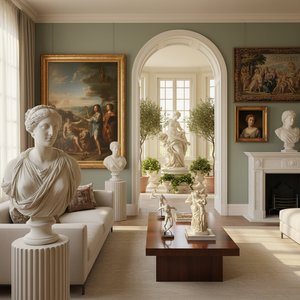 Die 10 Meisterwerke des Neoklassizismus: Kunst für Ihr Zuhause |Entdecken Sie die 10 Meisterwerke des Neoklassizismus! Von David bis Canova – erleben Sie Kunstgeschichte, elegante Ästhetik & zeitlose Sch…
 Die Rückkehr der Antike: Schönheit und Macht in der neoklassizistischen PorträtmalereiErfahren Sie alles über die Ära des Neoklassizismus und die Meister wie David. Jetzt die Kunstgeschichte entdecken.
 25 Kunstwerke im Museum of Fine Arts, Boston: Ein Guide durch die SammlungEntdecken Sie 25 Ikonen des Museum of Fine Arts, Boston. Von Monet bis Van Gogh: Jetzt die ganze Sammlung auf OriginalUniqueArt.com erleben.