Willi Baumeister: A Pioneer of German Modernism
Willi Baumeister, born in Stuttgart in 1889 and passing away in 1955, stands as a pivotal figure in the development of German
modern art. More than simply a painter, he was a multifaceted artist—a scenic designer, an influential art professor, and a skilled typographer – whose diverse practice reflects the dynamic artistic landscape of the early to mid-20th century. His career spanned decades, marked by experimentation, collaboration, and a persistent exploration of abstraction and form, ultimately establishing him as a key voice within the burgeoning modernist movement in Germany.
Baumeister’s early life laid the foundation for his future artistic pursuits. He began his training as a decorative painter in Stuttgart, gaining practical skills in color and composition while simultaneously immersing himself in art studies at the Königlich Württembergische Akademie der Bildenden Künste (Royal Württemberg Academy of Fine Arts). This apprenticeship provided a crucial grounding in traditional techniques, which he later skillfully deconstructed and reinterpreted through his own unique lens. A brief stint in the military during 1907-1908 offered a stark contrast to the artistic environment, but it undoubtedly shaped his understanding of discipline and observation – qualities that would prove invaluable in his subsequent work. His dismissal from Robert Poetzelberger’s drawing class, though initially a setback, ultimately steered him towards
Adolf Hölzel's composition class, where he found a more receptive environment for his evolving artistic vision. This shift marked the beginning of his exploration into abstraction and a move away from purely representational art.
The
early 20th century witnessed a period of intense artistic ferment in Germany, and Baumeister was deeply involved in its most exciting developments. His first trip to Paris in 1911 proved transformative, exposing him to the vibrant energy of the city’s avant-garde scene and introducing him to new ideas and techniques. He quickly gained recognition for his work, participating in gallery exhibitions in Zurich (1912) and showcasing his compositions at the *Erster Deutscher Herbstsalon* (First German Autumn Salon) in Berlin in 1914. This salon, a key platform for emerging artists, provided him with crucial exposure and connections to influential figures like
Franz Marc, whose expressive use of color profoundly influenced Baumeister’s own approach. His early solo exhibition at the *Der Neue Kunstsalon* in Stuttgart in 1914 solidified his position as an artist to watch. During World War I, he found himself in Vienna, engaging with artists such as
Oskar Kokoschka and Adolf Loos – encounters that further broadened his artistic horizons.
Baumeister’s work during the war years demonstrated a willingness to experiment and push boundaries. He participated in exhibitions like *
Hölzel und sein Kreis* (1916), showcasing his evolving style alongside fellow artists associated with
Hölzel's circle, and continued to refine his abstract compositions. His involvement with the Novembergruppe, founded in Berlin in 1918, signaled a commitment to engaging with contemporary artistic trends and challenging established norms. This group, comprised of artists like
Max Pechstein, represented a significant shift towards abstraction and a rejection of traditional academic styles. His later collaborations with
Fernand Léger and Kasimir Malevich further cemented his place within the international modernist dialogue. Beyond painting, Baumeister’s talents extended to scenic design, contributing significantly to theatrical productions throughout the 1920s and beyond, demonstrating his versatility and creative range.
Despite facing challenges – including rejection from the Stuttgart Academy due to a failed attempt to bring
Paul Klee to the institution – Baumeister remained a prolific and influential artist. His work during this period is characterized by bold
geometric forms, vibrant color palettes, and a deliberate simplification of subject matter. His designs for advertisements for companies like Bosch and DLW (Deutsche Linoleumwerke) showcased his ability to translate abstract principles into commercially viable visual communication. The “
Figurate with Red Ellipse” exemplifies this style – a striking composition dominated by a central face rendered in simplified shapes and punctuated by the bold red circle, embodying the artist’s signature approach to abstraction and form. Baumeister's legacy extends beyond his individual works; he played a vital role in fostering artistic exchange and shaping the trajectory of German
modernism, leaving an enduring mark on both the visual arts and the broader cultural landscape.
The Influence of Bauhaus and Beyond
Willi Baumeister’s artistic development was inextricably linked to the burgeoning influence of the
Bauhaus school, even though he wasn't formally associated with it. The principles of functionalism,
geometric abstraction, and a focus on craftsmanship that characterized the
Bauhaus – championed by figures like Walter Gropius and
Josef Albers – resonated deeply with Baumeister’s own artistic explorations. While he never attended the
Bauhaus institution in Dessau, his work shared many affinities with its core tenets, particularly in its emphasis on clarity of form, reduction of elements, and a deliberate rejection of superfluous ornamentation.
Furthermore, Baumeister's engagement with typography reflected this broader interest in design and visual communication. He experimented with different typefaces and layouts, seeking to create works that were both aesthetically pleasing and effectively communicative. His typographic designs for posters and other printed materials demonstrate a sophisticated understanding of the relationship between form and content – a hallmark of the
Bauhaus aesthetic. The influence of figures like Michel Seuphor, who embraced similar principles of clarity and
geometric abstraction in their own work, can also be discerned in Baumeister’s later compositions.
Following World War II, Baumeister continued to produce significant works, adapting his style while retaining his core artistic principles. His output during this period reflects a continuing engagement with abstraction and a willingness to experiment with new materials and techniques. His contributions to the art world were recognized through exhibitions both in Germany and abroad, solidifying his reputation as a leading figure in German
modernism.
Key Achievements and Artistic Style
Willi Baumeister’s artistic career was marked by several key achievements that cemented his place within the history of 20th-century art:
* **Early Recognition:** His participation in the *Erster Deutscher Herbstsalon* (1914) brought him to the attention of influential critics and collectors, establishing him as a promising new talent.
* **Solo Exhibitions:** He held several solo exhibitions throughout his career, providing opportunities to showcase his evolving style and artistic vision.
* **Collaboration with Leading Artists:** His associations with figures like
Franz Marc,
Fernand Léger, and Kasimir Malevich demonstrated his openness to diverse influences and his willingness to engage in collaborative projects.
* **Scenic Design Contributions:** His work as a scenic designer for theater productions significantly contributed to the visual culture of the interwar period.
* **Influence on Typographic Design:** His experiments with typography helped shape the development of modern
graphic design in Germany.
Baumeister’s artistic style is characterized by:
* **
Geometric Abstraction:** A preference for simplified
geometric forms and a deliberate rejection of representational imagery.
* **
Bold Color Palette:** The use of vibrant, often contrasting colors to create dynamic compositions.
* **Emphasis on Form and Composition:** A focus on the interplay of shapes, lines, and colors to achieve visual harmony and impact.
* **Reduction and Simplification:** A tendency to reduce complex subjects to their essential elements, stripping away unnecessary detail.
A Lasting Legacy
Willi Baumeister’s work continues to be exhibited and studied today, demonstrating the enduring relevance of his artistic vision. His contributions to German
modernism are widely recognized, and he is remembered as a pioneering figure who helped shape the course of 20th-century art. His legacy extends beyond individual artworks; he played a crucial role in fostering artistic exchange and promoting innovative approaches to design and visual communication. The “
Figurate with Red Ellipse” remains a powerful symbol of his distinctive style, embodying the artist’s commitment to abstraction, form, and color – qualities that continue to resonate with audiences today.


 Bavarian State Painting Collections
 Israel Museum
 Staatliche Kunsthalle Karlsruhe
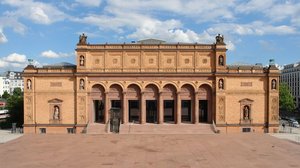 Hamburger Kunsthalle


