Portræt af Nicolai Abildgaard

De 100 mest berømte Nicolai Abildgaard-malerier, en galleriselektion

Opdateret oktober 2026 · rangeret efter vores popularitetsscore (søgninger, besøg og ordrer for hvert værk) · 106 værker af Nicolai Abildgaard i vores katalog

Kort sagt

Af alle de originale værker, som Nicolai Abildgaard efterlod, er det mest berømte The Greek Poet Sappho and the Girl from Mytilene (1809), som er en del af samlingen på Statens Museum for Kunst i København. Lige efter følger Cupid Playing the Lyre. (1782) og Christian V Presents Danish Law 1683 (1784). Vores katalog indeholder 106 værker af Nicolai Abildgaard; galleriet har bevaret de 100 værker, som verden beundrer mest, hver vist med sin dato, sit museum og sin historie.

1743 – 1809, København Neoclassicism Flest værker: Statens Museum for Kunst

Nicolai Abildgaards top 10 malerier: galleriets udvalg

1
The Greek Poet Sappho and the Girl from Mytilene (1809) af Nicolai Abildgaard

The Greek Poet Sappho and the Girl from Mytilene

1809 · Acrylic On Canvas · Statens Museum for Kunst, København

Nicolai Abildgaard’s Sappho and Mytilene: A Vision of Romantic Idealism The painting “The Greek Poet Sappho and the Girl from Mytilene,” created by Nicolai Abraham Abildgaard in 1809, stands as a cornerstone of Danish neoclassical art and embodies the fervent spirit of Romantic idealism. More than just a depiction of two figures, it’s an exploration of beauty, longing, and the sublime—themes central to the artistic sensibilities of the era. Housed…

2
Cupid Playing the Lyre. (1782) af Nicolai Abildgaard

Cupid Playing the Lyre.

1782 · Oil On Canvas · Thorvaldsens Museum, København

In the quiet stillness of a mythological moment, Cupid Playing the Lyre. emerges from the shadows. This oil on canvas work, created by Nicolai Abildgaard around 1782, captures a solitary figure caught in a private, celestial act. The scene centers on a youthful, winged Cupid, whose presence brings a sense of soft grace to the composition. He leans toward a lyre that rests upon a stone pedestal, his delicate form…

3
Christian V Presents Danish Law 1683 (1784) af Nicolai Abildgaard

Christian V Presents Danish Law 1683

1784 · Oil On Canvas · Statens Museum for Kunst, København

Christian V Presents Danish Law 1683 is an oil painting by Nicolai Abildgaard. Created in 1784, this work functions as a history scene depicting a specific real event. The subject matter focuses on a Danish king presenting a body of law, capturing a moment of official legal or political significance. The scene is rendered in a documentary style that emphasizes the gravity of the proceedings.

5
The Potuans are Surprised to see Niels Klim Genuflect in front of the Wise Prince. (1785) af Nicolai Abildgaard

The Potuans are Surprised to see Niels Klim Genuflect in front of the Wise Prince.

1785 · Oil · Statens Museum for Kunst, København

The canvas bears the title The Potuans are Surprised to see Niels Klim Genuflect in front of the Wise Prince. It is a work by Nicolai Abildgaard, a painter who emerged from the scholarly atmosphere of Copenhagen, Denmark. The oil on canvas captures a singular moment of protocol and tension, frozen in the year 1785.

6
Frederik II Builds Kronborg Castle at Elsinore (1782) af Nicolai Abildgaard

Frederik II Builds Kronborg Castle at Elsinore

1782 · Oil On Canvas · Statens Museum for Kunst, København

In this significant work of Danish history, Frederik II Builds Kronborg Castle at Elsinore, the artist Nicolai Abildgaard captures a moment of profound national construction. The painting centers on Frederick II of Denmark, depicted during the foundational stages of the Kronborg Castle at Elsinore. It is a scene that looks back at the 18th century through a lens of historical narrative, focusing on the architectural ambitions of the Danish monarchy.

7
Kulturens herredømme (1796) af Nicolai Abildgaard

Kulturens herredømme

1796 · Oil · Statens Museum for Kunst, København

The oil painting titled Kulturens herredømme, known in English as The supremacy of culture, was executed by the artist Nicolai Abildgaard. This work is identified by the accession number KMS1836. The composition features a monochromatic, black-and-white palette that emphasizes the play of light and shadow across the figures.

8
Christian VII Uniting the Ducal with the Royal Part of Holstein in 1767 (1790) af Nicolai Abildgaard

Christian VII Uniting the Ducal with the Royal Part of Holstein in 1767

1790 · Oil On Canvas · Statens Museum for Kunst, København

The composition centers on a seated male figure, identified as King Christian VII, positioned on the right side of the canvas. He is dressed in white and gold regalia, wearing a crown and holding a scepter. To his left, two female figures are positioned; one faces the viewer directly, while the other is seen in profile, gesturing toward the king. Above the central group, a dark eagle flies through a…

9
Magnus Stenbock Surrenders the Fortress of Tønningen to Frederik IV in 1714 (1785) af Nicolai Abildgaard

Magnus Stenbock Surrenders the Fortress of Tønningen to Frederik IV in 1714

1785 · Oil On Canvas · Statens Museum for Kunst, København

In the grand tapestry of European history, few moments capture the gravity of shifting power quite like the scene depicted in Nicolai Abraham Abildgaard’s 1785 masterpiece, Magnus Stenbock Surrenders the Fortress of Tønningen to Frederik IV in 1714. This evocative oil painting serves as a window into a pivotal era of military diplomacy and sovereign command. The composition is masterfully orchestrated, drawing the viewer into a crowded, dynamic tableau where…

10
The robber's housekeeper comforts the young girl by telling the myth of Amor and Psyche. Motif from Apulejus, The Golden Donkey (1808) af Nicolai Abildgaard

The robber's housekeeper comforts the young girl by telling the myth of Amor and Psyche. Motif from Apulejus, The Golden Donkey

1808 · Oil On Canvas · Statens Museum for Kunst, København

The robber's housekeeper comforts the young girl by telling the myth of Amor and Psyche. Motif from Apulejus, The Golden Donkey is an oil on canvas work created about 1808. This piece captures a quiet, narrative moment between two figures, framed by the presence of a donkey in the shadows. The scene draws its inspiration from the literary motifs found in Apuleius's writings.

Nicolai Abildgaard-udvalget fortsætter, fra 11 til 100

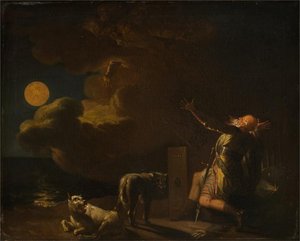
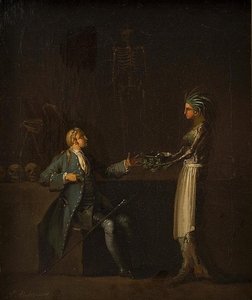
11Apollo charging the Parcae to visit Ceres, who has fled from the Earth (1809) af Nicolai AbildgaardApollo charging the Parcae to visit Ceres, who has fled from the Earth1809 · Statens Museum for Kunst 12Christian III Succouring Denmark (1780) af Nicolai AbildgaardChristian III Succouring Denmark1780 · Statens Museum for Kunst 13Christian III Succouring Denmark (1780) af Nicolai AbildgaardChristian III Succouring Denmark1780 · Statens Museum for Kunst 14The Construction of Copenhagen´s Dock in the Reign of Christian VI (1786) af Nicolai AbildgaardThe Construction of Copenhagen´s Dock in the Reign of Christian VI1786 · Statens Museum for Kunst 15The Prayers of the Potuans at the Feast of the Unfathomable God (1785) af Nicolai AbildgaardThe Prayers of the Potuans at the Feast of the Unfathomable God1785 · Statens Museum for Kunst 16A farewell scene (1783) af Nicolai AbildgaardA farewell scene1783 · Nivaagaards Malerisamling 17Rome as Ruler of the World (1784) af Nicolai AbildgaardRome as Ruler of the World1784 · Statens Museum for Kunst 18The Triumph of a Potuan, whose Reform Proposal has been Approved (1785) af Nicolai AbildgaardThe Triumph of a Potuan, whose Reform Proposal has been Approved1785 · Statens Museum for Kunst 19Absolute Monarchy Assigned to Frederik III in 1660 (1783) af Nicolai AbildgaardAbsolute Monarchy Assigned to Frederik III in 16601783 · Statens Museum for Kunst 20The Establishment of Schools (1781) af Nicolai AbildgaardThe Establishment of Schools1781 · Statens Museum for Kunst 21Asiatic Trade (1782) af Nicolai AbildgaardAsiatic Trade1782 · Statens Museum for Kunst 22Niels Klim thinks he hears the Deacon when he is awakened by a Bull (1785) af Nicolai AbildgaardNiels Klim thinks he hears the Deacon when he is awakened by a Bull1785 · Statens Museum for Kunst 23Standardization of Weights and Measures in 1683 (1784) af Nicolai AbildgaardStandardization of Weights and Measures in 16831784 · Statens Museum for Kunst 24The Foundation of the Royal Library (1783) af Nicolai AbildgaardThe Foundation of the Royal Library1783 · Statens Museum for Kunst 25Richard III wakes up from his nightmare in his tent in Bosworth (1785) af Nicolai AbildgaardRichard III wakes up from his nightmare in his tent in Bosworth1785 · Statens Museum for Kunst 26Alexander's messenger at the Persian philosopher (1785) af Nicolai AbildgaardAlexander's messenger at the Persian philosopher1785 27Alexander the Great and an officer visit Diogenes. (1785) af Nicolai AbildgaardAlexander the Great and an officer visit Diogenes.1785 28The Prince Royal Frederik awakens the sleeping Fama with the help of Clio. Study. (1783) af Nicolai AbildgaardThe Prince Royal Frederik awakens the sleeping Fama with the help of Clio. Study.1783 · The Museum of National History at Frederiksborg Castle 29Richard III Before the Battle of Bosworth (1780) af Nicolai AbildgaardRichard III Before the Battle of Bosworth1780 · Randers Kunstmuseum 30The Archangel Michael and Satan Disputing about the Body of Moses (1785) af Nicolai AbildgaardThe Archangel Michael and Satan Disputing about the Body of Moses1785 · ARoS Aarhus Kunstmuseum 31Niels Klim Receives the Homage of the Quamites. (1787) af Nicolai AbildgaardNiels Klim Receives the Homage of the Quamites.1787 · Statens Museum for Kunst 32King Priam Pleading with Achilles for the Corpse of Hector (1794) af Nicolai AbildgaardKing Priam Pleading with Achilles for the Corpse of Hector1794 · Statens Museum for Kunst 33The Foundation of the Copenhagen Fire Insurance (1786) af Nicolai AbildgaardThe Foundation of the Copenhagen Fire Insurance1786 · Statens Museum for Kunst 34Mercury by the Seashore (1794) af Nicolai AbildgaardMercury by the Seashore1794 · Statens Museum for Kunst 35Richard III (1787) af Nicolai AbildgaardRichard III1787 36Achilles and the Centaur Cheiron (1796) af Nicolai AbildgaardAchilles and the Centaur Cheiron1796 · Statens Museum for Kunst 37Thetis Immersing her Infant Son Achilles in the River Styx to Make him Invulnerable (1796) af Nicolai AbildgaardThetis Immersing her Infant Son Achilles in the River Styx to Make him Invulnerable1796 · Statens Museum for Kunst 38The Death of Achilles (1796) af Nicolai AbildgaardThe Death of Achilles1796 · Statens Museum for Kunst 39Philosophy. Allegorical figure. (1800) af Nicolai AbildgaardPhilosophy. Allegorical figure.1800 · Statens Museum for Kunst 40The Slave Davus and the Maid Mysis. From Terence´s Andria. (1804) af Nicolai AbildgaardThe Slave Davus and the Maid Mysis. From Terence´s Andria.1804 · Statens Museum for Kunst 41Christian I Raising the Province of Holstein to the State of a Duchy in 1460 (1778) af Nicolai AbildgaardChristian I Raising the Province of Holstein to the State of a Duchy in 14601778 · Statens Museum for Kunst 42Jurisprudence. Allegorical Figure (1800) af Nicolai AbildgaardJurisprudence. Allegorical Figure1800 · Statens Museum for Kunst 43Achilles and the Daughters of Lycomedes (1796) af Nicolai AbildgaardAchilles and the Daughters of Lycomedes1796 · Statens Museum for Kunst 44Theology. Allegorical figure (1800) af Nicolai AbildgaardTheology. Allegorical figure1800 · Statens Museum for Kunst 45Simo and his former slave Sosia. From Terence´s Andria. (1803) af Nicolai AbildgaardSimo and his former slave Sosia. From Terence´s Andria.1803 · Statens Museum for Kunst 46Julia and Fulvia (1800) af Nicolai AbildgaardJulia and Fulvia1800 · Nationalmuseet for kunst, arkitektur og design 47Portrait of the artist's son Marcus Aurelius Abildgaard. (1797) af Nicolai AbildgaardPortrait of the artist's son Marcus Aurelius Abildgaard.1797 48Fingal gives his weapons to Oscar. (1796) af Nicolai AbildgaardFingal gives his weapons to Oscar.1796 · Kunsten Museum of Modern Art Aalborg 49Allegory of Philosophy (1800) af Nicolai AbildgaardAllegory of Philosophy1800 50Allegory of Protestantism (1809) af Nicolai AbildgaardAllegory of Protestantism1809 · Ribe Kunstmuseum 51The Catholic Worldview, Allegory (1809) af Nicolai AbildgaardThe Catholic Worldview, Allegory1809 · Ribe Kunstmuseum 52The Oath of Fealty in 1660 (1806) af Nicolai AbildgaardThe Oath of Fealty in 16601806 · Statens Museum for Kunst 53Odysseus Takes Counsel with Teiresias. From Homer´s Odyssey (1809) af Nicolai AbildgaardOdysseus Takes Counsel with Teiresias. From Homer´s Odyssey1809 · Statens Museum for Kunst 54Fotis sees her Lover Lucius Transformed into an Ass. Motif from Apeleius' The Golden Ass (1809) af Nicolai AbildgaardFotis sees her Lover Lucius Transformed into an Ass. Motif from Apeleius' The Golden Ass1809 · Statens Museum for Kunst 55Tarquin and the Sibyl (1809) af Nicolai AbildgaardTarquin and the Sibyl1809 · Statens Museum for Kunst 56Hierarchy at its Peak at the time of the Crusades (1784) af Nicolai AbildgaardHierarchy at its Peak at the time of the Crusades1784 · Statens Museum for Kunst 57The Revival of Learning, the Invention of Printing and Gunpowder and the Discovery of America (1784) af Nicolai AbildgaardThe Revival of Learning, the Invention of Printing and Gunpowder and the Discovery of America1784 · Statens Museum for Kunst 58Papirius and his Mother (1809) af Nicolai AbildgaardPapirius and his Mother1809 · Statens Museum for Kunst 59Alexander the Great and Diogenes. (1809) af Nicolai AbildgaardAlexander the Great and Diogenes.1809 · Kunsten Museum of Modern Art Aalborg 60Fotis sees her Lover Lucius Transformed into an Ass. Motif from Apeleius' The Golden Ass (1809) af Nicolai AbildgaardFotis sees her Lover Lucius Transformed into an Ass. Motif from Apeleius' The Golden Ass1809 · Statens Museum for Kunst 61Tibullus Lamenting outside the Door of his Beloved (1808) af Nicolai AbildgaardTibullus Lamenting outside the Door of his Beloved1808 · Statens Museum for Kunst 62Christian IV Aboard his Flagship "The Trinity" (1782) af Nicolai AbildgaardChristian IV Aboard his Flagship "The Trinity"1782 · Statens Museum for Kunst 63Two Young Men Confessing to Alexander the Great their Conspiracy against Him (1800) af Nicolai AbildgaardTwo Young Men Confessing to Alexander the Great their Conspiracy against Him1800 · Statens Museum for Kunst 64Niels Klim Attends the Sentencing of the Deceased Potuan Prince. (1785) af Nicolai AbildgaardNiels Klim Attends the Sentencing of the Deceased Potuan Prince.1785 · Statens Museum for Kunst 65The Abolition of Adscription in 1788 (1790) af Nicolai AbildgaardThe Abolition of Adscription in 17881790 · Statens Museum for Kunst 66Frederik V as Patron of Science and Arts (1787) af Nicolai AbildgaardFrederik V as Patron of Science and Arts1787 · Statens Museum for Kunst 67The Midwife Taking Leave of the Girl from Andros (from Terence's Andria ) (1801) af Nicolai AbildgaardThe Midwife Taking Leave of the Girl from Andros (from Terence's Andria )1801 · Statens Museum for Kunst 68Nature Untamed (1784) af Nicolai AbildgaardNature Untamed1784 · Statens Museum for Kunst 69Hamlet Delivering a Letter Written by Himself to the Queen of Scotland (1776) af Nicolai AbildgaardHamlet Delivering a Letter Written by Himself to the Queen of Scotland1776 · Statens Museum for Kunst 70From Ludvig Holbergs´s The Journey of Niels Klim to The World Underground (1785) af Nicolai AbildgaardFrom Ludvig Holbergs´s The Journey of Niels Klim to The World Underground1785 · Statens Museum for Kunst 71Frederik II Builds Kronberg Castle at Elsinore (1781) af Nicolai AbildgaardFrederik II Builds Kronberg Castle at Elsinore1781 · Statens Museum for Kunst 72The Dying Messalina and Her Mother (1797) af Nicolai AbildgaardThe Dying Messalina and Her Mother1797 · Statens Museum for Kunst 73The Greek Poet Anacreon and Bathyll (1808) af Nicolai AbildgaardThe Greek Poet Anacreon and Bathyll1808 · Statens Museum for Kunst 74Christian I Elevates Holstein to a Duchy in 1474 (1778) af Nicolai AbildgaardChristian I Elevates Holstein to a Duchy in 14741778 · Statens Museum for Kunst 75Socrates in Prison (1784) af Nicolai AbildgaardSocrates in Prison1784 · Ny Carlsberg Glyptotek 76Niels Klim in Potu (1785) af Nicolai AbildgaardNiels Klim in Potu1785 · Statens Museum for Kunst 77Allegory on the Right of Citizenship (1790) af Nicolai AbildgaardAllegory on the Right of Citizenship1790 · Statens Museum for Kunst 78Culmin's Ghost Appears to his Mother (1794) af Nicolai AbildgaardCulmin's Ghost Appears to his Mother1794 79Fingal Sees the Ghosts of his Forefathers by Moonlight (1782) af Nicolai AbildgaardFingal Sees the Ghosts of his Forefathers by Moonlight1782 · Statens Museum for Kunst 80Male Figure after Michelangelo's 'Last Judgement' in the Sistine Chapel (1774) af Nicolai AbildgaardMale Figure after Michelangelo's 'Last Judgement' in the Sistine Chapel1774 · Statens Museum for Kunst 81Ismene and Antogone Plead with Theseus (1799) af Nicolai AbildgaardIsmene and Antogone Plead with Theseus1799 · Statens Museum for Kunst 82Hamlet and His Mother (1778) af Nicolai AbildgaardHamlet and His Mother1778 · Statens Museum for Kunst 83Richard III terrified by nightmarish visions. Shakespeare, Act 5, Scene 9 af Nicolai AbildgaardRichard III terrified by nightmarish visions. Shakespeare, Act 5, Scene 9Nivaagaards Malerisamling 84Amor and Psyche embracing each other af Nicolai AbildgaardAmor and Psyche embracing each otherNivaagaards Malerisamling 85Two Roman warriors watching a seated man embracing a child af Nicolai AbildgaardTwo Roman warriors watching a seated man embracing a child 86Scenes from 'Niels Klim's Subterranean Journey' af Nicolai AbildgaardScenes from 'Niels Klim's Subterranean Journey'Hamburger Kunsthalle 87Audhumla af Nicolai AbildgaardAudhumlaStatens Museum for Kunst 88The Doctor's Wife Reveals Her Husband's Intention of Anatomising Niels Klim (1787) af Nicolai AbildgaardThe Doctor's Wife Reveals Her Husband's Intention of Anatomising Niels Klim1787 · Statens Museum for Kunst 89The Finding of the Infant Moses af Nicolai AbildgaardThe Finding of the Infant MosesStatens Museum for Kunst 90Adam and Eve (1780) af Nicolai AbildgaardAdam and Eve1780 · Nationalmuseum 91Catullus, and Lesbia Seeking Comfort in his Arms for the Death of her Sparrow (1809) af Nicolai AbildgaardCatullus, and Lesbia Seeking Comfort in his Arms for the Death of her Sparrow1809 · Nivaagaards Malerisamling 92A view of Schie Church in Sweden af Nicolai AbildgaardA view of Schie Church in SwedenSorø Art Museum 93Adrastos Slays Himself on Atys' Tomb af Nicolai AbildgaardAdrastos Slays Himself on Atys' TombARoS Aarhus Kunstmuseum 94Lover Pamfilus in conversation with his forslagne serve Davus af Nicolai AbildgaardLover Pamfilus in conversation with his forslagne serve DavusStatens Museum for Kunst 95Portrait of Nicolai Abraham Abildgaard af Nicolai AbildgaardPortrait of Nicolai Abraham Abildgaard 96Ossian's swansong af Nicolai AbildgaardOssian's swansongStatens Museum for Kunst 97Hamlet Shows His Mother the Ghost of His Father af Nicolai AbildgaardHamlet Shows His Mother the Ghost of His Father 98Fingal Sees the Ghosts of His Ancestors in the Moonlight af Nicolai AbildgaardFingal Sees the Ghosts of His Ancestors in the Moonlight 99The Midwife taking Leave of the girl from Andros. From Terence's Andria af Nicolai AbildgaardThe Midwife taking Leave of the girl from Andros. From Terence's AndriaStatens Museum for Kunst 100Jupiter Weighing the Fate of Man af Nicolai AbildgaardJupiter Weighing the Fate of ManRibe Kunstmuseum

Nicolai Abildgaards berømte malerier, periode for periode

Motiverne, der fangede Nicolai Abildgaards blik

De fire motiver, der optræder hyppigst i disse originaler, hver med sit fineste eksempel.

De museer, der udstiller Nicolai Abildgaards originalværker

De 8 museer, der rummer flest af malerierne på denne side.

Museum By Værker af Nicolai Abildgaard Malerier fra denne liste
Statens Museum for Kunst, KøbenhavnStatens Museum for Kunst København 71 The Greek Poet Sappho and the Girl from Mytilene, Christian V Presents Danish Law 1683, Julia and Fulvia
Nivaagaards Malerisamling, NibeNivaagaards Malerisamling Nibe 4 A farewell scene, Richard III terrified by nightmarish visions. Shakespeare, Act 5, Scene 9, Amor and Psyche embracing each other
Ribe Kunstmuseum, EsbjergRibe Kunstmuseum Esbjerg 3 Allegory of Protestantism, The Catholic Worldview, Allegory, Jupiter Weighing the Fate of Man
ARoS Aarhus Kunstmuseum, AarhusARoS Aarhus Kunstmuseum Aarhus 2 The Archangel Michael and Satan Disputing about the Body of Moses, Adrastos Slays Himself on Atys' Tomb
Kunsten Museum of Modern Art Aalborg, AalborgKunsten Museum of Modern Art Aalborg Aalborg 2 Fingal gives his weapons to Oscar., Alexander the Great and Diogenes.
The Museum of National History at Frederiksborg Castle, HillerødThe Museum of National History at Frederiksborg Castle Hillerød 2 The Prince Royal Frederik awakens the sleeping Fama with the help of Clio. Study.
Nationalmuseum, StockholmNationalmuseum Stockholm 2 Adam and Eve
Sorø Art Museum, SorøSorø Art Museum Sorø 2 A view of Schie Church in Sweden

Nicolai Abildgaard årti for årti: det originale værk, der definerer hvert enkelt

Værker per årti

Vælg et årti for at se det originale værk, der definerer det.

Samleres spørgsmål om Nicolai Abildgaards malerier

Hvilket værk er Nicolai Abildgaard mest kendt for?Vis svaret

The Greek Poet Sappho and the Girl from Mytilene (1809), Statens Museum for Kunst, København. Derefter følger Cupid Playing the Lyre. (1782) og Christian V Presents Danish Law 1683 (1784).

Hvor gammel var Nicolai Abildgaard, da The Greek Poet Sappho and the Girl from Mytilene blev skabt?Vis svaret

66 år gammel: The Greek Poet Sappho and the Girl from Mytilene er fra 1809, og Nicolai Abildgaard blev født i 1743.

Hvad er de ti mest berømte Nicolai Abildgaard malerier?Vis svaret

The Greek Poet Sappho and the Girl from Mytilene, Cupid Playing the Lyre., Christian V Presents Danish Law 1683, Julia and Fulvia, The Potuans are Surprised to see Niels Klim Genuflect in front of the Wise Prince., Frederik II Builds Kronborg Castle at Elsinore, Kulturens herredømme, Christian VII Uniting the Ducal with the Royal Part of Holstein in 1767, Magnus Stenbock Surrenders the Fortress of Tønningen to Frederik IV in 1714 og The robber's housekeeper comforts the young girl by telling the myth of Amor and Psyche. Motif from Apulejus, The Golden Donkey. Ranglisten ovenfor viser det enkelte værks årstal og museum.

Hvor mange malerier efterlod Nicolai Abildgaard?Vis svaret

Vores katalog indeholder 106 værker af Nicolai Abildgaard, dateret fra 1774 til 1809.

I hvilke museer udstilles Nicolai Abildgaard's mesterværker?Vis svaret

Primært i Statens Museum for Kunst (København), Nivaagaards Malerisamling (Nibe) og Ribe Kunstmuseum (Esbjerg). Museumslisten ovenfor viser dem alle.

I hvilke år malede Nicolai Abildgaard sine mest berømte værker?Vis svaret

I 1780s: 40 af de 100 værker på denne side blev skabt dengang, herunder Cupid Playing the Lyre..

Hvad er de første og de sidste berømte originaler af Nicolai Abildgaard?Vis svaret

På denne side er det tidligste Male Figure after Michelangelo's 'Last Judgement' in the Sistine Chapel (1774) og det seneste The Greek Poet Sappho and the Girl from Mytilene (1809).

Hvilke motiver valgte Nicolai Abildgaard oftest?Vis svaret

Woman (12), Drapery (10) og Shadows (9), fordelt på de 100 værker på denne side.

Hvilken teknik brugte Nicolai Abildgaard mest?Vis svaret

Oil On Canvas, for 27 af de 100 værker på denne side.

Hvilken kunstretning tilhører Nicolai Abildgaard?Vis svaret

Neoclassicism og Neoclassical romanticism, baseret på originalerne på denne side.

Hvilke værker af Nicolai Abildgaard udstilles på Statens Museum for Kunst?Vis svaret

The Greek Poet Sappho and the Girl from Mytilene, Christian V Presents Danish Law 1683 og Julia and Fulvia: Statens Museum for Kunst, København har 71 af værkerne på denne side.

Kan jeg bestille en reproduktion af et maleri af Nicolai Abildgaard?Vis svaret

Ja, som reproduktion: det originale værk bliver i sit museum, men ethvert maleri på denne side kan males i hånden til dig, bestilt efter behov og malet ét ad gangen, direkte fra maleriets egen side.

Nicolai Abildgaard: liv og værk

Early Life and Artistic Foundations

Nicolai Abraham Abildgaard, født den 11. september 1743 i København, Danmark, udgjorde en del af en kunstnerisk og akademisk familie. Hans far, Søren Abildgaard, var en respekteret antikvitetstegner, hvilket gav unge Nicolai tidlig forståelse for klassiske former og præcis observation. Denne familiære indflydelse viste sig fundamentalt, da Abildgaard begyndte sin kunstneriske rejse, hvor han modtog første træning hos en lokal malermester før han officielt blev optaget på Det Kongelige Danske Kunstakademi i 1764. Hans talent blev hurtigt tydeligt; fra 1764 til 1767 vandt han konstant ros og medaljer, der erkendte hans spirende dygtighed. Disse tidlige succeser kulminerede i en rejsepengegodkendelse udstedt i 1767 – en afgørende mulighed, der skulle forme kunstnerens kunstneriske udvikling, selvom det var fem år før han kunne endelig udnytte den. Under disse formative år på Akademiet fik Abildgaard vejledning fra Johan Edvard Mandelberg og Johannes Wiedewelt, hvorved han absorberede deres teknikker og perspektiver samtidig med at han skabte sin egen unikke sti. Han blev født i København, Danmark, som søn af Anne Margrethe Bastholm og Søren Abildgaard, en kendt antiquitetstegner. Denne familie var dybt involveret i kunstens verden og havde stor betydning for hans kunstneriske udvikling. Efter at være blevet malersvend arbejdede han som medhjælper under Mandelberg, samtidig med at han gennemgik uddannelse på Akademiet, hvor han studerede under Wiedewelt. Han vandt en serie af medaljer ved Akademiet for sin briljans fra 1764 til 1767 og fik senere udnævnt til professor ved akademiet. Hans tidlige træning var essentielt for hans kunstneriske udvikling og gav ham et solidt fundament til at udforske klassisk kunst og arkitektur.

The Roman Awakening: A Shift in Perspective

I 1772 tog Nicolai Abildgaard endelig sin drøm om rejse til Rom ud af fantasien. Denne femårige ophold gjorde en betydelig forskel i hans kunstneriske udvikling og markerede et kritisk vendepunkt. Omgivet af hjertet af klassisk antikken dedikerede han sig til at studere ikke kun skulptur, men også arkitektur, dekorationskunst og de imponerende fresker, der prydede Palazzo Farnese. Et besøg i Napoli i 1776 med kunstner Jens Juel udvidede hans horisonter yderligere. Rom var ikke blot et sted for teknisk studie; det var en intellektuel opvækst. Abildgaard dykkede ned i historiepainting og søgte at mestre dets kompleksiteter og fortællende kraft. Han fandt inspiration i klassiske kunstnere som Caravaggio, Rafael og Michelangelo og absorberede deres kompositionsstrategier samt brug af lys og farve til at skabe dramatiske og følelsesladne billeder. Hans interesse for klassisk kunst var ikke blot akademisk; han blev dybt påvirket af den romantiske æra og studerede værker af kunstnere som Johann Tobias Sergel og Friedrich Heinrich Kupfer, hvilket førte til en udvikling af hans egen unikke stil. Han var særlig fascineret af Michelangelo Buonarroti og hans brug af perspektiv og anatomi i skulpturer som David og Moses. Denne interesse for klassisk kunst og arkitektur blev videreført gennem hele hans karriere og prægede hans kunstneriske arbejde. Hans besøg i Italien var essentielt for hans kunstneriske udvikling og gav ham mulighed for at studere klassiske monumenter og teknikker direkte fra kilden. Han udførte flere kopier af klassiske værker, hvilket demonstrerede hans dygtighed til at efterligne klassisk stil og teknik.

Royal Commissions and National Narratives

Efter hjemkomsten fra Rom i 1777 blev Abildgaard straks anerkendt som en kunstner på fremstormende niveau. Han fik hurtigt udnævnt til professor ved Det Kongelige Danske Kunstakademi i 1778 og tog senere direktørstillingen i 1789 sammen med professurrollen, hvilket gav ham en årlig løn af 200 daler courant – en sum, der kort efter blev forøget til det dobbelte. Han var medlem af Akademiet fra 1789 og fortsatte sin kunstneriske udvikling gennem hele livet. Hans største udfordring kom i form af en stor bestilling fra den danske regering: at male en serie af historiebilleder til Christiansborg Slot, hvor han skulle fortælle Danmark’s historie på en måde, der glorificerede kongelige magt og fremmede følelser af national identitet. Dette projekt blev hans største kunstneriske præstation og definerede hans karriere. Han arbejdede intensivt på dette projekt i flere år og brugte sine klassiske færdigheder til at skabe imponerende kompositioner og dramatiske billeder, der skulle inspirere publikum og fremme en følelse af patriotisme. Hans arbejde var ikke blot kunstnerisk udfordrende; det var også politisk betydningsfuldt, da han brugte sine kunstværker til at udtrykke sine synspunkter om samfundet og statens rolle. Han var særlig interesseret i klassiske fortællinger og søgte at efterligne stil og teknik hos nogle af verdens største kunstnere. Hans mål var ikke blot at skabe smukke billeder; han ville også formidle vigtige historiske og kulturelle budskaber til offentligheden. Dette projekt blev hans største udfordring og krævede både teknisk dygtighed og kunstnerisk kreativitet. Han var en af de få danske kunstnere, der fik mulighed for at arbejde direkte med kongelige myndigheder og udtrykke sine ideer gennem kunstværker. Hans arbejde havde stor betydning for dansk kunsthistorie og bidrog til udviklingen af den nordiske romantik.

Legacy and Enduring Influence

Nicolai Abildgaard døde i Frederiksdal den 4. juni 1809 efter en længere sygdom. Han efterlod sig et omfattende kunstnerisk værk, der omfatter både historiebilleder og skulpturer samt dekorative værker til forskellige offentlige bygninger og private klienter. Hans arbejde blev rost af mange samtidige kunstnere og kritikere og anses for at være en af de mest betydningsfulde kunstnere i dansk kunsthistorie. Han var særlig kendt for sine historiebilleder, hvor han brugte klassiske teknikker til at skildre vigtige begivenheder og personer fra Danmark’s historie på en måde, der var både præcis og følelsesladet. Hans mest berømte værk er "David Salves af Samuel", hvor han efterlignede Michelangelo Buonarroti og brugte klassisk perspektiv til at skildre denne ikoniske scene med stor dygtighed og følelsesmæssig kraft. Han var også en vigtig figur i udviklingen af dansk kunstakademi og uddannede mange talentfulde unge kunstnere, hvoraf nogle blev internationale kunstnere og bidrog betydeligt til dansk kunsthistories videre udvikling. Hans kunstneriske arv lever videre gennem hans elever og hans værker udstilles stadig på museer og galerier rundt om i verden og er et vidnesbyrd om hans kunstners dygtighed og hans betydning for dansk kultur og kunsthistorie. Han var en pionér indenfor dansk kunst og arkitektur og efterlod sig et varigt præg på dansk kunsthistories udvikling. Hans arbejde blev kritisk analyseret og vurderet af mange kunsthistorikere og kunstnere gennem tiden og anses for at være en af de mest betydningsfulde kunstnere i dansk kunsthistories udvikling. Han var en vigtig stemme indenfor dansk kunst og kultur og efterlod sig et varigt præg på dansk kunsthistories udvikling.

Alle 106 værker af Nicolai Abildgaard →