Portræt af Kawanabe Kyōsai

De 72 mest berømte Kawanabe Kyōsai-malerier, hver og en unik

Opdateret november 2026 · rangeret efter vores popularitetsscore (søgninger, besøg og ordrer for hvert værk) · 72 værker af Kawanabe Kyōsai i vores katalog

Kort sagt

Three Kyōgen Dancers (801) er det maleri af Kawanabe Kyōsai, der vækker mest opsigt; originalen findes på Metropolitan Museum of Art, New York. Derefter falder blikket på Sketches of East Asian Legendary Figures (801) og Yang Guifei Adjusting her Hair (1850). Blandt de 72 værker af Kawanabe Kyōsai i vores katalog er disse 72 de mest berømte, hver især et unikt originalværk præsenteret med sit årstal, sit museum og årsagen til dets tidløse betydning.

1831 – 1889, Koga Ukiyo-e Flest værker: Metropolitan Museum of Art

Top 10 malerier af Kawanabe Kyōsai, set gennem galleriets øjne

1
Three Kyōgen Dancers (801) af Kawanabe Kyōsai

Three Kyōgen Dancers

801 · Ink · Metropolitan Museum of Art, New York

A preliminary ink drawing captures three performers in the midst of a kyōgen dance. These figures, rendered with a fluid and spontaneous energy, embody the comedic essence of traditional Japanese theater. Each dancer is frozen in a distinct, expressive pose that suggests movement and rhythmic timing. One figure holds a drum, another a fan, and the third a bag, marking the specific roles and props essential to the performance. The…

2
Sketches of East Asian Legendary Figures (801) af Kawanabe Kyōsai

Sketches of East Asian Legendary Figures

801 · Ink · Metropolitan Museum of Art, New York

The ink flows across the paper, capturing a moment of quietude and myth. In this black and white drawing, figures from the realm of legend emerge from the shadows of the everyday. We see Japanese figures like Daikoku and Urashima Tarō sharing space with Chinese immortals and the Twenty-Four Paragons of Filial Piety. There is a strange, casual intimacy to the scene, as if these divine and legendary beings have…

3
Yang Guifei Adjusting her Hair (1850) af Kawanabe Kyōsai

Yang Guifei Adjusting her Hair

1850 · Ink On Paper · Los Angeles County Museum of Art, Los Angeles

In "Yang Guifei Adjusting her Hair" by Kawanabe Kyōsai, the brush captures a moment of quiet preparation. The subject is Yang Guifei, a woman known to history as Lady Yang. She was the beloved consort of Emperor Xuanzong of Tang and remains celebrated as one of the Four Beauties of ancient China. Here, she is a figure of grace, focused on the delicate task of arranging her hair.

4
Yamauba and Kintarō (1850) af Kawanabe Kyōsai

Yamauba and Kintarō

1850 · Ink On Paper · Los Angeles County Museum of Art, Los Angeles

In this vertical composition, Kawanabe Kyōsai presents a dynamic encounter between two figures from Japanese folklore. The work, created about 1850, centers on the mountain hag Yamauba and the superhuman child Kintarō. A large, standing female figure dominates the space, her presence defined by the voluminous folds of her robes. Beside her, a smaller, crouching male figure provides a sense of scale and tension. The arrangement of these two bodies…

5
Hell Courtesan (1870) af Kawanabe Kyōsai

Hell Courtesan

1870 · Cleveland Museum of Art, Cleveland

The scene unfolds within the delicate confines of a hanging scroll, where the figure of the Hell Courtesan, known in Japanese as Jigoku Tayū, emerges from the silk. This work, titled Hell Courtesan, captures a moment of profound stillness and spiritual weight. The artist, Kawanabe Kyōsai, brings this legendary character to life through a composition that balances the elegance of a high-ranking courtesan with the unsettling imagery of the afterlife.…

6
Frolicking Figures and Animals (1870) af Kawanabe Kyōsai

Frolicking Figures and Animals

1870 · Ink On Paper · Metropolitan Museum of Art, New York

In this horizontal handscroll from 1870, we find a quiet, almost whispered dialogue between human presence and the natural world. The composition relies heavily on the use of negative space, a deliberate emptiness that allows the viewer to focus entirely on the gestural energy of the brushstrokes. It is a work of profound restraint, where the absence of color speaks more loudly than a full palette could. The monochromatic shades…

7
Calligraphy and Painting Party (1877) af Kawanabe Kyōsai

Calligraphy and Painting Party

1877 · Ink On Paper

Calligraphy and Painting Party is a hanging scroll created by the Japanese painter and caricaturist Kawanabe Kyōsai. Born in 1831 in Koga, Japan, the artist navigated the shifting tides of the Edo and Meiji periods. This work dates to 1880, a moment when his brush captured the restless energy of a changing nation. His hand moved with the precision of a trained scholar and the wit of a satirist.

8
Wisteria Maiden and Demon Priest (1872) af Kawanabe Kyōsai

Wisteria Maiden and Demon Priest

1872 · Ink · Minneapolis Institute of Art, Minneapolis

In this work, Wisteria Maiden and Demon Priest, Kawanabe Kyōsai presents a dramatic encounter between a maiden and a demon priest. The composition is centered on a woman dressed in an ornate, multi-colored kimono featuring red, blue, and white patterns. She appears to dance or float gracefully above a crouching, monstrous figure. This figure, the demon priest, is depicted with a weathered, muscular, and grotesque face, wearing dark, heavy robes…

9
Painting Party (1880) af Kawanabe Kyōsai

Painting Party

1880 · Woodblock Print · Cleveland Museum of Art, Cleveland

Painting Party is a traditional Japanese ukiyo-e woodblock print by Kawanabe Kyōsai. The artist, born in 1831 in Koga, Japan, lived until 1889. This work emerged from a life defined by the shifting currents of the Meiji era. It captures a specific moment of social gathering through the precision of the woodblock medium.

10
Night Procession of One Hundred Demons (1880) af Kawanabe Kyōsai

Night Procession of One Hundred Demons

1880 · Ink

Kawanabe Kyōsai painted Night Procession of One Hundred Demons about 1880. The work captures a Hyakki Yagyō, a traditional Japanese Night Parade of One Hundred Demons. This supernatural event brings a chaotic procession of various yokai into the light of the viewer's gaze. It is a rhythmic movement of spirits passing through the dark.

Kawanabe Kyōsais berømte malerier, nummer 11 til 72

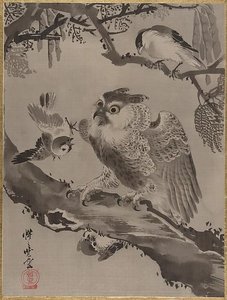
11Hell Courtesan (1880) af Kawanabe KyōsaiHell Courtesan1880 12Jurōjin [center of a triptych] (1884) af Kawanabe KyōsaiJurōjin [center of a triptych]1884 · Minneapolis Institute of Art 13Theatre Curtain of Shintomi-za, with an Impromputu Sketch Monster (1880) af Kawanabe KyōsaiTheatre Curtain of Shintomi-za, with an Impromputu Sketch Monster1880 14Squirrels Eating Chestnuts (1886) af Kawanabe KyōsaiSquirrels Eating Chestnuts1886 · Los Angeles County Museum of Art 15A Beauty in Front of King Enma's Mirror (1887) af Kawanabe KyōsaiA Beauty in Front of King Enma's Mirror1887 16Urashima Tarō Riding on a Tortoise (1888) af Kawanabe KyōsaiUrashima Tarō Riding on a Tortoise1888 · Metropolitan Museum of Art 17Two Children Playing with Goldfish (1887) af Kawanabe KyōsaiTwo Children Playing with Goldfish1887 · Metropolitan Museum of Art 18Two Birds on a Branch (1887) af Kawanabe KyōsaiTwo Birds on a Branch1887 · Metropolitan Museum of Art 19Singing Bird on a Branch (1887) af Kawanabe KyōsaiSinging Bird on a Branch1887 · Metropolitan Museum of Art 20滝に燕図 Swallows by a Waterfall (1887) af Kawanabe Kyōsai滝に燕図 Swallows by a Waterfall1887 · Metropolitan Museum of Art 21Tale of the Tongue-cut Sparrow (1800) af Kawanabe KyōsaiTale of the Tongue-cut Sparrow1800 · Los Angeles County Museum of Art 22Sketches of Birds and Animals (1870) af Kawanabe KyōsaiSketches of Birds and Animals1870 · Metropolitan Museum of Art 23Three Crossbills on a Leafless Tree (1878) af Kawanabe KyōsaiThree Crossbills on a Leafless Tree1878 · Minneapolis Institute of Art 24Chinese-style Landscape with Man Fishing from a Boat by Moonlight [right of a triptych] (1884) af Kawanabe KyōsaiChinese-style Landscape with Man Fishing from a Boat by Moonlight [right of a triptych]1884 · Minneapolis Institute of Art 25Landscape with River in Mountainous Country [left of a triptych] (1884) af Kawanabe KyōsaiLandscape with River in Mountainous Country [left of a triptych]1884 · Minneapolis Institute of Art 26猿を襲う鷲図 Eagle Attacking a Monkey (1885) af Kawanabe Kyōsai猿を襲う鷲図 Eagle Attacking a Monkey1885 · Metropolitan Museum of Art 27兎を追う鷲図 Eagle Pursuing Rabbit (1885) af Kawanabe Kyōsai兎を追う鷲図 Eagle Pursuing Rabbit1885 · Metropolitan Museum of Art 28Eagle Attacking a Mountain Lion (1885) af Kawanabe KyōsaiEagle Attacking a Mountain Lion1885 · Metropolitan Museum of Art 29White Eagle Eyeing a Mountain Lion (1885) af Kawanabe KyōsaiWhite Eagle Eyeing a Mountain Lion1885 · Metropolitan Museum of Art 30Rocky Landscape (1887) af Kawanabe KyōsaiRocky Landscape1887 · Metropolitan Museum of Art 31Crow on a Branch (1887) af Kawanabe KyōsaiCrow on a Branch1887 · Metropolitan Museum of Art 32Untitled (D2X7KF) (1887) af Kawanabe KyōsaiUntitled (D2X7KF)1887 · Metropolitan Museum of Art 33Fox Catching Bird (1887) af Kawanabe KyōsaiFox Catching Bird1887 · Metropolitan Museum of Art 34Bird and Frog (1887) af Kawanabe KyōsaiBird and Frog1887 · Metropolitan Museum of Art 35松に鴉図 Two Crows on a Pine Branch (1887) af Kawanabe Kyōsai松に鴉図 Two Crows on a Pine Branch1887 · Metropolitan Museum of Art 36Cranes in Marsh (1887) af Kawanabe KyōsaiCranes in Marsh1887 · Metropolitan Museum of Art 37Buffalo and Herdsman (1887) af Kawanabe KyōsaiBuffalo and Herdsman1887 · Metropolitan Museum of Art 38柳に鴉図 Crow and Willow Tree (1887) af Kawanabe Kyōsai柳に鴉図 Crow and Willow Tree1887 · Metropolitan Museum of Art 39岩に鴉図 Crow on a Rock (1887) af Kawanabe Kyōsai岩に鴉図 Crow on a Rock1887 · Metropolitan Museum of Art 40Owl Mocked by Small Birds (1887) af Kawanabe KyōsaiOwl Mocked by Small Birds1887 · Metropolitan Museum of Art 41木に鴉図 Crow on a Branch (1887) af Kawanabe Kyōsai木に鴉図 Crow on a Branch1887 · Metropolitan Museum of Art 42竹に鴉図 Crow on a Bamboo Branch (1887) af Kawanabe Kyōsai竹に鴉図 Crow on a Bamboo Branch1887 · Metropolitan Museum of Art 43旭に群鴉図 Flock of Crows at Dawn (1887) af Kawanabe Kyōsai旭に群鴉図 Flock of Crows at Dawn1887 · Metropolitan Museum of Art 44ムクドリ図 Starlings on a Branch (1887) af Kawanabe Kyōsaiムクドリ図 Starlings on a Branch1887 · Metropolitan Museum of Art 45Fish in a Whirlpool (1887) af Kawanabe KyōsaiFish in a Whirlpool1887 · Metropolitan Museum of Art 46富士図 Mount Fuji (1887) af Kawanabe Kyōsai富士図 Mount Fuji1887 · Metropolitan Museum of Art 47Rocky Landscape (1887) af Kawanabe KyōsaiRocky Landscape1887 · Metropolitan Museum of Art 48瓜に鼠図 Mice in a Melon (1887) af Kawanabe Kyōsai瓜に鼠図 Mice in a Melon1887 49Eagle Attacking Fish (1887) af Kawanabe KyōsaiEagle Attacking Fish1887 · Metropolitan Museum of Art 50Squirrels Gathering Chestnuts (1887) af Kawanabe KyōsaiSquirrels Gathering Chestnuts1887 · Metropolitan Museum of Art 51Monkey Hanging from Grapevines (1887) af Kawanabe KyōsaiMonkey Hanging from Grapevines1887 · Metropolitan Museum of Art 52雪中鴉図 Crow Flying in the Snow (1887) af Kawanabe Kyōsai雪中鴉図 Crow Flying in the Snow1887 · Metropolitan Museum of Art 53Waterfall, Eagle and Monkey (1887) af Kawanabe KyōsaiWaterfall, Eagle and Monkey1887 · Metropolitan Museum of Art 54月に鴉図 Crow and the Moon (1887) af Kawanabe Kyōsai月に鴉図 Crow and the Moon1887 · Metropolitan Museum of Art 55Pheasant Caught by a Snake (1887) af Kawanabe KyōsaiPheasant Caught by a Snake1887 · Metropolitan Museum of Art 56Shakyamuni Conquering the Demons (Shaka Gōma zu) (1888) af Kawanabe KyōsaiShakyamuni Conquering the Demons (Shaka Gōma zu)1888 · Metropolitan Museum of Art 57Eagle Holding Small Bird (1887) af Kawanabe KyōsaiEagle Holding Small Bird1887 · Metropolitan Museum of Art 58Monkeys (1888) af Kawanabe KyōsaiMonkeys1888 · Metropolitan Museum of Art 59Deer and Monkeys (1887) af Kawanabe KyōsaiDeer and Monkeys1887 · Metropolitan Museum of Art 60Rabbits (1887) af Kawanabe KyōsaiRabbits1887 · Metropolitan Museum of Art 61Cat Catching a Frog (1887) af Kawanabe KyōsaiCat Catching a Frog1887 · Metropolitan Museum of Art 62水辺に鴉図 Crow and Reeds by a Stream (1887) af Kawanabe Kyōsai水辺に鴉図 Crow and Reeds by a Stream1887 · Metropolitan Museum of Art 63白衣観音図 White Robed Kannon (1887) af Kawanabe Kyōsai白衣観音図 White Robed Kannon1887 · Metropolitan Museum of Art 64Playful Demon af Kawanabe KyōsaiPlayful DemonYale University Art Gallery 65Frolicking Animals, Nekomata and Tanuki Badger af Kawanabe KyōsaiFrolicking Animals, Nekomata and Tanuki Badger 66Long Arms [right of a pair of Long Legs and Long Arms] af Kawanabe KyōsaiLong Arms [right of a pair of Long Legs and Long Arms]Minneapolis Institute of Art 67Long Legs [left of a pair of Long Legs and Long Arms] af Kawanabe KyōsaiLong Legs [left of a pair of Long Legs and Long Arms]Minneapolis Institute of Art 68Seven Otafukus af Kawanabe KyōsaiSeven OtafukusMinneapolis Institute of Art 69Tanuki (Racoon Dog) Viewing Its Reflection in Water (801) af Kawanabe KyōsaiTanuki (Racoon Dog) Viewing Its Reflection in Water801 · Metropolitan Museum of Art 70Boy’s Day Carp Streamer and Shōki Banner (1870) af Kawanabe KyōsaiBoy’s Day Carp Streamer and Shōki Banner1870 · Metropolitan Museum of Art 71Figure Sketches af Kawanabe KyōsaiFigure Sketches 72Frolicking Figures and Animals af Kawanabe KyōsaiFrolicking Figures and Animals

Kawanabe Kyōsais berømte malerier, periode for periode

Motiverne, der fangede Kawanabe Kyōsais blik

De fire motiver, der optræder hyppigst i disse originaler, hver med sit fineste eksempel.

De museer, der udstiller Kawanabe Kyōsais originalværker

De 5 museer, der rummer flest af malerierne på denne side.

Museum By Værker af Kawanabe Kyōsai Malerier fra denne liste
Metropolitan Museum of Art, New YorkMetropolitan Museum of Art New York 48 Three Kyōgen Dancers, Sketches of East Asian Legendary Figures, Frolicking Figures and Animals
Minneapolis Institute of Art, MinneapolisMinneapolis Institute of Art Minneapolis 8 Wisteria Maiden and Demon Priest, Jurōjin [center of a triptych], Three Crossbills on a Leafless Tree
Los Angeles County Museum of Art, Los AngelesLos Angeles County Museum of Art Los Angeles 4 Yang Guifei Adjusting her Hair, Yamauba and Kintarō, Squirrels Eating Chestnuts
Cleveland Museum of Art, ClevelandCleveland Museum of Art Cleveland 2 Hell Courtesan, Painting Party
Yale University Art Gallery, New HavenYale University Art Gallery New Haven 1 Playful Demon

Kawanabe Kyōsai gennem årtierne: ét unikt originalværk til hver

Værker per årti

Vælg et årti for at se det originale værk, der definerer det.

Kawanabe Kyōsais malerier: spørgsmål til galleriet

Hvad er det mest berømte værk af Kawanabe Kyōsai?Vis svaret

Three Kyōgen Dancers (801), Metropolitan Museum of Art, New York. Derefter følger Sketches of East Asian Legendary Figures (801) og Yang Guifei Adjusting her Hair (1850).

Hvilke ti malerier af Kawanabe Kyōsai er de mest berømte?Vis svaret

Three Kyōgen Dancers, Sketches of East Asian Legendary Figures, Yang Guifei Adjusting her Hair, Yamauba and Kintarō, Hell Courtesan, Frolicking Figures and Animals, Calligraphy and Painting Party, Wisteria Maiden and Demon Priest, Painting Party og Night Procession of One Hundred Demons. Ranglisten ovenfor viser det enkelte værks årstal og museum.

Hvor mange værker af Kawanabe Kyōsai er kendt?Vis svaret

Vores katalog indeholder 72 værker af Kawanabe Kyōsai, dateret fra 1850 til 1888.

Hvor kan de mest berømte originaler af Kawanabe Kyōsai ses?Vis svaret

Primært i Metropolitan Museum of Art (New York), Minneapolis Institute of Art (Minneapolis) og Los Angeles County Museum of Art (Los Angeles). Museumslisten ovenfor viser dem alle.

I hvilken periode skabte Kawanabe Kyōsai sine mest kendte malerier?Vis svaret

I 1880s: 52 af de 72 værker på denne side blev skabt dengang, herunder Painting Party.

Hvilket berømt maleri af Kawanabe Kyōsai er det tidligste, og hvilket er det seneste?Vis svaret

På denne side er det tidligste Yang Guifei Adjusting her Hair (1850) og det seneste Urashima Tarō Riding on a Tortoise (1888).

Hvilke motiver foretrak Kawanabe Kyōsai?Vis svaret

Animals (8), Woman (6) og Black ink (6), fordelt på de 72 værker på denne side.

Hvilke materialer brugte Kawanabe Kyōsai mest til sine malerier?Vis svaret

Ink, for 8 af de 72 værker på denne side.

Hvilken stilart tilhører værkerne fra Kawanabe Kyōsai?Vis svaret

Ukiyo-e, baseret på originalerne på denne side.

Hvilke originalværker af Kawanabe Kyōsai kan jeg se på Metropolitan Museum of Art?Vis svaret

Three Kyōgen Dancers, Sketches of East Asian Legendary Figures og Frolicking Figures and Animals: Metropolitan Museum of Art, New York har 48 af værkerne på denne side.

Kawanabe Kyōsai: et portræt af kunstneren

Et liv af blæk og oprør

Kawanabe Kyōsai trådte ind i verden i 1831 i Koga, født ind i en samuraifamilie. Hans tidlige år var præget af et pludseligt og visceralt møde med døden, da han som niårig opdagede et menneskehoved, der var skilt fra et lig i Kanda-floden. Dette tidlige chok blev efterfulgt af en formel uddannelse under mestrene fra Kanō-skolen og Utagawa Kuniyoshi. Selvom han mestrede det præcise penselarbejde, som traditionen krævede, søgte hans ånd mod de mere frigjorte stilarter i de populære skoler. Han flyttede til Edo, hvor hans far blev en del af Shogunatets officielle brandkorps, og her begyndte Kyōsai at udvikle den personlighed, der skulle definere hans karriere.

Hans vej var aldrig præget af stille konformitet. Under de politiske skift fra Edo-perioden til Meiji-æraen blev han en figur, der vakte både fascination og friktion. Han blev anholdt tre gange af Shogunatets myndigheder, ofte på grund af det satiriske i hans værker, som hånede regeringsembedsmænd og kritiserede den gældende politik. Disse sammenstød med loven dæmpede ikke hans produktivitet; tværtimod styrkede de hans ry som en uafhængig tænker. Hans kunst afspejlede kaosset i en nation, der transformerede sig fra en feudalt tilstand til en moderne magt.

Penslens dæmon

Kyōsais tekniske dygtighed blev matchet af en vild og udisciplineret energi. Han fik øgenavnet Shuchu gaki, eller "malemonsteret", en titel han omfavnede gennem sin brug af forskellige segl i sine værker. Hans motiver var omfattende og ofte besynderlige, og strakte sig fra det religiøse til det groteske. Han fyldte sine lærreder med dæmoner, skeletter, frøer og dyr, som han ofte gav med menneskelignende humor eller politisk betydning. Et bemærkelsesværdigt langt maleri på en håndrulle, Kampen om prutterne, indfangede sin tids politiske uro gennem ren karikatur.

Hans kreative proces var lige så legendarisk som hans motiver. Det blev sagt, at han kunne male efter en hel nat med drikkevaner, hvor han trådte ind i en tilstand, hvor penslen bevægede sig med instinktiv hastighed. Denne spontane stil, som nogle gange refereres til som kyōga eller "skøre billeder", muliggjorde en flydende streg, der føltes levende. Selvom han besad det tekniske fundament fra Kanō-skolen, lænede hans arbejde sig mod kaos og komik snarere end stille ærefrygt. Han var en dygtig træsnitkunstner, der producerede værker som Kyōsai hyakuzu og forskellige namazu-e-tryk, der vakte stor genklang hos offentligheden.

En arv i linjer

Ud over sine individuelle malerier bidrog Kyōsai til udviklingen af visuel historiefortælling. I 1874 var han med til at skabe det, der betragtes som det første mangatidsskrift, Eshinbun Nipponchi, sammen med Kanagaki Robun. Selvom udgivelsen kun varede tre numre, repræsenterede den et tidligt forsøg på en ny form for grafiske medier. Hans indflydelse rakte langt ud over Japans grænser, da hans værker fandt vej til samlinger som British Museum og Guimet-museet i Paris. Selv vestlige besøgende, herunder arkitekter som Josiah Conder, dokumenterede hans ekstraordinære evner.

Kunstneren gik bort i 1889 som følge af mavekræft. Han efterlod sig en enorm produktion, anslået til over 10.000 værker, der spænder over tryk, skitser og album. Hans liv var et spejl af den æra, han levede i – turbulent, i overgang og dybt kompleks. Gennem hans blæk fandt overgangen fra middelalderen til et moderne industrisamfund sin mest ekspressive stemme.