Portræt af Jan Asselijn

Jan Asselijn malerier: De 76 mest berømte, set gennem et galleris øjne

Opdateret oktober 2026 · rangeret efter vores popularitetsscore (søgninger, besøg og ordrer for hvert værk) · 84 værker af Jan Asselijn i vores katalog

Kort sagt

I galleriets øjne er Jan Asselijns mest berømte maleri The Threatened Swan (1652), hvis original hænger på Rijksmuseum i Amsterdam. King Gustav Adolf II of Sweden in the Battle of Lutzen, 1632 (1634) og Landscape with a Bridge in the Italian Countryside (1652) fuldender trioen, som ethvert øje genkender. Ud af de 84 værker af Jan Asselijn i vores katalog præsenterer galleriet herunder de 76 mest berømte, hver som et originalværk med årstal, museum og det, der gør det unikt.

1610 – 1652, Dieppe Dutch golden age Flest værker: Rijksmuseum

Galleriets top 10 Jan Asselijn malerier

1
The Threatened Swan (1652) af Jan Asselijn

The Threatened Swan

1652 · Oil On Canvas · Rijksmuseum, Amsterdam

is an oil painting on canvas by the artist Jan Asselijn. Completed around 1650, the work captures a mute swan in a moment of fierce defense. The bird spreads its wings and hisses, guarding its nest against the approach of a dog. This struggle between the white plumage and the encroaching threat defines the central tension of the image.

2
King Gustav Adolf II of Sweden in the Battle of Lutzen, 1632 (1634) af Jan Asselijn

King Gustav Adolf II of Sweden in the Battle of Lutzen, 1632

1634 · Oil On Canvas · Statens Museum for Kunst, København

Jan Asselijn's “King Gustav Adolf II of Sweden in the Battle of Lutzen, 1632” isn’t merely a painting; it’s a visceral plunge into the heart of a pivotal moment in European history. Completed in 1634, this monumental work captures the chaotic fury and strategic brilliance of the Battle of Lutzen, fought on August 17th of that year, a clash that cemented Gustav Adolf II's reputation as a military genius and…

3
Landscape with a Bridge in the Italian Countryside (1652) af Jan Asselijn

Landscape with a Bridge in the Italian Countryside

1652 · Oil On Canvas · Cannon Hall Museum, Barnsley

A stone bridge with arched spans anchors this serene landscape, crossing a calm body of water that reflects the soft, overcast sky. To the left, a solitary figure sits upon a barrel, watching the quiet movement of the scene. On the right, the composition gathers around a horse and carriage; a person guides the animal toward the water's edge while another observer stands nearby. A dog occupies the foreground, grounding…

4
King Gustav Adolf II in the Battle of Lutzen on November 6,1632 (1632) af Jan Asselijn

King Gustav Adolf II in the Battle of Lutzen on November 6,1632

The air is thick with the scent of wet earth and sulfur. In the center of the chaos, King Gustav Adolf II of Sweden rides a horse through the fray, his sword a flash of cold light against the darkening sky. The Battle of Lutzen is not a quiet affair; it is a collision of muscle and metal. Soldiers on foot and mounted on horseback press against one another in…

5
Four Figures (1615) af Jan Asselijn

Four Figures

1615 · Oil · Groeningemuseum, Brugge

In Four Figures, Jan Asselijn organizes a group of men in period attire within a dimly lit, atmospheric setting. The composition centers on this cluster of figures, who are arranged in a loose, triangular formation. This structural choice draws the viewer's eye toward the middle of the group, where the subjects interact in a moment of quietude. One man is captured drinking from a vessel, while another stands holding a…

6
King Gustav Adolf II of Sweden, Battle near Lutzen 1632 (1635) af Jan Asselijn

King Gustav Adolf II of Sweden, Battle near Lutzen 1632

1635 · Oil On Panel · Gemäldegalerie, Berlin

The artwork titled King Gustav Adolf II of Sweden, Battle near Lutzen 1632 is a work by the artist Jan Asselijn. Dated about 1635, this oil on panel painting belongs to the genre of military history. The subject matter focuses on the Battle of Lützen, a significant conflict from the Thirty Years' War. The scene captures the king amidst the movement of a large-scale military engagement.

7
The Tiber River with the Ponte Molle at Sunset (1650) af Jan Asselijn

The Tiber River with the Ponte Molle at Sunset

1650 · Oil · National Gallery of Art, Washington

The sun hangs low over the horizon, casting a sharp, golden light through the four massive stone arches of the Ponte Molle. This light slices through the atmosphere, painting the sky in a gradient that shifts from a warm, glowing amber on the right to a pale, tranquil aquamarine as the eye moves toward the left. The river below remains placid, reflecting the changing colors of the sky, while the…

8
Ruined Building with Shepherd and Sheep (1646) af Jan Asselijn

Ruined Building with Shepherd and Sheep

1646 · Oil On Panel

Ruined Building with Shepherd and Sheep is an artwork by Jan Asselijn. This piece belongs to the Dutch Golden Age and the Italianate landscape style of the Early Modern period. The subject matter focuses on a pastoral landscape that incorporates ruins and sheep. The composition integrates elements of nature, shepherds, and weathered stone structures within a single scene.

9
Italian Landscape (1638) af Jan Asselijn

Italian Landscape

1638 · Oil On Canvas · Statens Museum for Kunst, København

The artwork titled Italian Landscape is a painting by the Dutch Golden Age painter Jan Asselijn. Created in 1638, this work represents a specific period in the artist's career. Asselijn was born in Dieppe, France, around 1610, before his family relocated to Amsterdam. His development as a painter was shaped by the artistic environment of the Dutch Golden Age, a time when landscape painting was evolving toward more atmospheric depictions.

10
Fight against Robbers (1638) af Jan Asselijn

Fight against Robbers

1638 · Oil On Panel · Statens Museum for Kunst, København

A violent skirmish unfolds across a rugged, rocky landscape, captured in a dramatic monochrome palette. The composition relies on a sharp diagonal arrangement, pulling the eye from the foreground into a chaotic center-right where figures engage in combat. Mounted riders and infantrymen clash amidst dense foliage and spindly, skeletal trees. The atmosphere is heavy with mist and swirling smoke, creating a sense of tension and movement. Light filters through an…

Jan Asselijns malerier, rangeret fra 11 til 76

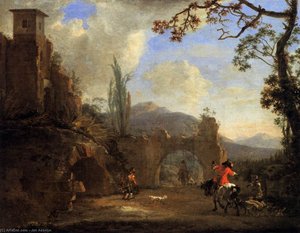
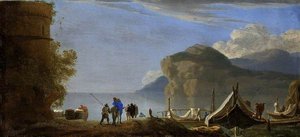
11Lion Hunting (1640) af Jan AsselijnLion Hunting1640 · Musée Fabre 12Italianate landscape with travellers by a stream with cattle (1652) af Jan AsselijnItalianate landscape with travellers by a stream with cattle1652 13Italian Landscape with a view from a Grotto (1639) af Jan AsselijnItalian Landscape with a view from a Grotto1639 · Nationalmuseum 14Landscape with Ruins and Hunting Party (1645) af Jan AsselijnLandscape with Ruins and Hunting Party1645 · Academy of Fine Arts Vienna 15PAYSAGE AVEC UN TROUPEAU TRAVERSANT UNE RIVIERE af Jan AsselijnPAYSAGE AVEC UN TROUPEAU TRAVERSANT UNE RIVIERELouvre 16River Bank with Herdsmen (1650) af Jan AsselijnRiver Bank with Herdsmen1650 · Academy of Fine Arts Vienna 17Coastal Scene with Resting Riders (detail) (1652) af Jan AsselijnCoastal Scene with Resting Riders (detail)1652 · Academy of Fine Arts Vienna 18Imaginary Italian Landscape (1652) af Jan AsselijnImaginary Italian Landscape1652 · Mauritshuis Royal Picture Gallery 19Landscape with a Cowherd (1594) af Jan AsselijnLandscape with a Cowherd1594 20Italianate Landscape (1631) af Jan AsselijnItalianate Landscape1631 · Bavarian State Painting Collections 21Cavalry Engagement (1635) af Jan AsselijnCavalry Engagement1635 22Peasants by a River Bank (1639) af Jan AsselijnPeasants by a River Bank1639 · Yale University Art Gallery 23Mountain - landscape (1639) af Jan AsselijnMountain - landscape1639 24Riders Gallopping towards the Gates of the Fortress (1645) af Jan AsselijnRiders Gallopping towards the Gates of the Fortress1645 · Hermitage Museum 25Winter Landscape (1645) af Jan AsselijnWinter Landscape1645 · Hermitage Museum 26Nocturnal Crayfishing (1638) af Jan AsselijnNocturnal Crayfishing1638 · Statens Museum for Kunst 27Vesuvius Erupting at Nightfall (1638) af Jan AsselijnVesuvius Erupting at Nightfall1638 · Statens Museum for Kunst 28Head of an Ox (1647) af Jan AsselijnHead of an Ox1647 · Musée des Beaux-Arts 29Catching Crayfish (1645) af Jan AsselijnCatching Crayfish1645 · Muzeum Palacu Króla Jana Iii w Wilanowie 30Ford between High Cliffs (1644) af Jan AsselijnFord between High Cliffs1644 · Nationalgalleriet i Prag 31Peasants and Cattle beside a Tower (1646) af Jan AsselijnPeasants and Cattle beside a Tower1646 32Winter landscape with huntsmen on a bridge (1647) af Jan AsselijnWinter landscape with huntsmen on a bridge1647 · Fondation Custodia 33A rocky mountain valley with shepherds and cattle (1645) af Jan AsselijnA rocky mountain valley with shepherds and cattle1645 · Staatliche Kunsthalle Karlsruhe 34Italian Landscape (1640) af Jan AsselijnItalian Landscape1640 · Pushkin State Museum of Fine Arts 35Frozen Moat outside City Walls (1647) af Jan AsselijnFrozen Moat outside City Walls1647 · Worcester Art Museum 36Italianate Landscape with Drovers, Cattle and Sheep beside Ruins (1647) af Jan AsselijnItalianate Landscape with Drovers, Cattle and Sheep beside Ruins1647 · Fogg Museum of Art 37Italianate Landscape with a River and an Arched Bridge (1648) af Jan AsselijnItalianate Landscape with a River and an Arched Bridge1648 · Staatsgalerie Schleissheim 38Southern Landscape with Cattle near Ruins (1650) af Jan AsselijnSouthern Landscape with Cattle near Ruins1650 · National Museum in Wrocław 39View of the Solario Bridge on the Teverone (1650) af Jan AsselijnView of the Solario Bridge on the Teverone1650 40Head of a lowing Ox (1650) af Jan AsselijnHead of a lowing Ox1650 · Staatliches Museum Schwerin 41Italianate landscape with bridge near Tivoli (1649) af Jan AsselijnItalianate landscape with bridge near Tivoli1649 42River Landscape with the Fort Saint-Jean and the Chateau Pierre-Scize in Lyon (1650) af Jan AsselijnRiver Landscape with the Fort Saint-Jean and the Chateau Pierre-Scize in Lyon1650 · Yale University Art Gallery 43The restoration of the Diemerdijk or Muiderdijk near Amsterdam in 1651 (1651) af Jan AsselijnThe restoration of the Diemerdijk or Muiderdijk near Amsterdam in 16511651 · Gemäldegalerie 44Breach of a Dyke by Storm Surge on March 5 1651 (1651) af Jan AsselijnBreach of a Dyke by Storm Surge on March 5 16511651 · Gemäldegalerie 45The Breach of the Sint Anthonisdijk in 1651 (1652) af Jan AsselijnThe Breach of the Sint Anthonisdijk in 16511652 · Amsterdam Museum 46The Breach of the Saint Anthony’s Dike near Amsterdam, Jan Asselijn, 1651 (1651) af Jan AsselijnThe Breach of the Saint Anthony’s Dike near Amsterdam, Jan Asselijn, 16511651 47Drovers with Cattle under an Arch of the Colosseum in Rome, Jan Asselijn, 1640 - 1652 (1652) af Jan AsselijnDrovers with Cattle under an Arch of the Colosseum in Rome, Jan Asselijn, 1640 - 16521652 · Rijksmuseum 48A Mediterranean Coastal View with Shipping and Mariners by a Fort (1650) af Jan AsselijnA Mediterranean Coastal View with Shipping and Mariners by a Fort1650 49A Mediterranean Coastal View with Shipping and Mariners by a Fort (1650) af Jan AsselijnA Mediterranean Coastal View with Shipping and Mariners by a Fort1650 50River Landscape with the Church of Santi Giovanni e Paolo (1650) af Jan AsselijnRiver Landscape with the Church of Santi Giovanni e Paolo1650 51Landscape with a Drover (1649) af Jan AsselijnLandscape with a Drover1649 · Holburne Museum 52Landscape with a Bridge in the Italian Countryside (1652) af Jan AsselijnLandscape with a Bridge in the Italian Countryside1652 · Cannon Hall Museum 53Coastal Scene with Resting Riders (1652) af Jan AsselijnCoastal Scene with Resting Riders1652 · Academy of Fine Arts Vienna 54PAYSAGE AVEC UNE TOUR af Jan AsselijnPAYSAGE AVEC UNE TOURLouvre 55RUINE ET CABANE DE BERGERS af Jan AsselijnRUINE ET CABANE DE BERGERSLouvre 56LANDSCAPE WITH A DEPARTURE FOR A HUNT af Jan AsselijnLANDSCAPE WITH A DEPARTURE FOR A HUNT 57Muleteers beside an Italian Ruin (1650) af Jan AsselijnMuleteers beside an Italian Ruin1650 · Rijksmuseum 58Hangout in Italy (1620) af Jan AsselijnHangout in Italy1620 · Rijksmuseum 59Herders with Their Animals under an Arch of the Colosseum in Rome (1652) af Jan AsselijnHerders with Their Animals under an Arch of the Colosseum in Rome1652 · Rijksmuseum 60Hunting Company out of Rome (1652) af Jan AsselijnHunting Company out of Rome1652 · Rijksmuseum 61Beggere foran en romersk kvikkäll (1638) af Jan AsselijnBeggere foran en romersk kvikkäll1638 · Academy of Fine Arts Vienna 62Asselijn - (50Riverbank) af Jan AsselijnAsselijn - (50Riverbank) 63Asselijn ruin af Jan AsselijnAsselijn ruinRijksmuseum 64Italian Coast Scene af Jan AsselijnItalian Coast Scene 65Italian Landscape with Two Horsemen and Figures on a Road af Jan AsselijnItalian Landscape with Two Horsemen and Figures on a Road 66Italian Landscape with the Church of Sts. Giovanni e Paolo in Rome af Jan AsselijnItalian Landscape with the Church of Sts. Giovanni e Paolo in RomeSzépművészeti Múzeum 67Mountainous Landscape af Jan AsselijnMountainous Landscape 68A rocky river landscape with travellers in the foreground and ships beyond af Jan AsselijnA rocky river landscape with travellers in the foreground and ships beyond 69A Landscape with Peasants (also known as Landscape with Herdsmen Fording a River) af Jan AsselijnA Landscape with Peasants (also known as Landscape with Herdsmen Fording a River)Ascott House 70A Cavalier on Horseback Before a Landscape af Jan AsselijnA Cavalier on Horseback Before a Landscape 71Landscape with shepherds and their flock crossing the Ponte Acquoria near Tivoli af Jan AsselijnLandscape with shepherds and their flock crossing the Ponte Acquoria near Tivoli 72an italianate river landscape with herders on a path with their flock and donkeys, classical ruins on a hilltop beyond af Jan Asselijnan italianate river landscape with herders on a path with their flock and donkeys, classical ruins on a hilltop beyondMinneapolis Institute of Art 73Italian Coast Scene af Jan AsselijnItalian Coast SceneFitzwilliam-museet 74Italian Landscape af Jan AsselijnItalian LandscapeFitzwilliam-museet 75Italian Landscape with the Ruins of a Roman Bridge and Aqueduct af Jan AsselijnItalian Landscape with the Ruins of a Roman Bridge and AqueductRijksmuseum 76Cavalry Attack at Sunset, Jan Asselijn, 1646 (1646) af Jan AsselijnCavalry Attack at Sunset, Jan Asselijn, 16461646 · Rijksmuseum

Jan Asselijns berømte malerier, periode for periode

Motiverne, der fangede Jan Asselijns blik

De fire motiver, der optræder hyppigst i disse originaler, hver med sit fineste eksempel.

De museer, der udstiller Jan Asselijns originalværker

De 8 museer, der rummer flest af malerierne på denne side.

Museum By Værker af Jan Asselijn Malerier fra denne liste
Rijksmuseum, AmsterdamRijksmuseum Amsterdam 9 The Threatened Swan, Drovers with Cattle under an Arch of the Colosseum in Rome, Jan Asselijn, 1640 - 1652, Muleteers beside an Italian Ruin
Statens Museum for Kunst, KøbenhavnStatens Museum for Kunst København 5 King Gustav Adolf II of Sweden in the Battle of Lutzen, 1632, Italian Landscape, Fight against Robbers
Academy of Fine Arts Vienna, WienAcademy of Fine Arts Vienna Wien 5 Landscape with Ruins and Hunting Party, River Bank with Herdsmen, Coastal Scene with Resting Riders (detail)
Gemäldegalerie, BerlinGemäldegalerie Berlin 3 King Gustav Adolf II of Sweden, Battle near Lutzen 1632, The restoration of the Diemerdijk or Muiderdijk near Amsterdam in 1651, Breach of a Dyke by Storm Surge on March 5 1651
Louvre, ParisLouvre Paris 3 PAYSAGE AVEC UN TROUPEAU TRAVERSANT UNE RIVIERE, PAYSAGE AVEC UNE TOUR, RUINE ET CABANE DE BERGERS
Cannon Hall Museum, BarnsleyCannon Hall Museum Barnsley 2 Landscape with a Bridge in the Italian Countryside, Landscape with a Bridge in the Italian Countryside
Yale University Art Gallery, New HavenYale University Art Gallery New Haven 2 Peasants by a River Bank, River Landscape with the Fort Saint-Jean and the Chateau Pierre-Scize in Lyon
Hermitage Museum, Sankt PetersborgHermitage Museum Sankt Petersborg 2 Riders Gallopping towards the Gates of the Fortress, Winter Landscape

Jan Asselijn, ét signaturmaleri per årti

Værker per årti

Vælg et årti for at se det originale værk, der definerer det.

Jan Asselijn's malerier: galleriets svar

Hvilket maleri af Jan Asselijn er det mest berømte af alle?Vis svaret

The Threatened Swan (1652), Rijksmuseum, Amsterdam. Derefter følger King Gustav Adolf II of Sweden in the Battle of Lutzen, 1632 (1634) og Landscape with a Bridge in the Italian Countryside (1652).

Hvor gammel var Jan Asselijn, da The Threatened Swan blev færdiggjort?Vis svaret

42 år gammel: The Threatened Swan er fra 1652, og Jan Asselijn blev født i 1610.

Hvilke er Jan Asselijns top 10 malerier?Vis svaret

The Threatened Swan, King Gustav Adolf II of Sweden in the Battle of Lutzen, 1632, Landscape with a Bridge in the Italian Countryside, King Gustav Adolf II in the Battle of Lutzen on November 6,1632, Four Figures, King Gustav Adolf II of Sweden, Battle near Lutzen 1632, The Tiber River with the Ponte Molle at Sunset, Ruined Building with Shepherd and Sheep, Italian Landscape og Fight against Robbers. Ranglisten ovenfor viser det enkelte værks årstal og museum.

Hvor mange værker skabte Jan Asselijn?Vis svaret

Vores katalog indeholder 84 værker af Jan Asselijn, dateret fra 1620 til 1652.

Hvor hænger Jan Asselijns mest berømte originaler?Vis svaret

Primært i Rijksmuseum (Amsterdam), Statens Museum for Kunst (København) og Academy of Fine Arts Vienna (Wien). Museumslisten ovenfor viser dem alle.

Hvornår skabte Jan Asselijn sine mest berømte malerier?Vis svaret

I 1650s: 24 af de 76 værker på denne side blev skabt dengang, herunder The Threatened Swan.

Hvilke er Jan Asselijns tidligste og seneste berømte værker?Vis svaret

På denne side er det tidligste Hangout in Italy (1620) og det seneste The Threatened Swan (1652).

Hvilke motiver vendte Jan Asselijn oftest tilbage til?Vis svaret

Landscape (26), Ruins (7) og Figures (6), fordelt på de 76 værker på denne side.

Hvilket medie arbejdede Jan Asselijn mest med?Vis svaret

Oil On Canvas, for 12 af de 76 værker på denne side.

Hvilken stilart er Jan Asselijn associeret med?Vis svaret

Dutch golden age og Baroque, baseret på originalerne på denne side.

Hvilke originalværker af Jan Asselijn findes i Rijksmuseum?Vis svaret

The Threatened Swan, Drovers with Cattle under an Arch of the Colosseum in Rome, Jan Asselijn, 1640 - 1652 og Muleteers beside an Italian Ruin: Rijksmuseum, Amsterdam har 9 af værkerne på denne side.

Jan Asselijn: kunstneren

A Life Forged in Landscape: The World of Jan Asselijn

Jan Asselin, født omkring 1610 i Dieppe, Frankrig, var en dansk kunstner, hvis rejse blev præget af religiøs uro og kunstnerisk udforskning. Hans familie, hugenotter på flugt fra forfølgelse, flyttede til Amsterdam i 1621, en pulserende handelsby og spirende kunstcentrum under den danske Gouden Æra. Denne omflytning viste sig afgørende, idet hun unge Jean blev kastet ud i en verden hvor landskabsmaleri hurtigt udviklede sig ud over traditionelle fremstillinger mod mere atmosfæriske og følelsesmæssigt resonerende scener. Han begyndte sin træning hos Jan Martszen den Yngre, hvor han finpudsede sine færdigheder i slagbilleder før han fandt sin sande kald – at fange skønheden og dramatikken både af naturlige landskaber og dyreliv. Hans tidlige eksponering for det danske lys og de ekspansive himmelstræk var en definerende karakteristik af hans arbejde, selvom et ophold i Italien virkelig cementerede hans kunstneriske vision.

The Italianate Embrace & The Bentvueghels

Som mange ambitiøse nordeuropæiske malere på tiden søgte Asselin raffinement i Italien, sandsynligvis ankommet efter 1635. Det var der han fuldt ud omfavnede *italiensk stils* – en genre præget af solbeskinnelige vidder, klassiske ruiner og pastorale scener fyldt med følelser af romantik. Han sluttede sig til kredsen af *Bentvueghels*, et farverigt samfund af danske og flamske kunstnere der arbejdede i Rom. Disse "Fugle ved siden af hinanden" var kendte for deres ukonventionelle adfærd, satiriske kælenavne og dedikation til at male direkte fra livet – hvilket afveg fra kravene om atelierarbejde. Indenfor dette livlige fællesskab fik Asselijn kælenavnet "Krabbetje" på grund af en fysisk handicap der påvirkede hans hånd, men han blomstrede kreativt. Han absorberede indflydelse fra kunstnere som Pieter van Laer (Bamboccio), hvis fremstillinger af romersk bondegårdsliv og landskaber resonerede dybt med Asselijn’s egen udviklende stil. Denne periode var afgørende for at forme hans evne til at udtrykke atmosfære, lys og en følelse af fortælling indenfor hans kompositioner. Han var særligt imponeret over Rembrandt og Frederik de Moucheron.

Mastering Light & Symbolism: Key Works

Asselijn vendte tilbage til Amsterdam med en raffineret teknik og en distinkt stemme. Hans malerier er karakteriseret af klarhed i udførelse og et mesterligt håndtering af lys – kvaliteter der hurtigt gav ham anerkendelse blandt sine samtidige. Selvom han producerede historiske og slagbilleder var det hans landskaber og dyrelivsmaleri der virkelig skilte sig ud. Den truende svane, malet omkring år 1640, forbliver hans mest fejrede værk. Mere end blot en fremstilling af fugleforsvar blev dette billede et kraftfuldt symbol på dansk national modstand mod eksterne trusler. Den hensynsløst beskyttende svane, aggressivt afværge indtrængere nær sin rede, resonerede med samtidens bekymringer og blev endda fortolket som en allegori for Johan de Witt, en fremtrædende dansk statsminister. Interessant nok tilføjede senere ejere symboliske tekster til lærredet – "Holland" på én af æggene og "Fiendtlig mod staten" ved siden af den truende hund – hvilket yderligere cementerede dets politiske undertoner. Andre bemærkelsesværdige værker inkluderer Slaget ved Sonnenfeld, hvor han viste sine tidligere færdigheder i slagbilleder med dramatisk flair og fremstillinger af landbrugsliv som f.eks. Drovers with Cattle under an Arch of the Colosseum i Rom, hvilket smukt blander italiensk stil landskaber med dyrelivsstudier. Han var særligt imponeret over Rembrandt og Frederik de Moucheron.

Influence & Legacy: A Lasting Impression

Jan Asselijn’s indflydelse udvandt sig udover hans egen produktive produktion. Han blev rost af samtidige som Rembrandt, der endda skabte træsnit af kunstneren ved arbejde – selvom bemærkelsesværdigt nok skjulte træsnittet Asselin’s hænder, måske en følsom erkendelse af hans fysiske udfordring. Han var også mentor til Frederik de Moucheron, en anden fremtrædende dansk landskabsmaler der videre populariserede italiensk stil. Asselijn’s innovative tilgang til lys og atmosfære påvirkede en hel generation af kunstnere og sikrede hans arv som en betydelig figur indenfor den danske Gouden Æra. Hans værker er nu placeret i prestigefulde samlinger såsom Rijksmuseum i Amsterdam, hvilket sikrer hans arv forbliver aktiv som et ikonisk eksempel på dansk kunsthistorie. Han døde relativt ung omkring år 1652 og efterlod sig en omfattende produktion der fortsat fascinerer publikum med sin skønhed, dramatik og subtile lag af mening.