Portræt af Jacopo Amigoni

Jacopo Amigoni malerier: De 80 mest berømte, set gennem et galleris øjne

Opdateret november 2026 · rangeret efter vores popularitetsscore (søgninger, besøg og ordrer for hvert værk) · 80 værker af Jacopo Amigoni i vores katalog

Kort sagt

I galleriets øjne er Jacopo Amigonis mest berømte maleri Portrait of a Young Clergyman (1745), hvis original hænger på Museum Boijmans Van Beuningen i Rotterdam. Peter I with Minerva (with the Allegorical Figure of Glory) (1732) og Elector Max Emanuel Receives a Turkish Embassy (1688) fuldender trioen, som ethvert øje genkender. Ud af de 80 værker af Jacopo Amigoni i vores katalog præsenterer galleriet herunder de 80 mest berømte, hver som et originalværk med årstal, museum og det, der gør det unikt.

1682 – 1752, Napoli Rococo Flest værker: Bavarian State Painting Collections

Galleriets top 10 Jacopo Amigoni malerier

1
Portrait of a Young Clergyman (1745) af Jacopo Amigoni

Portrait of a Young Clergyman

1745 · Oil · Museum Boijmans Van Beuningen, Rotterdam

This formal 18th-century portrait, executed in a Rococo style, presents a bust-length depiction of a young man, likely a clergyman. The subject is positioned slightly off-center, turned toward the viewer's right while casting his gaze back toward the center. The composition is defined by a restrained and somber color palette, where deep blacks and dark browns within the clothing and background create a sharp contrast against the luminous, pale tones…

2
Peter I with Minerva (with the Allegorical Figure of Glory) (1732) af Jacopo Amigoni

Peter I with Minerva (with the Allegorical Figure of Glory)

1732 · Oil On Canvas · Hermitage Museum, Sankt Petersborg

This oil on canvas work is titled Peter I with Minerva (with the Allegorical Figure of Glory). It was executed by the artist Jacopo Amigoni. The painting is also recognized by several other titles, including Peter the Great with Minerva and Peter I with Minerva. Through these various designations, the work captures a specific intersection of historical portraiture and classical allegory.

3
Elector Max Emanuel Receives a Turkish Embassy (1688) af Jacopo Amigoni

Elector Max Emanuel Receives a Turkish Embassy

1688 · Oil On Canvas · Bavarian State Painting Collections, München

The oil painting titled Elector Max Emanuel Receives a Turkish Embassy captures a moment of high diplomacy. Created by the Italian painter Jacopo Amigoni, this work functions as a fragment or detail of a larger composition. It depicts the Elector Max Emanuel receiving a Turkish legation, a scene of formal encounter between two distinct worlds. The brushwork traces the meeting of European and Ottoman figures within a structured, ceremonial space.

4
Europa (1695) af Jacopo Amigoni

Europa

1695

In this work, Europa, Jacopo Amigoni explores a moment of profound change. The painting captures the mythological scene of Europa and the Bull, a narrative centered on the intersection of the divine and the mortal. Dating to about 1695, the piece focuses on the tension inherent in the encounter between the woman and the animal. It is a study of the sudden shift from the pastoral to the mythic.

5
Jacob and Rachel (1701) af Jacopo Amigoni

Jacob and Rachel

1701 · Oil On Canvas · Nationalmuseet i Warszawa, Warszawa

In this dramatic oil painting, the biblical narrative of Jacob and Rachel unfolds before the viewer. Created by Jacopo Amigoni about 1701, the work captures a moment of intense human connection and tension. The scene centers on the intimate interaction between a young woman and a man, while an elderly man sits nearby, grounding the composition in a landscape that feels both vast and immediate. Every gesture and facial expression…

6
Herminia and the shepherds (1700) af Jacopo Amigoni

Herminia and the shepherds

1700 · Oil On Canvas

The scene unfolds in a painting titled Herminia and the shepherds, a work that captures a moment of dramatic interaction within a pastoral setting. This oil painting, also known by the name Herminia bei den Hirten, brings a sense of movement to the canvas as the central figure engages with those around her. The atmosphere feels heavy with the weight of a story being told through gesture and gaze.

7
mythological scene (1700) af Jacopo Amigoni

mythological scene

1700 · Oil On Canvas

This 18th-century oil painting, titled mythological scene, was executed by the Italian artist Jacopo Amigoni. The work is presented here as a monochrome reproduction, allowing for a focused study of its form and composition. It dates to about 1700, a period when Amigoni was establishing his presence within the European art landscape.

8
dancing nymph (1700) af Jacopo Amigoni

dancing nymph

1700 · Oil

In this work, titled dancing nymph, Jacopo Amigoni centers the composition around a luminous, semi-nude female figure caught in a moment of dance. She is positioned in a contrapposto stance, her body twisting with a natural grace that directs the viewer's eye through the movement. In her left hand, she holds a tambourine aloft, while her right hand reaches up to touch her hair. Light and voluminous drapery swirls around…

9
Sleeping Christ Child with Instruments of the Passion (1713) af Jacopo Amigoni

Sleeping Christ Child with Instruments of the Passion

1713 · Oil · Bavarian State Painting Collections, München

The scene unfolds in the quietude of "Sleeping Christ Child with Instruments of the Passion," a work that captures a profound stillness. Here, the infant Christ rests in a deep slumber, his small form a focal point of peace amidst the heavy symbolism surrounding him. This painting, created by Jacopo Amigoni, invites a close gaze into a moment of profound vulnerability and divine destiny.

10
Mary with Child (1713) af Jacopo Amigoni

Mary with Child

1713 · Oil On Canvas · Bavarian State Painting Collections, München

In Mary with Child by Jacopo Amigoni, the composition is a close-up, intimate portrait centered on a woman holding an infant. Mary is positioned slightly to the left of the frame, looking down toward the child with a serene and tender expression. The infant is held in her arms, facing away from the viewer, with its body angled toward her chest. This arrangement creates a tight, focused grouping of the…

Jacopo Amigonis malerier, rangeret fra 11 til 80

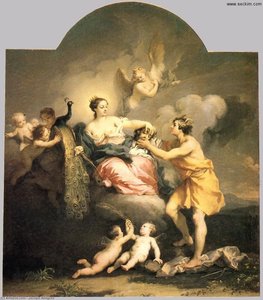
11Elector Max Emanuel Receives the Turkish Embassy (Oil Sketch) (1713) af Jacopo AmigoniElector Max Emanuel Receives the Turkish Embassy (Oil Sketch)1713 · Bavarian State Painting Collections 12Preaching of John the Baptist (1713) af Jacopo AmigoniPreaching of John the Baptist1713 · Bavarian State Painting Collections 13Adoration of the Magi (1713) af Jacopo AmigoniAdoration of the Magi1713 · Bavarian State Painting Collections 14Mary with the Child and the Infant John (1713) af Jacopo AmigoniMary with the Child and the Infant John1713 · Bavarian State Painting Collections 15Mary with Child (1713) af Jacopo AmigoniMary with Child1713 · Bavarian State Painting Collections 16Design for Ceiling Painting (1713) af Jacopo AmigoniDesign for Ceiling Painting1713 · Bavarian State Painting Collections 17Baptism of Christ (1713) af Jacopo AmigoniBaptism of Christ1713 · Bavarian State Painting Collections 18Mary with Child (1713) af Jacopo AmigoniMary with Child1713 · Bavarian State Painting Collections 19Saint John Preaching in the Desert (1713) af Jacopo AmigoniSaint John Preaching in the Desert1713 · Bavarian State Painting Collections 20Saint Joseph with the Christ Child (1713) af Jacopo AmigoniSaint Joseph with the Christ Child1713 · Bavarian State Painting Collections 21Portrait of Abbot Magnus Pachinger of Benediktbeuern (1713) af Jacopo AmigoniPortrait of Abbot Magnus Pachinger of Benediktbeuern1713 · Bavarian State Painting Collections 22Moses and the Brazen Serpent (1725) af Jacopo AmigoniMoses and the Brazen Serpent1725 · Musée des Beaux-Arts de Strasbourg 23Portrait of Sigismund Streit (1739) af Jacopo AmigoniPortrait of Sigismund Streit1739 · Gemäldegalerie 24Marcus Curius Dentatus refuses the gifts of the Samnites (1738) af Jacopo AmigoniMarcus Curius Dentatus refuses the gifts of the Samnites1738 · Museum Bredius 25Boys Playing with a Goat (1735) af Jacopo AmigoniBoys Playing with a Goat1735 · Royal Collection 26Frederick, Prince of Wales (1707-51) (1735) af Jacopo AmigoniFrederick, Prince of Wales (1707-51)1735 · Royal Collection 27Anne, Princess Royal and Princess of Orange (1709-1759) (1734) af Jacopo AmigoniAnne, Princess Royal and Princess of Orange (1709-1759)1734 · Royal Collection 28Bacchus and Ariadne (1740) af Jacopo AmigoniBacchus and Ariadne1740 · Art Gallery of New South Wales 29Abraham's Sacrifice of Isaac (1742) af Jacopo AmigoniAbraham's Sacrifice of Isaac1742 · Gemäldegalerie 30Susanna and the Elders (1742) af Jacopo AmigoniSusanna and the Elders1742 · Gemäldegalerie 31Bathseba at her bath receives the message of David (1742) af Jacopo AmigoniBathseba at her bath receives the message of David1742 · Gemäldegalerie 32Portrait of the singer Farinelli (Carlo Broschi) 1705-1782 (1740) af Jacopo AmigoniPortrait of the singer Farinelli (Carlo Broschi) 1705-17821740 · Carnavalet Museum 33Maria Anna Caroline of Baviera (1696-1750) as nun (1750) af Jacopo AmigoniMaria Anna Caroline of Baviera (1696-1750) as nun1750 · Bavarian State Painting Collections 34The Infanta María Antonia Fernanda, Daughter of Philip V (1750) af Jacopo AmigoniThe Infanta María Antonia Fernanda, Daughter of Philip V1750 · Museo del Prado 35Portrait group: The singer Farinelli and friends (1750) af Jacopo AmigoniPortrait group: The singer Farinelli and friends1750 · National Gallery of Victoria 36Portrait of a Lady as Diana (1757) af Jacopo AmigoniPortrait of a Lady as Diana1757 · Gemäldegalerie 37Portrait of the Marquis de la Ensenada (1750) af Jacopo AmigoniPortrait of the Marquis de la Ensenada1750 · Museo del Prado 38Jupiter and Callisto (1750) af Jacopo AmigoniJupiter and Callisto1750 · Hermitage Museum 39The Holy Face (1701) af Jacopo AmigoniThe Holy Face1701 · Museo del Prado 40Venus and Adonis (1740) af Jacopo AmigoniVenus and Adonis1740 · Gallerie dell'Accademia di Venezia 41Apollo and the Muses (1700) af Jacopo AmigoniApollo and the Muses1700 · Museo de Arte de Ponce 42Mercury About to Slay Argus (1730) af Jacopo AmigoniMercury About to Slay Argus1730 43Jael and Sisera (1739) af Jacopo AmigoniJael and Sisera1739 44Venus and Adonis (detail) (1740) af Jacopo AmigoniVenus and Adonis (detail)1740 · Gallerie dell'Accademia di Venezia 45The Last Supper af Jacopo AmigoniThe Last SupperBavarian State Painting Collections 46The Birth of Adonis af Jacopo AmigoniThe Birth of AdonisNational Gallery of Ireland 47Apollo and the Muses af Jacopo AmigoniApollo and the MusesMuseum of Fine Arts 48Peter I, Emperor of Russia af Jacopo AmigoniPeter I, Emperor of RussiaNational Portrait Gallery of Sweden 49Children playing with a little bird af Jacopo AmigoniChildren playing with a little birdCa' Rezzonico – Museum for det 18. århundredes Venedig 50The Triumph of the Arts af Jacopo AmigoniThe Triumph of the Arts 51Diana and Callisto af Jacopo AmigoniDiana and Callisto 52Abraham and the three Angels af Jacopo AmigoniAbraham and the three Angels 53Lady Sophia Bentinck (1701–1748), Duchess of Kent af Jacopo AmigoniLady Sophia Bentinck (1701–1748), Duchess of Kent 54Flora and Zephyr (1730) af Jacopo AmigoniFlora and Zephyr1730 · Metropolitan Museum of Art 55Persée délivrant Andromède af Jacopo AmigoniPersée délivrant AndromèdeMusée Hyacinthe Rigaud 56Joseph in the Pharaoh's Palace af Jacopo AmigoniJoseph in the Pharaoh's PalaceMuseo del Prado 57Queen caroline af Jacopo AmigoniQueen caroline 58Caroline Wilhelmina of Brandenburg-Ansbach af Jacopo AmigoniCaroline Wilhelmina of Brandenburg-AnsbachNational Portrait Gallery 59Princess anne af Jacopo AmigoniPrincess anne 60The Rape of Europa af Jacopo AmigoniThe Rape of EuropaOsterley Park And House 61Peter I (1672–1725), 'Peter the Great', Tsar of Russia, with Minerva af Jacopo AmigoniPeter I (1672–1725), 'Peter the Great', Tsar of Russia, with Minerva 62Jupiter and Io with Cupid and Attendant Putti af Jacopo AmigoniJupiter and Io with Cupid and Attendant Putti 63Argus Guarding Io Who Has Been Transformed into a White Heifer af Jacopo AmigoniArgus Guarding Io Who Has Been Transformed into a White Heifer 64Mercury about to Kill Argus Having Lulled Him to Sleep af Jacopo AmigoniMercury about to Kill Argus Having Lulled Him to Sleep 65Coriolanus Entreated by His Womenfolk af Jacopo AmigoniCoriolanus Entreated by His WomenfolkCalke Abbey 66Princess caroline elizabeth af Jacopo AmigoniPrincess caroline elizabethIckworth 67Solomon Sacrificing to His Wives' Idols af Jacopo AmigoniSolomon Sacrificing to His Wives' IdolsOsterley Park And House 68Mrs Elizabeth Thompson, nee Croft of Stillington af Jacopo AmigoniMrs Elizabeth Thompson, nee Croft of Stillington 69Queen Caroline of Brandenburg-Anspach af Jacopo AmigoniQueen Caroline of Brandenburg-AnspachScottish National Portrait Gallery 70Aeneas and Achates Wafted in a Cloud before Dido, Queen of Carthage, with Cupid at Her Feet af Jacopo AmigoniAeneas and Achates Wafted in a Cloud before Dido, Queen of Carthage, with Cupid at Her FeetOsterley Park And House 71James Howe, Benjamin Tilden and Richard John Thompson af Jacopo AmigoniJames Howe, Benjamin Tilden and Richard John Thompson 72Cupids at Play af Jacopo AmigoniCupids at Play 73Portrait of a Lady af Jacopo AmigoniPortrait of a Lady 74Sir thomas reeve af Jacopo AmigoniSir thomas reeve 75Allegory of Charity af Jacopo AmigoniAllegory of CharityAntony House 76Portrait of a Gentlemen in Blue Jacket af Jacopo AmigoniPortrait of a Gentlemen in Blue Jacket 77Dronning Caroline af Brandenburg-Ansbach af Jacopo AmigoniDronning Caroline af Brandenburg-AnsbachDurham University 78Venus and Adonis af Jacopo AmigoniVenus and AdonisAlte Pinakothek 79Juno Receiving the Head of Argos (1730) af Jacopo AmigoniJuno Receiving the Head of Argos1730 80Portrait of the Soprano Carlo Broschi, known as Il Farinelli (1752) af Jacopo AmigoniPortrait of the Soprano Carlo Broschi, known as Il Farinelli1752 · Staatsgalerie Stuttgart

Jacopo Amigonis berømte malerier, periode for periode

Motiverne, der fangede Jacopo Amigonis blik

De fire motiver, der optræder hyppigst i disse originaler, hver med sit fineste eksempel.

De museer, der udstiller Jacopo Amigonis originalværker

De 8 museer, der rummer flest af malerierne på denne side.

Museum By Værker af Jacopo Amigoni Malerier fra denne liste
Bavarian State Painting Collections, MünchenBavarian State Painting Collections München 16 Elector Max Emanuel Receives a Turkish Embassy, Sleeping Christ Child with Instruments of the Passion, Mary with Child
Gemäldegalerie, BerlinGemäldegalerie Berlin 5 Portrait of Sigismund Streit, Abraham's Sacrifice of Isaac, Susanna and the Elders
Museo del Prado, MadridMuseo del Prado Madrid 4 The Infanta María Antonia Fernanda, Daughter of Philip V, Portrait of the Marquis de la Ensenada, The Holy Face
Royal Collection, LondonRoyal Collection London 3 Boys Playing with a Goat, Frederick, Prince of Wales (1707-51), Anne, Princess Royal and Princess of Orange (1709-1759)
Osterley Park And House, LondonOsterley Park And House London 3 The Rape of Europa, Solomon Sacrificing to His Wives' Idols, Aeneas and Achates Wafted in a Cloud before Dido, Queen of Carthage, with Cupid at Her Feet
Hermitage Museum, Sankt PetersborgHermitage Museum Sankt Petersborg 2 Peter I with Minerva (with the Allegorical Figure of Glory), Jupiter and Callisto
Gallerie dell'Accademia di Venezia, VenedigGallerie dell'Accademia di Venezia Venedig 2 Venus and Adonis, Venus and Adonis (detail)
Museum Boijmans Van Beuningen, RotterdamMuseum Boijmans Van Beuningen Rotterdam 1 Portrait of a Young Clergyman

Jacopo Amigoni, ét signaturmaleri per årti

Værker per årti

Vælg et årti for at se det originale værk, der definerer det.

Jacopo Amigoni's malerier: galleriets svar

Hvilket maleri af Jacopo Amigoni er det mest berømte af alle?Vis svaret

Portrait of a Young Clergyman (1745), Museum Boijmans Van Beuningen, Rotterdam. Derefter følger Peter I with Minerva (with the Allegorical Figure of Glory) (1732) og Elector Max Emanuel Receives a Turkish Embassy (1688).

Hvor gammel var Jacopo Amigoni, da Portrait of a Young Clergyman blev færdiggjort?Vis svaret

63 år gammel: Portrait of a Young Clergyman er fra 1745, og Jacopo Amigoni blev født i 1682.

Hvilke er Jacopo Amigonis top 10 malerier?Vis svaret

Portrait of a Young Clergyman, Peter I with Minerva (with the Allegorical Figure of Glory), Elector Max Emanuel Receives a Turkish Embassy, Europa, Jacob and Rachel, Herminia and the shepherds, mythological scene, dancing nymph, Sleeping Christ Child with Instruments of the Passion og Mary with Child. Ranglisten ovenfor viser det enkelte værks årstal og museum.

Hvor mange værker skabte Jacopo Amigoni?Vis svaret

Vores katalog indeholder 80 værker af Jacopo Amigoni, dateret fra 1695 til 1752.

Hvor hænger Jacopo Amigonis mest berømte originaler?Vis svaret

Primært i Bavarian State Painting Collections (München), Gemäldegalerie (Berlin) og Museo del Prado (Madrid). Museumslisten ovenfor viser dem alle.

Hvornår skabte Jacopo Amigoni sine mest berømte malerier?Vis svaret

I 1710s: 13 af de 80 værker på denne side blev skabt dengang, herunder Sleeping Christ Child with Instruments of the Passion.

Hvilke er Jacopo Amigonis tidligste og seneste berømte værker?Vis svaret

På denne side er det tidligste Europa (1695) og det seneste Portrait of the Soprano Carlo Broschi, known as Il Farinelli (1752).

Hvilke motiver vendte Jacopo Amigoni oftest tilbage til?Vis svaret

Drapery (20), Woman (19) og Man (18), fordelt på de 80 værker på denne side.

Hvilket medie arbejdede Jacopo Amigoni mest med?Vis svaret

Oil On Canvas, for 27 af de 80 værker på denne side.

Hvilken stilart er Jacopo Amigoni associeret med?Vis svaret

Rococo og Baroque, baseret på originalerne på denne side.

Hvilke originalværker af Jacopo Amigoni findes i Bavarian State Painting Collections?Vis svaret

Elector Max Emanuel Receives a Turkish Embassy, Sleeping Christ Child with Instruments of the Passion og Mary with Child: Bavarian State Painting Collections, München har 16 af værkerne på denne side.

Jacopo Amigoni: kunstneren

Jacopo Amigoni: En mester af rokokoens hof

Født i Napoli omkring 1682 og med sin død i Madrid i 1752, står Jacopo Amigoni som en skelsættende skikkelse i den sene barok og den tidlige rokoko-kunstverden. Efter sin indledende uddannelse i Venedig blomstrede hans karriere på tværs af Europa, hvilket etablerede ham som en af sin tids mest eftertragtede portrætister og scenemalere. Amignis rejse var præget af konstant bevægelse – fra de venetianske atelierer til de overdådige hoffer i Bayern, England, Spanien og videre – hvor hvert eneste sted satte sit særprægede aftryk på hans udviklende stil og motivverden.

I begyndelsen af sin karriere skabte Amigoni værker, der omfattede både mytologiske fortællinger og religiøse scener. Disse tidlige stykker vidner om en spirende teknisk kunnen og en sans for dramatisk komposition. Men i takt med at det 18. århundrede skred frem, og han vandt anerkendelse blandt aristokratiske mæcener, skiftede hans fokus mod mere intime salonmalerier – skildringer af guder i dvalelignende positurer, allegoriske emner og portrætter, der indfangede essensen af det europæiske aristokrati. Hans evne til at gengive luksuriøse tekstiler, glitrende juveler og ekspressive ansigter blev selve kendetegnet ved hans unikke stil.

En hofmaler på tværs af kontinenter

Amignis karriere er uadskilleligt forbundet med hans rejser. Han begyndte sit virke i Bayern omkring 1717, oprindeligt for hoffet på Nymphenburg Slot, og fandt senere en prestigefyldt stilling på Schloss Schleissheim fra 1725 til 1729. Hans tid i disse tyske landskaber cementerede hans ry for at skabe teknisk dygtige værker med en rig detaljegrad. Fra 1726 og frem rejste han til Venedig, hvor han fortsatte med at tjene prominente venetianske familier som Streit og Savoia og producerede en betydelig mængde værker til deres residenser.

Midten af det 18. århundrede bød på Amignis omfattende rejser gennem England. Han tilbragte flere år i London, hvor han arbejdede for forskellige mæcener, herunder Lord Tankerville, og endda bidrog til det teatralske miljø i Covent Garden. Hans tilstedeværelse i England var bemærkelsesværdig; han indgik i en livlig udveksling med samtidige kritikere som James Ralph, hvis skarpe anmeldelser fremhævede både skønheden og de opfattede overdrivelser i Amignis arbejde. Denne periode så ham også spille en afgørende rolle i at opmuntre Canaletto til at flytte til England ved at udnytte sine forbindelser i den engelske kunstverden.

Hans rejse fortsatte til Paris i 1736, hvor han mødte den berømte kastrat Farinelli og skabte to bemærkelsesværdige portrætter af sangeren og hans følge. Senere tilbragte han tid i Madrid, hvor han blev hofmaler for Ferdinand VI af Spanien og direktør for det kongelige akademi San Fernando – en position, der gav ham betydelig indflydelse inden for det spanske kunstetablissement. Her stiftede han også bekendtskab med værkerne fra François Lemoyne og Boucher, hvilket berigede hans egen stil med elementer fra deres unikke udtryk.

Stil og indflydelse

Amignis stil er karakteriseret ved sin overdådighed, tekniske brillans og en mesterlig beherskelse af farve og lys. Hans malerier er ofte gennemsyret af en følelse af teatralsk dramatik, hvor han anvender dramatisk chiaroscuro for at skabe dybde og fremhæve nøglefigurer i kompositionen. Han var særligt dygtig til at gengive teksturer – fra folderne i fløjlskapper til juvelernes glimt – hvilket bidrog væsentligt til den luksuriøse atmosfære i hans værker.

Selvom han var påvirket af baroktraditionerne fra kunstnere som Giuseppe Nogari, udviklede Amigoni en distinkt rokoko-sensibilitet, kendetegnet ved elegance, ynde og fokus på dekorative detaljer. Hans portrætter er ikke blot gengivelser af lighed; de indfanger personlighederne og den sociale status hos deres motiver med en bemærkelsesværdig følsomhed. Hans arbejde vidner om et skarpt øje for mode og en dyb forståelse for tidens herskende æstetiske strømninger.

Eftermæle og betydningsfulde værker

Jacopo Amignis eftermæle rækker langt ud over hans omfattende produktion. Han fungerede som mentor for flere lovende unge kunstnere, herunder Charles Joseph Flipart, Michelangelo Morlaiter og Pietro Antonio Novelli, hvilket sikrede hans kunstneriske linjes fortsættelse. Hans indflydelse kan tydeligt spores i værkerne fra efterfølgende generationer af malere.

Blandt hans mest fejrede værker er “Juno modtager hovedet af Argos” (1730), en dramatisk skildring af den romerske gudinde, og “Abraham og de tre engle”, en kraftfuld fremstilling af guddommelig indgriben. Hans “Allegori over velgørenhed” eksemplificerer hans evne til at formidle komplekse allegoriske temaer med elegance og ynde. Hans portræt af Farinelli står som et særligt bemærkelsesværdigt eksempel på hans evne til at indfange personligheden og karismaen hos sine motiver.

Amignis liv fandt sin afslutning i Madrid, hvor han døde i 1752. Hans datter, Caterina Amigoni Castellini, førte familiens kunstneriske tradition videre som pastelmaler, hvilket yderligere cementerede navnet Amigoni i kunstverdenen. Hans værker beundres stadig den dag i dag for deres skønhed, tekniske snilde og deres evne til at fremkalde det europæiske aristokratiske liv under rokoko-æraen.