Portræt af Cosimo Rosselli

De 24 mest berømte Cosimo Rosselli-malerier, hver og en unik

Opdateret oktober 2026 · rangeret efter vores popularitetsscore (søgninger, besøg og ordrer for hvert værk) · 25 værker af Cosimo Rosselli i vores katalog

Kort sagt

The Last Supper (detail) (8) (1481) er det maleri af Cosimo Rosselli, der vækker mest opsigt; originalen findes på Det Sixtinske Kapel, Vatikanstaten. Derefter falder blikket på The Last Supper (1481) og The Last Supper (detail) (1481). Blandt de 25 værker af Cosimo Rosselli i vores katalog er disse 24 de mest berømte, hver især et unikt originalværk præsenteret med sit årstal, sit museum og årsagen til dets tidløse betydning.

1439 – 1507, Firenze Renaissance Flest værker: Det Sixtinske Kapel

Top 10 malerier af Cosimo Rosselli, set gennem galleriets øjne

1
The Last Supper (detail) (8) (1481) af Cosimo Rosselli

The Last Supper (detail) (8)

1481 · Fresco · Det Sixtinske Kapel, Vatikanstaten

Cosimo Rosselli's “The Last Supper,” completed in 1481-82 during the High Renaissance, stands as one of the most iconic depictions of Christianity. More than just a painting; it’s a testament to artistic innovation and spiritual contemplation—a scene meticulously rendered by Rosselli and his collaborators within the grandeur of Michelangelo's Sistine Chapel.

2
The Last Supper (1481) af Cosimo Rosselli

The Last Supper

1481 · Acrylic On Canvas · Det Sixtinske Kapel, Vatikanstaten

Cosimo Rosselli’s “The Last Supper,” painted in 1481–82 for the Sistine Chapel in Rome, isn't merely a depiction of a biblical meal; it’s a profound meditation on faith, betrayal, and the human condition. Commissioned during a period of immense artistic innovation—a time when Leonardo da Vinci was laying the groundwork for modern painting—Rosselli’s fresco stands as a testament to the Florentine Renaissance’s vibrant spirit and its masterful command of perspective…

3
The Last Supper (detail) (1481) af Cosimo Rosselli

The Last Supper (detail)

1481 · Fresco · Det Sixtinske Kapel, Vatikanstaten

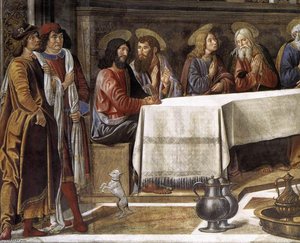
To gaze upon this detail from Cosimo Rosselli's rendition of The Last Supper is to be transported across the centuries, into a moment suspended between profound intimacy and monumental destiny. This scene, painted in 1481 within the sacred confines of the Cappella Sistina, transcends mere depiction; it captures the very breath of human drama set against the backdrop of divine revelation. Rosselli masterfully frames the final meal shared by Jesus…

4
The Last Supper (detail) (1481) af Cosimo Rosselli

The Last Supper (detail)

1481 · Acrylic · Det Sixtinske Kapel, Vatikanstaten

Cosimo Rosselli’s “The Last Supper,” a breathtaking detail from his monumental fresco cycle within the Cappella Sistina, offers an unparalleled glimpse into the heart of the late 15th century. Completed in 1481-82 amidst a complex political reconciliation between Florence and Rome, this work transcends mere biblical narrative; it’s a profound meditation on faith, betrayal, and the human condition. More than just a depiction of Christ's final meal with his disciples,…

5
The Last Supper (detail) (1481) af Cosimo Rosselli

The Last Supper (detail)

1481 · Fresco · Det Sixtinske Kapel, Vatikanstaten

Cosimo Rosselli’s “The Last Supper (Detail),” painted in 1481 as part of the monumental fresco cycle adorning the Sistine Chapel, is more than just a depiction of a biblical event; it's a vibrant testament to the burgeoning artistic spirit of the High Renaissance. This intimate detail captures a pivotal moment – the announcement of betrayal – with an intensity and emotional resonance that continues to captivate viewers centuries later. Commissioned…

6
Portrait of a Man (1481) af Cosimo Rosselli

Portrait of a Man

1481 · Acrylic On Canvas · Metropolitan Museum of Art, New York

Cosimo Rosselli’s “Portrait of a Man,” painted around 1481 in Florence, is far more than a simple likeness; it's a carefully constructed tableau of status, ambition, and the burgeoning artistic currents of the High Renaissance. This remarkably preserved panel painting offers a rare window into the world of Florentine nobility, capturing not just a man’s appearance but also his projected persona – a testament to the era’s fascination with portraiture…

7
The Last Supper (after restauration) (1481) af Cosimo Rosselli

The Last Supper (after restauration)

1481 · Acrylic On Canvas · Det Sixtinske Kapel, Vatikanstaten

Artist and Title Cosimo Rosselli was an Italian Renaissance painter born in Florence in 1439. He is best known for his frescoes, including the one we will discuss here: The Last Supper. Size and Media This masterpiece measures 349 cm x 570 cm and was created using the fresco technique. Fresco is a painting method in which pigments are applied to wet plaster, allowing them to become part of the…

8
Saint Catherine of Siena as Spiritual Mother of the Second and Third Orders of Saint Dominic (1499) af Cosimo Rosselli

Saint Catherine of Siena as Spiritual Mother of the Second and Third Orders of Saint Dominic

1499 · Tempera On Panel · Scottish National Gallery, Edinburgh

In this formal altarpiece from 1499, we find ourselves within a highly structured sacred space. The composition is centered upon Saint Catherine of Siena, who sits enthroned with a quiet, commanding presence. She is flanked by standing saints and surrounded by kneeling nuns, arranged in a pyramidal formation that directs the eye upward toward her figure. The scene is one of profound solemnity, a moment of communal devotion captured through…

9
Madonna and Child with the Young Saint John the Baptist (1490) af Cosimo Rosselli

Madonna and Child with the Young Saint John the Baptist

1490 · Tempera On Panel · Metropolitan Museum of Art, New York

The composition centers on a tender, vertical arrangement of three figures: the Madonna, the Christ Child, and a young Saint John the Baptist. Set against a split background of ornate gold patterning and a distant, atmospheric landscape, the scene focuses on the intimate act of nursing. The Virgin wears a deep crimson tunic beneath a mantle of rich ultramarine blue, her features rendered with soft, fluid lines that define the…

10
The Adoration of the Christ Child (1500) af Cosimo Rosselli

The Adoration of the Christ Child

1500 · Oil On Panel · Rijksmuseum, Amsterdam

The world settles into a quiet, circular hush within this tondo painting. At the very heart of the composition, the Virgin Mary kneels in prayer, her form anchored by the deep ultramarine blue of her mantle. Before her, the infant Jesus rests upon the earth, a small and precious focal point that draws every gaze toward the ground. Around them, the air feels soft and diffused, as if an overcast…

Cosimo Rossellis berømte malerier, nummer 11 til 24

Cosimo Rossellis berømte malerier, periode for periode

Motiverne, der fangede Cosimo Rossellis blik

De fire motiver, der optræder hyppigst i disse originaler, hver med sit fineste eksempel.

De museer, der udstiller Cosimo Rossellis originalværker

De 8 museer, der rummer flest af malerierne på denne side.

Museum By Værker af Cosimo Rosselli Malerier fra denne liste
Det Sixtinske Kapel, VatikanstatenDet Sixtinske Kapel Vatikanstaten 10 The Last Supper (detail) (8), The Last Supper, The Last Supper (detail)
Metropolitan Museum of Art, New YorkMetropolitan Museum of Art New York 3 Portrait of a Man, Madonna and Child with the Young Saint John the Baptist, Madonna and Child with Angels
Gemäldegalerie, BerlinGemäldegalerie Berlin 3 The Virgin and Blessing Child Enthroned with Sts. John, Augustine, Dominic, Peter and Victims of the bethemitic Child Murder, The Virgin with the Blessing Child in Glory, adored by Angels, Saints, Prayers and a Donor, The Domination of Christ
Museum of Fine Arts, BostonMuseum of Fine Arts Boston 2 Virgin and Child with an Angel, The Descent From the Cross
Scottish National Gallery, EdinburghScottish National Gallery Edinburgh 1 Saint Catherine of Siena as Spiritual Mother of the Second and Third Orders of Saint Dominic
Rijksmuseum, AmsterdamRijksmuseum Amsterdam 1 The Adoration of the Christ Child
Musée de Tessé, Le MansMusée de Tessé Le Mans 1 Portrait of Bartolomeo di Giovanni Berzichelli
Musée du Petit Palais, AvignonMusée du Petit Palais Avignon 1 The Annunciation between Four Saints

Cosimo Rosselli gennem årtierne: ét unikt originalværk til hver

Værker per årti

Vælg et årti for at se det originale værk, der definerer det.

Cosimo Rossellis malerier: spørgsmål til galleriet

Hvad er det mest berømte værk af Cosimo Rosselli?Vis svaret

The Last Supper (detail) (8) (1481), Det Sixtinske Kapel, Vatikanstaten. Derefter følger The Last Supper (1481) og The Last Supper (detail) (1481).

Hvilken alder havde Cosimo Rosselli, da The Last Supper (detail) (8) blev skabt?Vis svaret

42 år gammel: The Last Supper (detail) (8) er fra 1481, og Cosimo Rosselli blev født i 1439.

Hvilke ti malerier af Cosimo Rosselli er de mest berømte?Vis svaret

The Last Supper (detail) (8), The Last Supper, The Last Supper (detail), The Last Supper (detail), The Last Supper (detail), Portrait of a Man, The Last Supper (after restauration), Saint Catherine of Siena as Spiritual Mother of the Second and Third Orders of Saint Dominic, Madonna and Child with the Young Saint John the Baptist og The Adoration of the Christ Child. Ranglisten ovenfor viser det enkelte værks årstal og museum.

Hvor mange værker af Cosimo Rosselli er kendt?Vis svaret

Vores katalog indeholder 25 værker af Cosimo Rosselli, dateret fra 1450 til 1500.

Hvor kan de mest berømte originaler af Cosimo Rosselli ses?Vis svaret

Primært i Det Sixtinske Kapel (Vatikanstaten), Metropolitan Museum of Art (New York) og Gemäldegalerie (Berlin). Museumslisten ovenfor viser dem alle.

I hvilken periode skabte Cosimo Rosselli sine mest kendte malerier?Vis svaret

I 1480s: 12 af de 24 værker på denne side blev skabt dengang, herunder The Last Supper (detail) (8).

Hvilket berømt maleri af Cosimo Rosselli er det tidligste, og hvilket er det seneste?Vis svaret

På denne side er det tidligste Portrait of Bartolomeo di Giovanni Berzichelli (1450) og det seneste The Adoration of the Christ Child (1500).

Hvilke motiver foretrak Cosimo Rosselli?Vis svaret

Woman (7), Last supper (5) og Child (5), fordelt på de 24 værker på denne side.

Hvilke materialer brugte Cosimo Rosselli mest til sine malerier?Vis svaret

Tempera On Panel, for 8 af de 24 værker på denne side.

Hvilken stilart tilhører værkerne fra Cosimo Rosselli?Vis svaret

Renaissance og Early renaissance, baseret på originalerne på denne side.

Hvilke originalværker af Cosimo Rosselli kan jeg se på Det Sixtinske Kapel?Vis svaret

The Last Supper (detail) (8), The Last Supper og The Last Supper (detail): Det Sixtinske Kapel, Vatikanstaten har 10 af værkerne på denne side.

Cosimo Rosselli: et portræt af kunstneren

Cosimo Rosselli (1439–1507): A Florentine Hand in Rome

Cosimo Rosselli, born around 1439 in the vibrant heart of Florence, emerged from a family of established merchants—a background that afforded him a stable upbringing and access to the burgeoning cultural life of the Renaissance. Unlike many artists who began their training in youth, Rosselli’s artistic journey commenced relatively late, around the age of twenty. He entered the workshop of Domenico Ghirlandaio, a leading figure in Florentine painting renowned for his masterful frescoes and exquisitely detailed altarpieces. This environment was not merely an apprenticeship; it was immersion into a bustling hub of creativity where numerous assistants contributed to a constant stream of commissions. Here, Rosselli absorbed the fundamentals of drawing, composition, and the meticulous techniques that would define his early style. Ghirlandaio’s influence was profound, instilling in him a linear precision, a vibrant palette, and a narrative clarity that characterized much of his work. Yet, even within this formative period, Rosselli began to demonstrate an individual sensibility, subtly absorbing elements from earlier masters like Masaccio and Fra Angelico—artists who had already revolutionized the depiction of space, light, and emotion in painting.
  • Early Foundations: Domenico Ghirlandaio’s workshop provided Rosselli with a crucial foundation in painting techniques and compositional principles, shaping his early aesthetic sensibilities. He learned from Ghirlandaio's mastery of perspective and draughtsmanship, establishing a stylistic bedrock that would inform his subsequent endeavors.
  • Roman Experience: A pivotal moment arrived in 1481 when Rosselli received an invitation to participate in the monumental fresco cycle decorating the walls of the Sistine Chapel in Rome. This commission, alongside such luminaries as Pietro Perugino and Sandro Botticelli, marked a significant turning point in his career, catapulting him onto an international stage. The overarching theme of these frescoes was a carefully constructed parallel between the stories of Moses and Christ—a deliberate attempt to legitimize papal authority and underscore the continuity of divine law. Rosselli’s contributions focused on scenes from the Life of Jesus, showcasing his ability to translate complex narratives into visually compelling compositions.

Florentine Commissions and a Developing Style

Upon returning to Florence from Rome, Rosselli continued to receive a steady flow of commissions for altarpieces, frescoes, and panel paintings. His mature style blossomed during this period, characterized by refined compositions, elegant figures, and increasingly detailed landscapes. He retained the linear precision and vibrant colors he had learned from Ghirlandaio but began to incorporate elements of Perugino’s more graceful and harmonious aesthetic. Notable works from this time include frescoes for the Santissima Annunziata church—a significant commission that allowed him to showcase his evolving style on a grand scale—and numerous altarpieces adorning chapels throughout Florence. Rosselli possessed a talent for portraying the psychological states of his figures, imbuing them with a sense of inner life that resonated with contemporary audiences. He developed a distinctive approach to depicting religious scenes, emphasizing human emotions and interactions while maintaining an atmosphere of reverence and piety.

Influences and Artistic Development

Rosselli’s artistic journey is a compelling example of how Renaissance artists navigated the complex interplay between tradition, innovation, and patronage, leaving behind a legacy that continues to inspire and captivate audiences today. He absorbed elements from earlier masters like Masaccio and Fra Angelico, incorporating their innovations—such as realistic depictions of space and emotional expression—into his own distinctive style. This demonstrates a deep understanding of art history and a willingness to learn from those who came before him. His early training under Ghirlandaio instilled in him a meticulous attention to detail and a mastery of linear perspective, shaping the foundational principles of his artistic practice.

Legacy and Historical Significance

Cosimo Rosselli continued working diligently throughout the early 16th century, securing commissions from prominent Florentine families and religious institutions. However, as new artistic stars rose—Raphael and Michelangelo foremost among them—his prominence gradually diminished. He passed away in Florence around 1520, leaving behind a body of work that reflects his skill as a painter and his dedication to depicting religious themes with clarity and elegance. Today, Rosselli is remembered as a skilled Florentine artist who played an important role in the development of Renaissance art. His participation in the Sistine Chapel frescoes helped solidify Florence’s position as a leading center of artistic innovation, and his own works demonstrate his ability to synthesize diverse influences into a distinctive and refined style. While perhaps not achieving the same level of fame as some of his contemporaries, Cosimo Rosselli's contributions remain significant—a testament to his talent, dedication, and enduring legacy within the rich tapestry of Renaissance art.