Portræt af Ando Hiroshige

Ando Hiroshige malerier: De 100 mest berømte, set gennem et galleris øjne

Opdateret oktober 2026 · rangeret efter vores popularitetsscore (søgninger, besøg og ordrer for hvert værk) · 353 værker af Ando Hiroshige i vores katalog

Kort sagt

I galleriets øjne er Ando Hiroshiges mest berømte maleri Early Department from a Daimyo, hvis original hænger på Nakagawa-machi Bato Hiroshige Museum of Art i Nagasaki. The maple leaves of Mama, Tekona shrine and Tsugi bridge (1857) og Hakone (1834) fuldender trioen, som ethvert øje genkender. Ud af de 353 værker af Ando Hiroshige i vores katalog præsenterer galleriet herunder de 100 mest berømte, hver som et originalværk med årstal, museum og det, der gør det unikt.

1797 – 1858, Edo Japanese landscape painting Flest værker: Nakagawa-machi Bato Hiroshige Museum of Art

Galleriets top 10 Ando Hiroshige malerier

1
Early Department from a Daimyo af Ando Hiroshige

Early Department from a Daimyo

Woodblock Print · Nakagawa-machi Bato Hiroshige Museum of Art, Nagasaki

In the delicate dance of lines and muted pigments, Utagawa Hiroshige’s Early Department from a Daimyo invites us to step through a portal into the heart of Edo-period Japan. This exquisite woodblock print captures a moment of vibrant communal life along a bustling riverside, where the rigid structures of social hierarchy melt into the shared leisure of a sunny afternoon. As we gaze upon the scene, we are not merely…

2
The maple leaves of Mama, Tekona shrine and Tsugi bridge (1857) af Ando Hiroshige

The maple leaves of Mama, Tekona shrine and Tsugi bridge

1857 · Woodblock Print · Van Gogh Museet, Amsterdam

Utagawa Hiroshige (1797-1858), arguably the last titan of *ukiyo-e*, didn't merely depict landscapes; he crafted them into meditations on beauty and impermanence. “The Maple Leaves of Mama, Tekona Shrine and Tsugi Bridge,” created in 1857 during a period of significant societal transformation—the waning influence of feudal Japan as Western ideas crept in—stands as a testament to his enduring artistic legacy. More than just a visual record, it’s an embodiment of…

3
Hakone (1834) af Ando Hiroshige

Hakone

1834 · Woodblock Print · Indianapolis Kunstmuseum, Indianapolis

Utagawa Hiroshige’s “Hakone,” created in 1834, is more than just a landscape; it's a poetic meditation on the beauty and transience of nature within Edo-period Japan. This woodblock print, part of his renowned series "The Fifty-three Stations of the Tōkaidō," captures a specific moment along the vital trade route connecting Tokyo (then Edo) with Kyoto. However, Hiroshige elevates this seemingly simple depiction of a mountain pass into something profoundly evocative,…

4
Station 36, Goyu; Kyoka Tokaido Series (1855) af Ando Hiroshige

Station 36, Goyu; Kyoka Tokaido Series

1855 · Woodblock Print · Indianapolis Kunstmuseum, Indianapolis

In the delicate interplay of ink and paper, Utagawa Hiroshige’s "Station 36, Goyu; Kyoka Tokaido Series" offers much more than a mere topographical record of a journey. Completed in 1855, this exquisite woodblock print serves as a profound distillation of Edo-period sensibilities, capturing a yearning for tranquility amidst the burgeoning dynamism of a Japan in transition. As the nation stood at a pivotal crossroads between ancient feudal traditions and the…

5
Fushimi Station #51 (1842) af Ando Hiroshige

Fushimi Station #51

1842 · Akryl på lærred · Indianapolis Kunstmuseum, Indianapolis

Fushimi, Station # 51 – Et Poetisk Øje På Edo Japans Landskaber Utagawa Hiroshige er en kunstner hvis navn vil fremkalde billeder af fredfyldte japanske landskaber og atmosfæriske trædstykker. Han var ikke blot en dygtig tekniker, men også en visionær kunstner, der formåede at fange essensen af sin tid og udtrykke følelser gennem sit arbejde – hvilket har gjort hans kunst til et ikon inden for ukiyo-e og inspireret kunstnere…

6
Ichikoku Bridge in the Eastern Capital (Tōto: Ichikoku bashi) (1858) af Ando Hiroshige

Ichikoku Bridge in the Eastern Capital (Tōto: Ichikoku bashi)

1858 · Woodblock Print · Indianapolis Kunstmuseum, Indianapolis

The Ichikoku Bridge spans a quiet stretch of water in the Eastern Capital. Beneath its wooden arch, two boats drift through the current. People move across the structure, some carrying backpacks and others clutching small handbags. A mountain rises in the distance, watching over the scene. Trees frame the edges of the view, their leaves casting shadows near the water's edge.

7
Shinagawa Sunrise from the series Fifty-three Stations on the Tokaido Road (1834) af Ando Hiroshige

Shinagawa Sunrise from the series Fifty-three Stations on the Tokaido Road

1834 · Woodblock Print · Hill-Stead Museum, Farmington

In the soft, burgeoning light of a nineteenth-century morning, Utagawa Hiroshige invites us to witness a moment of profound stillness along the Tōkaidō road. Shinagawa Sunrise is not merely a depiction of a coastal village; it is a masterclass in the art of atmosphere. As the sun begins its ascent, the boundary between the heavens and the earth dissolves into a luminous haze. The water of the bay reflects a…

8
The Rokugo River Ferry, Kawasaki, from the series the Fifty-three Stations of the Tokaido (Hoeido edition ) af Ando Hiroshige

The Rokugo River Ferry, Kawasaki, from the series the Fifty-three Stations of the Tokaido (Hoeido edition )

Woodblock Print · Nakagawa-machi Bato Hiroshige Museum of Art, Nagasaki

In the delicate dance of woodblock printing, few masters captured the ephemeral beauty of Japanese life as profoundly as Utagawa Hiroshige. His masterpiece, The Rokugo River Ferry, Kawasaki, serves as a breathtaking window into the Edo period, inviting the viewer to step onto the bustling banks of one of the most vital crossings on the Tokaido road. This evocative scene from his legendary series, The Fifty-three Stations of the Tokaido,…

9
Itsukushima in Aki Province (1858) af Ando Hiroshige

Itsukushima in Aki Province

1858 · Woodblock Print · Brooklyn Museum, Brooklyn

In the delicate interplay of mist and water, Itsukushima in Aki Province offers more than a mere glimpse of a Japanese landmark; it provides a profound meditation on the ephemeral nature of existence. Created by the legendary ukiyo-e master Ando Hiroshige in 1858, this woodcut print captures the spiritual essence of the Itsukushima shrine area with a poetic sensitivity that remains unparalleled. As one gazes upon the composition, the eye…

10
Tenryu River Ferry Crossing, Mitsuke, from the series The Fifty-three Stations of the Tokaido (Gyosho Edition) af Ando Hiroshige

Tenryu River Ferry Crossing, Mitsuke, from the series The Fifty-three Stations of the Tokaido (Gyosho Edition)

Woodblock Print · Nakagawa-machi Bato Hiroshige Museum of Art, Nagasaki

The woodblock print depicts a section of the Tenryu River near the station of Mitsuke. In the center of the composition, a large sandbank divides the water into two distinct currents. Several small wooden boats occupy the river, with figures positioned within them to manage the crossing. Some vessels are moored directly against the central sandbank, while others navigate the moving water. The far shore is visible in the distance,…

Ando Hiroshiges malerier, rangeret fra 11 til 100

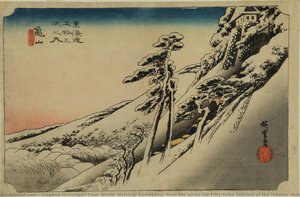
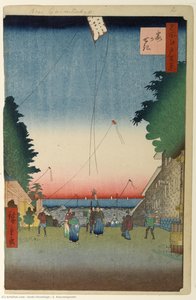
11Parrot og Druvbær (1800) af Ando HiroshigeParrot og Druvbær1800 · Indianapolis Kunstmuseum 12The Pine Woods of Miho in Suruga Province (Suruga Miho no matsubara) (1858) af Ando HiroshigeThe Pine Woods of Miho in Suruga Province (Suruga Miho no matsubara)1858 · Indianapolis Kunstmuseum 1362 (55) Komakata Hall and Azuma Bridge (1857) af Ando Hiroshige62 (55) Komakata Hall and Azuma Bridge1857 · Brooklyn Museum 14Evening Snow at Kanbara (1834) af Ando HiroshigeEvening Snow at Kanbara1834 · Los Angeles County Museum of Art 15Dawn in the licensed quarters (1857) af Ando HiroshigeDawn in the licensed quarters1857 · Art Gallery of New South Wales 16Night View of Saruwakacho af Ando HiroshigeNight View of Saruwakacho 17Station 28, Fukuroi (1855) af Ando HiroshigeStation 28, Fukuroi1855 · Indianapolis Kunstmuseum 18Evening Snow at Asakusa or Woman with Umbrella from the series Eight Views of the Environs of Edo (1800) af Ando HiroshigeEvening Snow at Asakusa or Woman with Umbrella from the series Eight Views of the Environs of Edo1800 · Hill-Stead Museum 19Keishi (Kyoto), Capital (1834) af Ando HiroshigeKeishi (Kyoto), Capital1834 · Indianapolis Kunstmuseum 20Hara: View of Ashitakayama and Fuji (1855) af Ando HiroshigeHara: View of Ashitakayama and Fuji1855 · Indianapolis Kunstmuseum 21Yokkaichi (Station #44) (1834) af Ando HiroshigeYokkaichi (Station #44)1834 · Indianapolis Kunstmuseum 22Desolate Wintry Scene, Hamamatsu, from the series the Fifty-three Stations of the Tokaido (Hoeido edition) af Ando HiroshigeDesolate Wintry Scene, Hamamatsu, from the series the Fifty-three Stations of the Tokaido (Hoeido edition)Nakagawa-machi Bato Hiroshige Museum of Art 23Noge and Yokohama in Musashi Province (Musashi, Noge, Yokohama) (1858) af Ando HiroshigeNoge and Yokohama in Musashi Province (Musashi, Noge, Yokohama)1858 · Indianapolis Kunstmuseum 24Wild sea breaking on the rocks (1856) af Ando HiroshigeWild sea breaking on the rocks1856 25Shirasuga, Shiomi-zaka zu (View of Shima Slope) (1833) af Ando HiroshigeShirasuga, Shiomi-zaka zu (View of Shima Slope)1833 · Indianapolis Kunstmuseum 26Mt.Fuji on the Left, Yoshiwara, from the series the Fifty-three Stations of the Tokaido (Hoeido edition) af Ando HiroshigeMt.Fuji on the Left, Yoshiwara, from the series the Fifty-three Stations of the Tokaido (Hoeido edition)Nakagawa-machi Bato Hiroshige Museum of Art 27Tsukuda Offing in the Eastern Capital (Tōto: Tsukuda oki) (1858) af Ando HiroshigeTsukuda Offing in the Eastern Capital (Tōto: Tsukuda oki)1858 · Indianapolis Kunstmuseum 28Kawachi (1853) af Ando HiroshigeKawachi1853 · Indianapolis Kunstmuseum 29The Dye Craft Shops of Arimatsu, Narumi, from the series The Fifty-three Stations of the Tokaido (Gyosho edition) af Ando HiroshigeThe Dye Craft Shops of Arimatsu, Narumi, from the series The Fifty-three Stations of the Tokaido (Gyosho edition)Nakagawa-machi Bato Hiroshige Museum of Art 30View of Shiomi Slope, Shirasuka, from the series The Fifty-three Stations of the Tokaido (Gyosho edition) af Ando HiroshigeView of Shiomi Slope, Shirasuka, from the series The Fifty-three Stations of the Tokaido (Gyosho edition)Nakagawa-machi Bato Hiroshige Museum of Art 31Entrance to Enoshima in Sagami Province (Sagami Enoshima iriguchi) (1858) af Ando HiroshigeEntrance to Enoshima in Sagami Province (Sagami Enoshima iriguchi)1858 · Indianapolis Kunstmuseum 32Morning Mist, Mishima, from the series the Fifty-three Stations of the Tokaido (Hoeido edition ) af Ando HiroshigeMorning Mist, Mishima, from the series the Fifty-three Stations of the Tokaido (Hoeido edition )Nakagawa-machi Bato Hiroshige Museum of Art 33The Imagire Sea Ferry, Maisaka, from the series The Fifty-three Stations of the Tokaido (Gyosho edition) af Ando HiroshigeThe Imagire Sea Ferry, Maisaka, from the series The Fifty-three Stations of the Tokaido (Gyosho edition)Nakagawa-machi Bato Hiroshige Museum of Art 34Sukiya Riverbank in the Eastern Capital (Tōto sukiya kaigan) (1858) af Ando HiroshigeSukiya Riverbank in the Eastern Capital (Tōto sukiya kaigan)1858 · Indianapolis Kunstmuseum 35Satta Pass, Yui, from the series the Fifty-three Stations of the Tokaido (Hoeido edition) af Ando HiroshigeSatta Pass, Yui, from the series the Fifty-three Stations of the Tokaido (Hoeido edition)Nakagawa-machi Bato Hiroshige Museum of Art 36True View of Imagire, Maisaka, from the series the Fifty-three Stations of the Tokaido (Hoeido edition) af Ando HiroshigeTrue View of Imagire, Maisaka, from the series the Fifty-three Stations of the Tokaido (Hoeido edition)Nakagawa-machi Bato Hiroshige Museum of Art 37Kanbara, NatSne (1834) af Ando HiroshigeKanbara, NatSne1834 · Indianapolis Kunstmuseum 38Clear Winter Morning, Kameyama, from the series the Fifty-three Stations of the Tokaido (Hoeido edition) af Ando HiroshigeClear Winter Morning, Kameyama, from the series the Fifty-three Stations of the Tokaido (Hoeido edition)Nakagawa-machi Bato Hiroshige Museum of Art 39The Tenryu River, Mitsuke, from the series the Fifty-three Stations of the Tokaido (Hoeido edition) af Ando HiroshigeThe Tenryu River, Mitsuke, from the series the Fifty-three Stations of the Tokaido (Hoeido edition)Nakagawa-machi Bato Hiroshige Museum of Art 40The Seven-ri Ferry Crossing, Kuwana, from the series the Fifty-three Stations of the Tokaido (Hoeido edition) af Ando HiroshigeThe Seven-ri Ferry Crossing, Kuwana, from the series the Fifty-three Stations of the Tokaido (Hoeido edition)Nakagawa-machi Bato Hiroshige Museum of Art 41Aronia and Bullfinch af Ando HiroshigeAronia and Bullfinch 42Sangfugle der hjem finder ved Katata (1834) af Ando HiroshigeSangfugle der hjem finder ved Katata1834 · Indianapolis Kunstmuseum 43Yugyoji Temple, Fujisawa, from the series the Fifty-three Stations of the Tokaido (Hoeido edition) af Ando HiroshigeYugyoji Temple, Fujisawa, from the series the Fifty-three Stations of the Tokaido (Hoeido edition)Nakagawa-machi Bato Hiroshige Museum of Art 44Travellers and Soliciting Women, Goyu, from the series the Fifty-three Stations of the Tokaido (Hoeido edition) af Ando HiroshigeTravellers and Soliciting Women, Goyu, from the series the Fifty-three Stations of the Tokaido (Hoeido edition)Nakagawa-machi Bato Hiroshige Museum of Art 45The Totoumi Bank of the Oi River, Kanaya, from the series the Fifty-three Stations of the Tokaido (Hoeido edition) af Ando HiroshigeThe Totoumi Bank of the Oi River, Kanaya, from the series the Fifty-three Stations of the Tokaido (Hoeido edition)Nakagawa-machi Bato Hiroshige Museum of Art 46The Suruga Bank of the Oi River, Shimada, from the series the Fifty-three Stations of the Tokaido (Hoeido edition) af Ando HiroshigeThe Suruga Bank of the Oi River, Shimada, from the series the Fifty-three Stations of the Tokaido (Hoeido edition)Nakagawa-machi Bato Hiroshige Museum of Art 47Kyoka Tokaido Series, Kanagawa (Yokohama) af Ando HiroshigeKyoka Tokaido Series, Kanagawa (Yokohama)Indianapolis Kunstmuseum 48Distant View of Miho, Ejiri, from the series the Fifty-three Stations of the Tokaido (Hoeido edition) af Ando HiroshigeDistant View of Miho, Ejiri, from the series the Fifty-three Stations of the Tokaido (Hoeido edition)Nakagawa-machi Bato Hiroshige Museum of Art 49Mt. Fuji in the Morning, Hara, from the series the Fifty-three Stations of the Tokaido (Hoeido edition) af Ando HiroshigeMt. Fuji in the Morning, Hara, from the series the Fifty-three Stations of the Tokaido (Hoeido edition)Nakagawa-machi Bato Hiroshige Museum of Art 50A Horse Fair, Chiriu, from the series the Fifty-three Stations of the Tokaido (Hoeido edition) af Ando HiroshigeA Horse Fair, Chiriu, from the series the Fifty-three Stations of the Tokaido (Hoeido edition)Nakagawa-machi Bato Hiroshige Museum of Art 51Wakasa (1853) af Ando HiroshigeWakasa1853 · Indianapolis Kunstmuseum 52Distant View of Mt.Akiba, Kakegawa, from the series the Fifty-three Stations of the Tokaido (Hoeido edition) af Ando HiroshigeDistant View of Mt.Akiba, Kakegawa, from the series the Fifty-three Stations of the Tokaido (Hoeido edition)Nakagawa-machi Bato Hiroshige Museum of Art 53The Ichiri-Han Sea Ferry, Arai, from the series The Fifty-three Stations of the Tokaido (Gyosho edition) af Ando HiroshigeThe Ichiri-Han Sea Ferry, Arai, from the series The Fifty-three Stations of the Tokaido (Gyosho edition)Nakagawa-machi Bato Hiroshige Museum of Art 54Gateway Entrance to the Atsuta Shrine on the Beach, Miya, from the series The Fifty-three Stations of the Tokaido (Gyosho edition) af Ando HiroshigeGateway Entrance to the Atsuta Shrine on the Beach, Miya, from the series The Fifty-three Stations of the Tokaido (Gyosho edition)Nakagawa-machi Bato Hiroshige Museum of Art 55Akasaka, from the series The Fifty-three Stations of the Tokaido (Gyosho edition) af Ando HiroshigeAkasaka, from the series The Fifty-three Stations of the Tokaido (Gyosho edition)Nakagawa-machi Bato Hiroshige Museum of Art 56The Sakawa River, Odawara, from the series the Fifty-three Stations of the Tokaido (Hoeido edition) af Ando HiroshigeThe Sakawa River, Odawara, from the series the Fifty-three Stations of the Tokaido (Hoeido edition)Nakagawa-machi Bato Hiroshige Museum of Art 57A Footpath between Ricefield, Hiratsuka, from the series the Fifty-three Stations of the Tokaido (Hoeido edition) af Ando HiroshigeA Footpath between Ricefield, Hiratsuka, from the series the Fifty-three Stations of the Tokaido (Hoeido edition)Nakagawa-machi Bato Hiroshige Museum of Art 58Awa Province: Whirlpool at Naruto (1853) af Ando HiroshigeAwa Province: Whirlpool at Naruto1853 5973 The City Flourishing, the Tanabata Festival (1857) af Ando Hiroshige73 The City Flourishing, the Tanabata Festival1857 60Sarugababa Plain, Futagawa, from the series the Fifty-three Stations of the Tokaido (Hoeido edition) af Ando HiroshigeSarugababa Plain, Futagawa, from the series the Fifty-three Stations of the Tokaido (Hoeido edition)Nakagawa-machi Bato Hiroshige Museum of Art 61Local Specialty Teahouse, Mariko, from the series the Fifty-three Stations of the Tokaido (Hoeido edition) af Ando HiroshigeLocal Specialty Teahouse, Mariko, from the series the Fifty-three Stations of the Tokaido (Hoeido edition)Nakagawa-machi Bato Hiroshige Museum of Art 62Sakanoshita af Ando HiroshigeSakanoshitaIndianapolis Kunstmuseum 63Station 23, Fujieda af Ando HiroshigeStation 23, FujiedaIndianapolis Kunstmuseum 64Marsh Grasses and Mandarin Ducks af Ando HiroshigeMarsh Grasses and Mandarin Ducks 6550th station, Minakuchi af Ando Hiroshige50th station, Minakuchi 66Sakanoshita: the Throwing Away the Brush Peak (1834) af Ando HiroshigeSakanoshita: the Throwing Away the Brush Peak1834 · Brooklyn Museum 67Shibaura Bay of Musashi Province (801) af Ando HiroshigeShibaura Bay of Musashi Province801 · Metropolitan Museum of Art 68Koyurugi Beach of Sagami Province (801) af Ando HiroshigeKoyurugi Beach of Sagami Province801 · Metropolitan Museum of Art 69Honmoku Bay of Musashi Province (801) af Ando HiroshigeHonmoku Bay of Musashi Province801 · Metropolitan Museum of Art 70Untitled (Two Rabbits, Pampas Grass, and Full Moon) (1851) af Ando HiroshigeUntitled (Two Rabbits, Pampas Grass, and Full Moon)1851 7111. Kiyomizu Hall and Shinobazu Pond at Ueno (1857) af Ando Hiroshige11. Kiyomizu Hall and Shinobazu Pond at Ueno1857 7285. Kinokuni Hill and Distant View of Akasaka and the Tameike Pond (1857) af Ando Hiroshige85. Kinokuni Hill and Distant View of Akasaka and the Tameike Pond1857 7376 Bamboo Quay by Kyōbashi Bridge (1857) af Ando Hiroshige76 Bamboo Quay by Kyōbashi Bridge1857 7458 (52) Sudden Shower over Shin-Ōhashi bridge and Atake (1857) af Ando Hiroshige58 (52) Sudden Shower over Shin-Ōhashi bridge and Atake1857 · Tokyo Fuji Art Museum 75103. Senju Great Bridge (1857) af Ando Hiroshige103. Senju Great Bridge1857 7618. The Ōji Inari Shrine (1857) af Ando Hiroshige18. The Ōji Inari Shrine1857 77113. Aoi Slope Outside Toranomon Gate (1857) af Ando Hiroshige113. Aoi Slope Outside Toranomon Gate1857 78114. Bikuni Bridge in Snow (1857) af Ando Hiroshige114. Bikuni Bridge in Snow1857 7970 (60) The Mouth of the Nakagawa River (1857) af Ando Hiroshige70 (60) The Mouth of the Nakagawa River1857 802. Kasumigaseki (1857) af Ando Hiroshige2. Kasumigaseki1857 8115. Suwa Bluff in Nippori (1857) af Ando Hiroshige15. Suwa Bluff in Nippori1857 8263 (69) The Ayase River and Kanegafuchi (1857) af Ando Hiroshige63 (69) The Ayase River and Kanegafuchi1857 83115. The Takata Riding Grounds (1857) af Ando Hiroshige115. The Takata Riding Grounds1857 8486. Naitō Shinjuku in Yotsuya (1857) af Ando Hiroshige86. Naitō Shinjuku in Yotsuya1857 8516. Flower Park and Dangozaka Slope in Sendagi (1857) af Ando Hiroshige16. Flower Park and Dangozaka Slope in Sendagi1857 8668 (59) Open Garden at the Hachiman Shrine in Fukagawa (1857) af Ando Hiroshige68 (59) Open Garden at the Hachiman Shrine in Fukagawa1857 8710. Sunrise at Kanda Myōjin Shrine (1857) af Ando Hiroshige10. Sunrise at Kanda Myōjin Shrine1857 88Peach and Long-tailed Bird af Ando HiroshigePeach and Long-tailed Bird 89Golden Pheasant in Bracken af Ando HiroshigeGolden Pheasant in Bracken 90The Imado Bridge at the Foot of Mount Matsuchi (801) af Ando HiroshigeThe Imado Bridge at the Foot of Mount Matsuchi801 · Metropolitan Museum of Art 91Dog (1858) af Ando HiroshigeDog1858 · Indianapolis Kunstmuseum 92118. Kitsunebi on New Year's Night Under the Enoki Tree near Ōji (1857) af Ando Hiroshige118. Kitsunebi on New Year's Night Under the Enoki Tree near Ōji1857 93109. Minami Shinagawa and Samezu Coast (1857) af Ando Hiroshige109. Minami Shinagawa and Samezu Coast1857 94Night View of Matsuchiyama and the San (1857) af Ando HiroshigeNight View of Matsuchiyama and the San1857 · Los Angeles County Museum of Art 95Akasaka, nr. 37 af Ando HiroshigeAkasaka, nr. 37Indianapolis Kunstmuseum 96Shiojiri Pass in Shinano Province (Shinano Shiojiritōge) (1858) af Ando HiroshigeShiojiri Pass in Shinano Province (Shinano Shiojiritōge)1858 · Indianapolis Kunstmuseum 97Yoshiwara af Ando HiroshigeYoshiwaraIndianapolis Kunstmuseum 98Fuchu, No. 20 af Ando HiroshigeFuchu, No. 20Indianapolis Kunstmuseum 99Woman Walking in the Snow (1850) af Ando HiroshigeWoman Walking in the Snow1850 · Metropolitan Museum of Art 10082. Moon Viewing (1857) af Ando Hiroshige82. Moon Viewing1857

Ando Hiroshiges berømte malerier, periode for periode

Motiverne, der fangede Ando Hiroshiges blik

De fire motiver, der optræder hyppigst i disse originaler, hver med sit fineste eksempel.

De museer, der udstiller Ando Hiroshiges originalværker

De 8 museer, der rummer flest af malerierne på denne side.

Museum By Værker af Ando Hiroshige Malerier fra denne liste
Nakagawa-machi Bato Hiroshige Museum of Art, NagasakiNakagawa-machi Bato Hiroshige Museum of Art Nagasaki 30 Early Department from a Daimyo, The Rokugo River Ferry, Kawasaki, from the series the Fifty-three Stations of the Tokaido (Hoeido edition ), Tenryu River Ferry Crossing, Mitsuke, from the series The Fifty-three Stations of the Tokaido (Gyosho Edition)
Indianapolis Kunstmuseum, IndianapolisIndianapolis Kunstmuseum Indianapolis 36 Hakone, Station 36, Goyu; Kyoka Tokaido Series, Fushimi Station #51
Metropolitan Museum of Art, New YorkMetropolitan Museum of Art New York 8 Shibaura Bay of Musashi Province, Koyurugi Beach of Sagami Province, Honmoku Bay of Musashi Province
Brooklyn Museum, BrooklynBrooklyn Museum Brooklyn 4 Itsukushima in Aki Province, 62 (55) Komakata Hall and Azuma Bridge, Sakanoshita: the Throwing Away the Brush Peak
Hill-Stead Museum, FarmingtonHill-Stead Museum Farmington 3 Shinagawa Sunrise from the series Fifty-three Stations on the Tokaido Road, Evening Snow at Asakusa or Woman with Umbrella from the series Eight Views of the Environs of Edo
Los Angeles County Museum of Art, Los AngelesLos Angeles County Museum of Art Los Angeles 2 Evening Snow at Kanbara, Night View of Matsuchiyama and the San
Van Gogh Museet, AmsterdamVan Gogh Museet Amsterdam 1 The maple leaves of Mama, Tekona shrine and Tsugi bridge
Art Gallery of New South Wales, SydneyArt Gallery of New South Wales Sydney 1 Dawn in the licensed quarters

Ando Hiroshige, ét signaturmaleri per årti

Værker per årti

Vælg et årti for at se det originale værk, der definerer det.

Ando Hiroshige's malerier: galleriets svar

Hvilket maleri af Ando Hiroshige er det mest berømte af alle?Vis svaret

Early Department from a Daimyo, Nakagawa-machi Bato Hiroshige Museum of Art, Nagasaki. Derefter følger The maple leaves of Mama, Tekona shrine and Tsugi bridge (1857) og Hakone (1834).

Hvilke er Ando Hiroshiges top 10 malerier?Vis svaret

Early Department from a Daimyo, The maple leaves of Mama, Tekona shrine and Tsugi bridge, Hakone, Station 36, Goyu; Kyoka Tokaido Series, Fushimi Station #51, Ichikoku Bridge in the Eastern Capital (Tōto: Ichikoku bashi), Shinagawa Sunrise from the series Fifty-three Stations on the Tokaido Road, The Rokugo River Ferry, Kawasaki, from the series the Fifty-three Stations of the Tokaido (Hoeido edition ), Itsukushima in Aki Province og Tenryu River Ferry Crossing, Mitsuke, from the series The Fifty-three Stations of the Tokaido (Gyosho Edition). Ranglisten ovenfor viser det enkelte værks årstal og museum.

Hvor mange værker skabte Ando Hiroshige?Vis svaret

Vores katalog indeholder 353 værker af Ando Hiroshige, dateret fra 1833 til 1858.

Hvor hænger Ando Hiroshiges mest berømte originaler?Vis svaret

Primært i Nakagawa-machi Bato Hiroshige Museum of Art (Nagasaki), Indianapolis Kunstmuseum (Indianapolis) og Metropolitan Museum of Art (New York). Museumslisten ovenfor viser dem alle.

Hvornår skabte Ando Hiroshige sine mest berømte malerier?Vis svaret

I 1850s: 43 af de 100 værker på denne side blev skabt dengang, herunder The maple leaves of Mama, Tekona shrine and Tsugi bridge.

Hvilke er Ando Hiroshiges tidligste og seneste berømte værker?Vis svaret

På denne side er det tidligste Shirasuga, Shiomi-zaka zu (View of Shima Slope) (1833) og det seneste Ichikoku Bridge in the Eastern Capital (Tōto: Ichikoku bashi) (1858).

Hvilke motiver vendte Ando Hiroshige oftest tilbage til?Vis svaret

Edo period (32), Woodblock print (22) og Ukiyo-e (22), fordelt på de 100 værker på denne side.

Hvilket medie arbejdede Ando Hiroshige mest med?Vis svaret

Woodblock Print, for 60 af de 100 værker på denne side.

Hvilken stilart er Ando Hiroshige associeret med?Vis svaret

Japanese landscape painting, baseret på originalerne på denne side.

Hvilke originalværker af Ando Hiroshige findes i Nakagawa-machi Bato Hiroshige Museum of Art?Vis svaret

Early Department from a Daimyo, The Rokugo River Ferry, Kawasaki, from the series the Fifty-three Stations of the Tokaido (Hoeido edition ) og Tenryu River Ferry Crossing, Mitsuke, from the series The Fifty-three Stations of the Tokaido (Gyosho Edition): Nakagawa-machi Bato Hiroshige Museum of Art, Nagasaki har 29 af værkerne på denne side.

Kan jeg få et maleri af Ando Hiroshige reproduceret i hånden?Vis svaret

Ja, som reproduktion: det originale værk bliver i sit museum, men ethvert maleri på denne side kan males i hånden til dig, bestilt efter behov og malet ét ad gangen, direkte fra maleriets egen side.

Ando Hiroshige: kunstneren

Utagawa Hiroshige: En Poetisk Betragter af Edo-Japan

Utagawa Hiroshige, født Andō Tokutarō i 1797 i den pulserende by Edo (moderne Tokyo), står som en central figur i verden af *ukiyo-e*, eller “billeder fra det flydende verden.” Selvom han var dybt forankret i traditionerne i japansk træblokstik, overgik Hiroshige blot at reproducere; han indgydede sine landskaber med en poetisk sanselighed, der resonerede dybt både inden for Japan og senere på tværs af den vestlige kunstverden. Hans liv udspillede sig under en periode med relativ fred og velstand under Tokugawa-shogunen, men også én præget af stigende social forandring og den efterfølgende vestliggørelse – kræfter, der bidrog til *ukiyo-e’s* nedgang, selvom de forstærkede Hiroshige's vedvarende arv. I første omgang var han bestemt til en mere konventionel vej inden for en samurai-familie – hans far tjente som brandvagt – men Hiroshige's kunstneriske tilbøjeligheder førte ham til et lærerskab under Utagawa Toyohiro, en mester i Utagawas skole. Dette viste sig at være et afgørende vendepunkt, der drev ham væk fra de populære fremstillinger af kurtisiner og skuespillere, som mange *ukiyo-e*-kunstnere foretrak, mod fokus på landskab, en genre han i sidste ende ville gendefinere.

Fra Genrebilleder til Evocative Landskaber

Hiroshige's tidlige arbejde fulgte skolens konventioner, med portrætter og scener fra dagligdagen. Men det var hans omfavnelse af landskab, der virkelig skilte ham ud. Påvirket af tidligere mestre som Hokusai – hvis *Tretti seks visninger af Fuji* allerede havde fangeres publikums opmærksomhed – udviklede Hiroshige en unik stil karakteriseret ved atmosfærisk perspektiv, subtile farvepaletter og en dyb følsomhed over for skiftene årstider. Han portrætterede ikke blot steder; han fremkaldte deres stemning, fangede essensen af et bestemt øjeblik i tiden. Serien *De femtysne stationer på Tōkaidō* (1833–1834), måske hans mest berømte præstation, dokumenterede rejsen langs Tōkaidō-vejen, den vigtigste rute mellem Edo og Kyoto, ikke som en simpel rejsebeskrivelse, men som en serie af evocative vignetter – et pludseligt regnskyl i Shono, en fjerntliggende udsigt til Fuji fra Kanaya, den travle aktivitet ved Odawara. Hvert tryk er gennemsyret af en følelse af forgængelighed og stille skønhed, der inviterer seerne til at opleve rejsen sammen med de reisende. Han udnyttede mesterligt *bokashi*, en teknik, der involverer flere tryk i samme område for at skabe subtile nuancer af farve, hvilket tilføjede dybde og atmosfære til sine kompositioner.

En Mester af Atmosfære og Teknik

Hiroshige's tekniske færdigheder var lige så bemærkelsesværdige som hans kunstneriske vision. Han var ikke blot interesseret i nøjagtig gengivelse; han søgte at fange *følelsen* af et sted. Hans brug af farver, selvom den ofte var mere sparsommelig end hos nogle af sine samtidige, var afgørende for at opnå dette. Han udnyttede ofte flere blokke for en enkelt farve, hvilket tillod ham at skabe nuancerede nuancer og atmosfæriske effekter, der var utroligt vanskelige at efterligne. De delikate blå nuancer i hans fremstillinger af regn eller tåge, de varme toner af efterårsblade – disse var ikke tilfældige; de var omhyggeligt overvejede elementer designet til at vække specifikke følelser og sansninger. Udover *bokashi* var Hiroshige dygtig til at udnytte tomrum – *ma*, et koncept centralt for japansk æstetik, der tillod områder af trykket at "trække vejret" og forbedrede den overordnede følelse af ro. Hans serie *En hundrede berømte visninger af Edo* (1856–1858) viste yderligere hans mesterskab, hvilket tilbød intime glimt ind i livet og landskaberne i hans elskede by.

Indflydelse og Arv

Hiroshige's arbejde var ikke uden forudgående indflydelser. Han var dybt påvirket af den kinesiske traditionelle malerkunst, især *sumi-e*, og af den mere formelle kanon i den ældre *ukiyo-e*-skole. Samtidig lærte han af Hokusai's radikale tilgang til landskabstrykkene, der var en markant afvigelse fra de traditionelle motiver. Hiroshige fandt sin egen unikke stil ved at kombinere disse elementer og skabe et mere atmosfærisk og poetisk udtryk. Hans tryk blev hurtigt populære i Japan, men det var først i Vesten, hvor de blev anerkendt for deres kunstneriske værdi og deres evne til at fange den flygtige skønhed i naturen. Impressionister og post-impressionister som Monet og Van Gogh var dybt fascineret af Hiroshiges farver og kompositioner, der inspirerede dem til at eksperimentere med lignende teknikker og motiver i deres egne værker. Hiroshige's død markerede starten på en hurtig nedgang i *ukiyo-e*-traditionen, accelereret af Meiji-restaureringen og den efterfølgende vestliggørelse. Alligevel har hans indflydelse på kunstverdenen vist sig at være bemærkelsesværdigt vedvarende. I det sene 19. århundrede strømmede japanske tryk til Europa, hvilket udløste et fænomen kendt som *Japonisme*. Kunstnere som Manet og Van Gogh blev betaget af *ukiyo-e’s* dristige kompositioner, flade perspektiver og ukonventionelle farveskalaer, der inspirerede dem til at inkorporere disse elementer i deres egne værker. Hiroshige's arbejde er et vidnesbyrd om en kunstners evne til at fange essensen af øjeblikket og skabe billeder, der fortsat fascinerer og inspirerer os i dag.

Alle 353 værker af Ando Hiroshige →