Portræt af Thomas Wyck

De 80 mest berømte Thomas Wyck-malerier, hver og en unik

Opdateret november 2026 · rangeret efter vores popularitetsscore (søgninger, besøg og ordrer for hvert værk) · 89 værker af Thomas Wyck i vores katalog

Kort sagt

St Anthony, Archbishop of Florence (1654) er det maleri af Thomas Wyck, der vækker mest opsigt; originalen findes på Nationalmuseum, Stockholm. Derefter falder blikket på Interior of a Dutch Farm Cottage (1654) og The Alchemist (1650). Blandt de 89 værker af Thomas Wyck i vores katalog er disse 80 de mest berømte, hver især et unikt originalværk præsenteret med sit årstal, sit museum og årsagen til dets tidløse betydning.

1616 – 1677, Beverwijk Dutch golden age Flest værker: Bavarian State Painting Collections

Top 10 malerier af Thomas Wyck, set gennem galleriets øjne

1
St Anthony, Archbishop of Florence (1654) af Thomas Wyck

St Anthony, Archbishop of Florence

1654 · Oil · Nationalmuseum, Stockholm

The saint stands within a frame of heavy, arched architecture. He is a pillar of white and black, his monastic habit catching a sharp, directional light from the upper left. This light carves the folds of his robes and illuminates a face set with solemn authority. In one hand, he holds a tall processional cross; in the other, a scale. The metal of the scale catches the light, a small…

2
Interior of a Dutch Farm Cottage (1654) af Thomas Wyck

Interior of a Dutch Farm Cottage

1654 · Oil · Statens Museum for Kunst, København

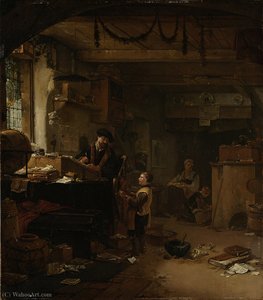
In this 1654 work, we find ourselves drawn into the hushed, dim atmosphere of a rustic farm cottage. The composition is anchored by a heavy, dark architectural archway in the foreground, which acts as a threshold, inviting us to peer into a private, domestic world. A soft, directional light enters from a window on the left, casting a gentle glow across the scene. This light catches the subtle textures of…

3
The Alchemist (1650) af Thomas Wyck

The Alchemist

1650 · Oil · Mauritshuis, Haag

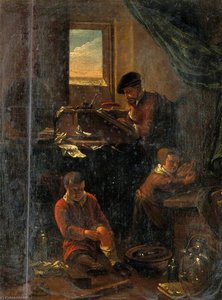
The Alchemist is a detailed 17th-century genre painting that captures a cluttered workshop filled with a sense of intense scholarly focus. The composition is densely packed, utilizing a deep, shadowed interior that directs the viewer's eye toward a light source entering from a window on the left. The color palette is dominated by earthy tones, such as ochres and browns, which are sharply interrupted by the vibrant, saturated red of…

4
The Tinker (1654) af Thomas Wyck

The Tinker

1654 · Oil On Canvas · Statens Museum for Kunst, København

The Tinker is a genre painting by the Dutch artist Thomas Wijck. Created about 1654, the work depicts a man engaged in his manual trade within a workshop setting. The subject matter focuses on the specific activities of a laborer, providing a view into the daily existence of a traveling repairman. This depiction of a craftsman at work places the figure within the tradition of seventeenth-century Dutch genre scenes.

5
Almsgiving (1660) af Thomas Wyck

Almsgiving

1660 · Oil On Canvas · Philadelphia Museum of Art, Philadelphia

Almsgiving is a somber and atmospheric genre painting from 1660 that depicts a scene of charity within an old European setting. The composition is framed by a large, dark architectural archway in the foreground, which creates a sense of depth and directs the viewer's eye toward the central group of figures. The subject matter focuses on the interaction between people in a moment of social welfare, evoking themes of piety,…

6
Capriccio of a Fort by the Sea, with Orientals and an Antique Statue (1673) af Thomas Wyck

Capriccio of a Fort by the Sea, with Orientals and an Antique Statue

1673 · Oil On Canvas · National Trust, Thames

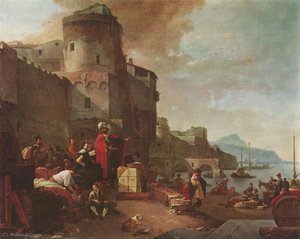
To gaze upon this magnificent Capriccio of a Fort by the Sea is to step directly into a sun-drenched moment plucked from the heart of the Dutch Golden Age. Thomas Wyck’s masterful oil painting, dated 1673, transports us to a vibrant, almost theatrical harbor scene where the solidity of classical architecture meets the ephemeral energy of human endeavor. It is more than just a depiction of a port; it is…

7
Woman at Her Sewing Table (1655) af Thomas Wyck

Woman at Her Sewing Table

1655 · Oil On Canvas · Städel Museum, Frankfurt

In this intimate scene from 1655, we find ourselves drawn into a private, domestic moment. A woman sits at her sewing table, her attention entirely consumed by the needlework in her hands. The composition is tightly framed, pulling the viewer into the stillness of her world. Light enters from an unseen source to the left, washing over the bright white of her linen collar and the fabric she works upon,…

8
View of the Bay of Naples with Orientals and an Antique Statue (1673) af Thomas Wyck

View of the Bay of Naples with Orientals and an Antique Statue

1673 · Oil On Canvas · National Trust, Thames

Gaze upon this exquisite vision of the Bay of Naples, a scene that transports the viewer directly to an era of opulent leisure and artistic contemplation. The composition is alive with the gentle murmur of activity—the distant sails catching the sun, the figures gathered along the shore engaging in moments of quiet enjoyment. It is more than just a depiction of a beautiful vista; it is an immersion into a…

9
A rustic interior (1654) af Thomas Wyck

A rustic interior

1654 · Oil On Panel · Museum Boijmans Van Beuningen, Rotterdam

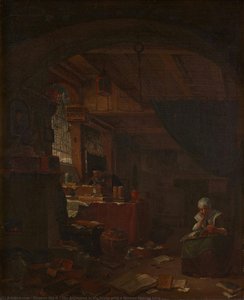
The air inside this room feels heavy and still, thick with the scent of woodsmoke and old stone. A low, heavy ceiling presses down upon the scene, creating a sense of profound intimacy that wraps around the figures like a shroud. Light enters from a single, unseen source to the left, slicing through the gloom to catch the bright white of a woman's headscarf. This sudden brightness pulls the eye…

10
An Alchemist in His Studio (1600) af Thomas Wyck

An Alchemist in His Studio

1600 · Oil · Science History Institute, Philadelphia

A soft, warm light spills across a cluttered desk, illuminating an old man lost in the silent labor of thought. He sits hunched over a book, his eyes tracing lines of text that perhaps hold the secrets of the universe. The room feels heavy with the scent of old parchment and the stillness of a life dedicated to study. Around him, the tools of his obsession are scattered like fragments…

Thomas Wycks berømte malerier, nummer 11 til 80

11Harbor Scene (1646) af Thomas WyckHarbor Scene1646 · Bavarian State Painting Collections 12An Alchemist (1646) af Thomas WyckAn Alchemist1646 · Bavarian State Painting Collections 13Italian Landscape with Figures at a Fountain among Antique Ruins (1647) af Thomas WyckItalian Landscape with Figures at a Fountain among Antique Ruins1647 · Städel Museum 14man reading in his laboratory (1641) af Thomas Wyckman reading in his laboratory1641 15Southern Sea-Harbour with architecture; tradesmen (1641) af Thomas WyckSouthern Sea-Harbour with architecture; tradesmen1641 16Morra-Players (1640) af Thomas WyckMorra-Players1640 · Academy of Fine Arts Vienna 17On the Gulf of Naples (1650) af Thomas WyckOn the Gulf of Naples1650 · Bavarian State Painting Collections 18Interior with Two Men and a Woman with a Baby (1656) af Thomas WyckInterior with Two Men and a Woman with a Baby1656 19Merchants with commodities in a Levante Harbour (1660) af Thomas WyckMerchants with commodities in a Levante Harbour1660 · Musée Fabre 20Painting (1656) af Thomas WyckPainting1656 · Nationalmuseet for kunst, arkitektur og design 21The Gipsy Woman Telling the Soldiers their Fortunes (1660) af Thomas WyckThe Gipsy Woman Telling the Soldiers their Fortunes1660 · Statens Museum for Kunst 22The Yard of an Italian Tavern (1654) af Thomas WyckThe Yard of an Italian Tavern1654 · Statens Museum for Kunst 23The Weaver at Work in his Home (1654) af Thomas WyckThe Weaver at Work in his Home1654 · Statens Museum for Kunst 24A scholar in his Study (1660) af Thomas WyckA scholar in his Study1660 · Hallwyl Museum 25Alchemist in his laboratory (1650) af Thomas WyckAlchemist in his laboratory1650 · Staatliches Museum Schwerin 26An alchemist's workshop (1654) af Thomas WyckAn alchemist's workshop1654 · Gemäldegalerie 27The Alchemist in his Study with a Woman Making Lace (1660) af Thomas WyckThe Alchemist in his Study with a Woman Making Lace1660 · Science History Institute 28An Alchemist in his Laboratory (1654) af Thomas WyckAn Alchemist in his Laboratory1654 · Statens Museum for Kunst 29An Alchemist and His Family (1660) af Thomas WyckAn Alchemist and His Family1660 · Science History Institute 30Landscape with Arch Bridge (1646) af Thomas WyckLandscape with Arch Bridge1646 · Bavarian State Painting Collections 31Italian street scene af Thomas WyckItalian street scene 32Alchemist af Thomas WyckAlchemistRijksmuseum 33Mountain Monastery (1646) af Thomas WyckMountain Monastery1646 · Bavarian State Painting Collections 34Rock Landscape (1646) af Thomas WyckRock Landscape1646 · Bavarian State Painting Collections 35At the Seaport (1646) af Thomas WyckAt the Seaport1646 · Bavarian State Painting Collections 36Vegetable Market (1646) af Thomas WyckVegetable Market1646 · Bavarian State Painting Collections 37Italian Harbor with Fortifications and Staffage (1641) af Thomas WyckItalian Harbor with Fortifications and Staffage1641 38Italian Coastal Landscape (1640) af Thomas WyckItalian Coastal Landscape1640 39Interior of a Cave (1640) af Thomas WyckInterior of a Cave1640 40Apple Seller at a City Gate (1654) af Thomas WyckApple Seller at a City Gate1654 · National Museum in Wrocław 41A washerwoman and children by a river before a walled bridge (1654) af Thomas WyckA washerwoman and children by a river before a walled bridge1654 · Wallraf-Richartz-Museum 42Figures in the Courtyard of a House (1660) af Thomas WyckFigures in the Courtyard of a House1660 · Fairfax House 43An Alchemist at Work, with a Mother by a Cradle Beyond (1650) af Thomas WyckAn Alchemist at Work, with a Mother by a Cradle Beyond1650 · Science History Institute 44View of port of Ripa Grande. (1670) af Thomas WyckView of port of Ripa Grande.1670 · Musée Fabre 45A View of the Forum (1674) af Thomas WyckA View of the Forum1674 · National Trust 46An Alchemist in His Laboratory (1673) af Thomas WyckAn Alchemist in His Laboratory1673 · National Trust 47Capriccio of a Seaport with Orientals, Ruins, and an Antique Statue (1673) af Thomas WyckCapriccio of a Seaport with Orientals, Ruins, and an Antique Statue1673 · National Trust 48An Alchemist in His Laboratory, with an Assistant (1673) af Thomas WyckAn Alchemist in His Laboratory, with an Assistant1673 · National Trust 49Italian Courtyard (1677) af Thomas WyckItalian Courtyard1677 · Dulwich Picture Gallery 50Landscape with Bay (1646) af Thomas WyckLandscape with Bay1646 · Bavarian State Painting Collections 51Old Building af Thomas WyckOld BuildingKunsthistorisches Museum 52Interior of a Weaver's Cottage af Thomas WyckInterior of a Weaver's CottageNational Gallery of Ireland 53landscape with fountain and fig. af Thomas Wycklandscape with fountain and fig. 54horsemen resting before an inn af Thomas Wyckhorsemen resting before an inn 55Figures outside a tavern with a woman sewing, travellers on a bridge beyond af Thomas WyckFigures outside a tavern with a woman sewing, travellers on a bridge beyond 56Whitehall and St James's Park, London af Thomas WyckWhitehall and St James's Park, London 57Capriccio of a Roman Ruins with Orientals, a Fountain and an Antique Statue af Thomas WyckCapriccio of a Roman Ruins with Orientals, a Fountain and an Antique StatueNational Trust 58An Alchemist af Thomas WyckAn AlchemistHermitage Museum 59Dancing couple + many people at ruins af Thomas WyckDancing couple + many people at ruins 60A church interior af Thomas WyckA church interior 61Washerwomen at the Foot of the Torre delle Milizie, Rome af Thomas WyckWasherwomen at the Foot of the Torre delle Milizie, Rome 62Italian port af Thomas WyckItalian port 63Levantijnse haven af Thomas WyckLevantijnse havenRijksmuseum 64Southern Landscape af Thomas WyckSouthern Landscape 65Washerwomen in a yard. af Thomas WyckWasherwomen in a yard.Nationalmuseet i Warszawa 66The Alchemist af Thomas WyckThe AlchemistFitzwilliam-museet 67Riders by Italianate ruins with a seaport beyond af Thomas WyckRiders by Italianate ruins with a seaport beyond 68Italian Street Scene af Thomas WyckItalian Street SceneThe Ashmolean Museum of Art and Archaeology 69Spinning farmer af Thomas WyckSpinning farmerRijksmuseum 70View of the Thames at Westminster on Lord Mayor's Day af Thomas WyckView of the Thames at Westminster on Lord Mayor's Day 71The Poor Being Fed at a Monastery af Thomas WyckThe Poor Being Fed at a Monastery 72The Wreckers, Stormy Coast Scene with Tower af Thomas WyckThe Wreckers, Stormy Coast Scene with Tower 73A Philosopher in His Study, with Two Children af Thomas WyckA Philosopher in His Study, with Two Children 74Interior with an Alchemist af Thomas WyckInterior with an Alchemist 75Interior with an Alchemist Making a Gesture of Surprise, and a Female Assistant af Thomas WyckInterior with an Alchemist Making a Gesture of Surprise, and a Female Assistant 76Interior with an Alchemist Examining a Bowl Brought by a Boy af Thomas WyckInterior with an Alchemist Examining a Bowl Brought by a Boy 77Interior with an Alchemist Studying a Book, His Assistant Pouring Liquid into a Bowl af Thomas WyckInterior with an Alchemist Studying a Book, His Assistant Pouring Liquid into a Bowl 78Interior with an Alchemist Seated at a Table, Looking out of the Picture af Thomas WyckInterior with an Alchemist Seated at a Table, Looking out of the Picture 79Interior with an Alchemist Seated at a Table, Looking out of the Picture af Thomas WyckInterior with an Alchemist Seated at a Table, Looking out of the Picture 80Kitchen interior af Thomas WyckKitchen interiorFinnish National Gallery

Thomas Wycks berømte malerier, periode for periode

Motiverne, der fangede Thomas Wycks blik

De fire motiver, der optræder hyppigst i disse originaler, hver med sit fineste eksempel.

De museer, der udstiller Thomas Wycks originalværker

De 8 museer, der rummer flest af malerierne på denne side.

Museum By Værker af Thomas Wyck Malerier fra denne liste
Bavarian State Painting Collections, MünchenBavarian State Painting Collections München 9 Harbor Scene, An Alchemist, On the Gulf of Naples
National Trust, ThamesNational Trust Thames 7 Capriccio of a Fort by the Sea, with Orientals and an Antique Statue, View of the Bay of Naples with Orientals and an Antique Statue, A View of the Forum
Statens Museum for Kunst, KøbenhavnStatens Museum for Kunst København 6 Interior of a Dutch Farm Cottage, The Tinker, The Gipsy Woman Telling the Soldiers their Fortunes
Science History Institute, PhiladelphiaScience History Institute Philadelphia 4 An Alchemist in His Studio, The Alchemist in his Study with a Woman Making Lace, An Alchemist and His Family
Rijksmuseum, AmsterdamRijksmuseum Amsterdam 3 Alchemist, Levantijnse haven, Spinning farmer
Städel Museum, FrankfurtStädel Museum Frankfurt 2 Woman at Her Sewing Table, Italian Landscape with Figures at a Fountain among Antique Ruins
Musée Fabre, MontpellierMusée Fabre Montpellier 2 Merchants with commodities in a Levante Harbour, View of port of Ripa Grande.
Nationalmuseum, StockholmNationalmuseum Stockholm 1 St Anthony, Archbishop of Florence

Thomas Wyck gennem årtierne: ét unikt originalværk til hver

Værker per årti

Vælg et årti for at se det originale værk, der definerer det.

Thomas Wycks malerier: spørgsmål til galleriet

Hvad er det mest berømte værk af Thomas Wyck?Vis svaret

St Anthony, Archbishop of Florence (1654), Nationalmuseum, Stockholm. Derefter følger Interior of a Dutch Farm Cottage (1654) og The Alchemist (1650).

Hvilken alder havde Thomas Wyck, da St Anthony, Archbishop of Florence blev skabt?Vis svaret

38 år gammel: St Anthony, Archbishop of Florence er fra 1654, og Thomas Wyck blev født i 1616.

Hvilke ti malerier af Thomas Wyck er de mest berømte?Vis svaret

St Anthony, Archbishop of Florence, Interior of a Dutch Farm Cottage, The Alchemist, The Tinker, Almsgiving, Capriccio of a Fort by the Sea, with Orientals and an Antique Statue, Woman at Her Sewing Table, View of the Bay of Naples with Orientals and an Antique Statue, A rustic interior og An Alchemist in His Studio. Ranglisten ovenfor viser det enkelte værks årstal og museum.

Hvor mange værker af Thomas Wyck er kendt?Vis svaret

Vores katalog indeholder 89 værker af Thomas Wyck, dateret fra 1640 til 1677.

Hvor kan de mest berømte originaler af Thomas Wyck ses?Vis svaret

Primært i Bavarian State Painting Collections (München), National Trust (Thames) og Statens Museum for Kunst (København). Museumslisten ovenfor viser dem alle.

I hvilken periode skabte Thomas Wyck sine mest kendte malerier?Vis svaret

I 1650s: 17 af de 80 værker på denne side blev skabt dengang, herunder St Anthony, Archbishop of Florence.

Hvilket berømt maleri af Thomas Wyck er det tidligste, og hvilket er det seneste?Vis svaret

På denne side er det tidligste Morra-Players (1640) og det seneste Italian Courtyard (1677).

Hvilke motiver foretrak Thomas Wyck?Vis svaret

Man (14), Woman (12) og People (12), fordelt på de 80 værker på denne side.

Hvilke materialer brugte Thomas Wyck mest til sine malerier?Vis svaret

Oil, for 23 af de 80 værker på denne side.

Hvilken stilart tilhører værkerne fra Thomas Wyck?Vis svaret

Dutch golden age og Baroque, baseret på originalerne på denne side.

Hvilke originalværker af Thomas Wyck kan jeg se på Bavarian State Painting Collections?Vis svaret

Harbor Scene, An Alchemist og On the Gulf of Naples: Bavarian State Painting Collections, München har 9 af værkerne på denne side.

Thomas Wyck: et portræt af kunstneren

Livet og eftermælet efter Thomas Wyck

Født ind i en slægt af skabere trådte Thomas Wyck frem som en fremtrædende skikkelse i det levende landskab af hollandsk guldalder-maleri. Hans kunstneriske rejse begyndte under sin fars vågne øje, som han modtog sin grundlæggende træning fra – en begyndelse, der forankrede ham dybt i sit håndværks traditioner. Denne tidlige fordybelse i oliemaleriet tekniske nuancer forberedte ham på et liv præget af udforskning og stilistisk udvikling. Som maler af både havneudsigter og genrebilleder besad Wyck en unik evne til at indfange den sydende energi i den maritime handel og de intime, ofte mystiske, øjeblikke i dagliglivet.

Hans karrieres forløb blev dybt præget af hans rejser gennem Middelhavet. Selvom de historiske optegnelser vedrørende hans præcise bevægelser er genstand for akademisk debat, tyder beviser på, at der omkring 1640 var en maler kendt som Tommaso fiammingo aktiv i Rom, en skikkelse som mange mener er Wyck selv. Denne periode med italiensk indflydelse er mærkbar i hans værker; hans lærreder ånder ofte med lyset og atmosfæren fra romerske landskaber og Neapols kystskønhed. I Neapols omegn udførte han omhyggelige skitser, som senere blomstrede op til detaljerede tegninger af kystudsigter, hvilket vidner om et skarpt øje for mødet mellem naturens storhed og menneskelig tilstedeværelse.

Mestring af genre og maritime scener

Wycks kunstneriske repertoire var bemærkelsesværdigt mangfoldigt og strakte sig fra de teatralske italienske landskaber til den dybe symbolik, man finder i genrebilleder. Han excellerede i skabelsen af capriccios – fantasifulde, ofte arkitektoniske fantasi-scener – såsom hans skildringer af fæstninger ved havet, hvor antikkens klassiske storhed møder den livlige bevægelse i det samtidige maritime liv. Hans evne til at befolke disse scener med en mangfoldighed af figurer gjorde det muligt for ham at væve komplekse fortællinger om handel, fritid og historisk ærefrygt ind i en enkelt komposition.

Ud over de vidstrakte vuer af havne og bugter dykkede Wyck ned i de mere skyggefulde, introspektive hjørner af den menneskelige erfaring. Hans værk An Alchemist står som et åndeløst eksempel på hans evne til at indfange intellektuel spænding. I dette værk bruger kunstneren rammen om et afsidesliggende laboratorium til at udforske de udviskede grænser mellem den spirende videnskab og gammel mystik. Gennem den omhyggelige arrangering af genstande som ure, bøger og manuskripter inviterer han beskueren til at overveje temaer som tid, udholdenhed og den utrættelige stræben efter skjult viden.

Professionel anseelse og varig indflydelse

Ved sin hjemkomst til det nordlige Nederland i 1642 etablerede Wyck sig som en grundpille i det kunstneriske samfund. Hans professionelle status blev cementeret gennem hans medlemskab af Haarlem Guild of St. Luke, en institution hvor han i 1660 steg i graderne til den ærefulde post som dekan. Denne periode i hans liv markerede et højdepunkt for lokal indflydelse og anerkendelse, idet han blev en central figur i den hollandske kunstscene.

Rækkevidden af Wycks indflydelse strakte sig langt ud over Nederlandenes grænser. Under den engelske Restoration rejste han til England, hvor hans talenter var i høj kurs. Hans eftermæle blev yderligere styrket gennem hans rolle som lærer; hans søn og elev, Jan Wyck, blev en betydningsfuld skikkelse i udviklingen af engelsk sportsmaleri, mens hans elev Jan van der Vaart også bragte disse traditioner til nye lande. Gennem hans efterkommere og elever fortsatte Thomas Wycks tekniske brillans og atmosfæriske følsomhed med at genlyde gennem århundrederne og efterlod et uudsletteligt mærke på den europæiske malerkunsts historie.