Abaporu
Tarsila do Amaral skabte det oliemaleri Abaporu i 1928. Værket blev malet som en fødselsdagsgave til hendes mand, forfatteren Oswald de Andrade. Dette specifikke værk opstod i en periode med betydelig kunstnerisk udvikling for kunstneren.
Kort sagt
Abaporu (1928) er det maleri af Tarsila Do Amaral, der fanger flest blikke. Derefter falder blikket på Amor (Ilustração para (1925) og Rio de Janeiro (Sugar Loaf) (1923). Blandt de 46 værker af Tarsila Do Amaral i vores katalog er disse 39 de mest berømte, hver især et unikt originalværk præsenteret med sit årstal, sit museum og årsagen til dets tidløse betydning.
Tarsila do Amaral skabte det oliemaleri Abaporu i 1928. Værket blev malet som en fødselsdagsgave til hendes mand, forfatteren Oswald de Andrade. Dette specifikke værk opstod i en periode med betydelig kunstnerisk udvikling for kunstneren.
In the delicate interplay of light and shadow, Tarsila do Amaral presents us with a profound moment of tenderness in her 1925 work, Amor. This evocative illustration transcends simple imagery, offering instead a soulful meditation on affection and purity. At its heart, the composition features a graceful bird—reminiscent of a dove—captured in a moment of flight with wings elegantly spread. Clutched tenderly within its beak is a heart, inscribed with…
In this 1923 oil on canvas, we find ourselves looking upon a quiet corner of Rio de Janeiro. The composition is anchored by the presence of the Sugar Loaf mountain, which rises with a steady, singular strength in the background. There is a certain stillness here. In the foreground, two palm trees lean into the frame, their forms simplified and clean, grounding the viewer in a tropical atmosphere. A small…
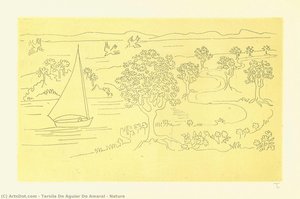
In this 1971 work, we find ourselves drifting into a tranquil coastal sanctuary. The composition centers on a single sailboat, suspended upon a shimmering expanse of water that reflects the soft, ambient light of a peaceful afternoon. There is a profound sense of stillness here, interrupted only by the rhythmic vitality of birds in flight, their silhouettes dancing against the sky. A lush shoreline, lined with verdant trees, frames the…
Antropofagic animals in the landscape is a stylized drawing created in 1971. The composition features a landscape where anthropomorphic animals are situated within a natural setting. The imagery includes several animal figures, such as hands, a bird-like creature, and a human-like figure, interacting with their environment.
Tarsila do Amaral’s “Paisagem Antropofágica” (Anthropophagous Landscape), painted in 1930, isn't merely a depiction of a landscape; it’s a vibrant distillation of Brazil itself – its anxieties, its aspirations, and its complex relationship with the influences that shaped its identity. This iconic work, housed within the collections of major museums worldwide, offers a profound glimpse into the heart of Brazilian modernism and the artist’s unique vision. The painting immediately captivates…
The sun hangs over a wide, open landscape where time seems to slow to the pace of grazing animals. In this 1971 work, the earth feels heavy and present, stretching out in a way that invites the eye to wander toward the distant trees. Three cows occupy the space, scattered across the field in a rhythmic arrangement that guides the viewer through the greenery. One rests on the left, another…
Tarsila do Amaral's "São Paulo," painted in 1924, isn't merely a depiction of a city; it’s a vibrant distillation of a nation’s burgeoning identity and a bold declaration of modernism. Emerging from the fertile ground of early 20th-century Brazil, this oil on canvas transports us to a São Paulo undergoing rapid transformation – a metropolis embracing progress while simultaneously retaining echoes of its rural past. The painting captures a pivotal…
The subject sits in a relaxed pose, her dark hair framing a face that meets the viewer with a subtle, knowing smile. She wears a dress of bright orange, a color that commands the eye and anchors the composition. In the background, secondary figures appear like whispers, adding a sense of depth and social context to this personal encounter. The gaze is direct, bridging the gap between the painted world…
De fire motiver, der optræder hyppigst i disse originaler, hver med sit fineste eksempel.
De 7 museer, der rummer flest af malerierne på denne side.
| Museum | By | Værker af Tarsila Do Amaral | Malerier fra denne liste |
|---|---|---|---|
| São Paulo | 15 | Amor (Ilustração para, Paisagem antropofágica, Pão de Açúcar (Ilustração para | |
| Brasília | 13 | Nature, Antropofagic animals in the landscape, Antropofagic landscape with ox | |
| São Paulo | 6 | Retrato de Marechal Arouche, Retrato de Antonio de Toledo Piza, Retrato de José Maria Nunes Garcia | |
| São Paulo | 1 | Rio de Janeiro (Sugar Loaf) | |
| São Paulo | 1 | São Paulo | |
| Rio de Janeiro | 1 | Urutu Snake | |
| Rio de Janeiro | 1 | Paisagem Antropofágica |
Vælg et årti for at se det originale værk, der definerer det.
Tarsila do Amaral skabte det oliemaleri Abaporu i 1928. Værket blev malet som en fødselsdagsgave til hendes mand, forfatteren Oswald de Andrade. Dette specifikke værk opstod i en periode med betydelig kunstnerisk udvikling for kunstneren.
Tarsila do Amaral’s “Paisagem Antropofágica” (Anthropophagous Landscape), painted in 1930, isn't merely a depiction of a landscape; it’s a vibrant distillation of Brazil itself – its anxieties, its aspirations, and its complex relationship with the influences that shaped its identity. This iconic work, housed within the collections of major museums worldwide, offers a profound glimpse into the heart of Brazilian modernism and the artist’s unique vision. The painting immediately captivates…
In the vast landscape of Brazilian Modernism, few works capture the tranquil essence of coastal life as poignantly as Tarsila do Amaral’s Port I. Painted in 1953, this masterpiece serves as a window into a world where the rhythmic pulse of the ocean meets the steadfast presence of the mountains. The composition is a masterful study in depth and perspective; several boats, varying in scale, are scattered across the shimmering…
In this 1971 work, we find ourselves drifting into a tranquil coastal sanctuary. The composition centers on a single sailboat, suspended upon a shimmering expanse of water that reflects the soft, ambient light of a peaceful afternoon. There is a profound sense of stillness here, interrupted only by the rhythmic vitality of birds in flight, their silhouettes dancing against the sky. A lush shoreline, lined with verdant trees, frames the…
Abaporu (1928). Derefter følger Amor (Ilustração para (1925) og Rio de Janeiro (Sugar Loaf) (1923).
42 år gammel: Abaporu er fra 1928, og Tarsila Do Amaral blev født i 1886.
Abaporu, Amor (Ilustração para, Rio de Janeiro (Sugar Loaf), Nature, Antropofagic animals in the landscape, Paisagem antropofágica, Antropofagic landscape with ox, São Paulo, Retrato de Marechal Arouche og Self-portrait with orange dress. Ranglisten ovenfor viser det enkelte værks årstal og museum.
Vores katalog indeholder 46 værker af Tarsila Do Amaral, dateret fra 1921 til 1971.
Primært i Centro Cultural São Paulo (São Paulo), Museu de Valores do Banco Central do Brasil (Brasília) og Ipiranga Museum (São Paulo). Museumslisten ovenfor viser dem alle.
I 1920s: 19 af de 39 værker på denne side blev skabt dengang, herunder Abaporu.
På denne side er det tidligste Self-portrait with orange dress (1921) og det seneste Nature (1971).
Landscape (12), Brazil (7) og Portrait (5), fordelt på de 39 værker på denne side.
Painting, for 6 af de 39 værker på denne side.
Modernism, baseret på originalerne på denne side.
Amor (Ilustração para, Paisagem antropofágica og Pão de Açúcar (Ilustração para: Centro Cultural São Paulo, São Paulo har 15 af værkerne på denne side.