Portræt af Sol LeWitt

De 40 mest berømte Sol LeWitt-malerier, en galleriselektion

Opdateret oktober 2026 · rangeret efter vores popularitetsscore (søgninger, besøg og ordrer for hvert værk) · 42 værker af Sol LeWitt i vores katalog

Kort sagt

Af alle de originale værker, som Sol LeWitt efterlod, er det mest berømte Serial Project #1 ABCD (1966), som er en del af samlingen på MoMA - Museum of Modern Art i New York City. Lige efter følger Wall drawing #1091: arcs, circles and bands (room) (2003) og Distorted Cubes Bozuk Küpler. Vores katalog indeholder 42 værker af Sol LeWitt; galleriet har bevaret de 40 værker, som verden beundrer mest, hver vist med sin dato, sit museum og sin historie.

1928 – 2007, Hartford Minimalism Flest værker: MASS MoCA

Sol LeWitts top 10 malerier: galleriets udvalg

1
Serial Project #1 ABCD (1966) af Sol LeWitt

Serial Project #1 ABCD

1966 · Sculpture · MoMA - Museum of Modern Art, New York City

A systematic arrangement of white cubes and rectangular prisms occupies a grid-like base, set against a stark black void. This geometric composition, titled Serial Project #1 ABCD, functions as an architectural exploration of structure and seriality. Rather than representing a specific building, the work investigates the permutations of simple shapes. The arrangement follows a predetermined algorithm, where the placement of each element is dictated by a logical sequence rather than…

2
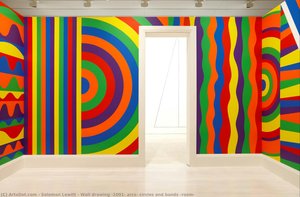
Wall drawing #1091: arcs, circles and bands (room) (2003) af Sol LeWitt

Wall drawing #1091: arcs, circles and bands (room)

2003 · Installation Art · Art Gallery of New South Wales, Sydney

To stand before Wall drawing #1091: arcs, circles and bands (room) is to witness not merely an arrangement of pigment on a surface, but the vibrant echo of artistic reinvention. This monumental piece by Solomon Lewitt captures a moment of profound resurgence in his later career. Where earlier works might have favored a more restrained palette, this drawing explodes with exuberant color—a joyous chromatic symphony applied across the architectural expanse…

3
Distorted Cubes Bozuk Küpler af Sol LeWitt

Distorted Cubes Bozuk Küpler

Painting · Borusan Contemporary, Istanbul

In the realm of conceptual mastery, few works capture the rhythmic pulse of modern abstraction as vibrantly as Sol LeWitt’s Distorted Cubes Bozuk Küpler. This captivating piece serves as a brilliant testament to the artist's ability to transform rigid mathematical precision into a dance of visual delight. At first glance, the viewer is greeted by an intricate mosaic of fourteen distinct colored squares, each meticulously arranged to create a sense…

4
Wall Drawing #391 (1983) af Sol LeWitt

Wall Drawing #391

1983 · Indian Ink · MASS MoCA, Adams

Wall Drawing #391 is an artwork by Solomon Lewitt. Created in April 1983, this two-part drawing occupies a specific space within the MASS MoCA in Adams. The work exists as a structural dialogue between two adjacent surfaces, mapping out a logic that relies on the intersection of planes and the direction of the line.

5
Wall Drawing #831 (1997) af Sol LeWitt

Wall Drawing #831

1997 · Drawing · Guggenheim Museum Bilbao, Bilbao

In the vast landscape of twentieth-century modernism, few names resonate with as much intellectual rigor as Solomon Lewitt. His Wall Drawing #831, created in 1997, serves as a breathtaking testament to the power of the idea over the hand. As a pioneer of both Minimalism and Conceptual Art, Lewitt famously posited that the concept itself is the machine that makes the art. This particular work is not merely a painting…

6
Wall Drawing #915 (1999) af Sol LeWitt

Wall Drawing #915

1999 · Installation Art · MASS MoCA, Adams

Wall Drawing #915 exists as an installation of mathematical precision. Created in 1999, the work utilizes a palette of pastels, anchored by a primary tone of steel blue. The composition relies on geometric patterns and interlocking shapes that transform architectural surfaces into active participants in the art. Through the use of arcs and circles, the piece establishes a rhythmic movement across the wall.

7
Incomplete open cube 5/6 (1974) af Sol LeWitt

Incomplete open cube 5/6

1974 · Metal · Art Gallery of New South Wales, Sydney

Incomplete Open Cube No.5-6 – A Testament to Minimalist Geometry The ‘Incomplete open cubes’ represent a pivotal moment in Sol LeWitt's artistic trajectory, encapsulating the core tenets of his conceptual approach and solidifying his position as one of the pioneers of Minimalism. Created in 1974, this sculpture—a precisely crafted aluminum structure—isn’t merely an object; it’s an embodiment of intellectual rigor distilled into a deceptively simple form. LeWitt himself famously articulated…

8
Kaldor Public Art Project 06: Sol LeWitt 1977 (1977) af Sol LeWitt

Kaldor Public Art Project 06: Sol LeWitt 1977

1977 · Drawing · Kaldor Public Art Projects, Sydney

In the quiet, transformative moment captured in this 1977 photograph, we witness more than just the documentation of a mural; we see the physical manifestation of an idea. Part of the prestigious Kaldor Public Art Project, this work by Solomon LeWitt serves as a profound testament to the power of Conceptualism. The image presents a stark, monochromatic dialogue between two observers and a monumental wall drawing that consumes the architectural…

9
Wall Drawing #146A (2000) af Sol LeWitt

Wall Drawing #146A

2000 · Crayon · MASS MoCA, Adams

In the realm of contemporary minimalism, few names resonate with as much intellectual authority as Solomon LeWitt. His work, particularly the mesmerizing Wall Drawing #14 6A, serves as a profound testament to the power of the concept over the physical object. This particular piece, captured in its striking blue crayon medium, transcends the boundaries of traditional painting to become an immersive environment. As one gazes upon the composition, the distinction…

Sol LeWitt-udvalget fortsætter, fra 11 til 40

11Pyramid (2005) af Sol LeWittPyramid2005 · Art Gallery of New South Wales 12Black with White Lines, Vertical Not Touching (1970) af Sol LeWittBlack with White Lines, Vertical Not Touching1970 · MoMA - Museum of Modern Art 13Cubo af Sol LeWittCuboCAMUSAC Cassino Museum of Contemporary Art 14Vertical Lines, Not Touching (1970) af Sol LeWittVertical Lines, Not Touching1970 · MoMA - Museum of Modern Art 15Objectivity (1962) af Sol LeWittObjectivity1962 16Irregular Grid af Sol LeWittIrregular GridElgiz Museum of Contemporary Art 17Wall Drawing #822 (1997) af Sol LeWittWall Drawing #8221997 · MASS MoCA 18Four Color Woodcuts-Curvy Bands I-IV (1996) af Sol LeWittFour Color Woodcuts-Curvy Bands I-IV1996 · Borusan Contemporary 19Kaldor Public Art Project 11: Sol LeWitt 1998 (1998) af Sol LeWittKaldor Public Art Project 11: Sol LeWitt 19981998 · Kaldor Public Art Projects 20Blue Vertical (2000) af Sol LeWittBlue Vertical2000 21Wal Drawing #999 (2001) af Sol LeWittWal Drawing #9992001 · MASS MoCA 22Isometric Figures in Five and Six Colors (2002) af Sol LeWittIsometric Figures in Five and Six Colors2002 · Borusan Contemporary 23Wall Drawing #1171 (2005) af Sol LeWittWall Drawing #11712005 · MASS MoCA 24Wall Drawing #1185 (2005) af Sol LeWittWall Drawing #11852005 · MASS MoCA 25brushstrokes 2 af Sol LeWittbrushstrokes 2CAMUSAC Cassino Museum of Contemporary Art 26Lincoln Center Print af Sol LeWittLincoln Center PrintBorusan Contemporary 27brushstrokes af Sol LeWittbrushstrokesCAMUSAC Cassino Museum of Contemporary Art 28Wall drawing #338: Two part drawing. The wall is divided vertically into two parts. Each part is divided horizontally and vertically into four equal parts. 1st part: Lines in four directions, one direction in each quarter. 2nd part: Lines in four dir.... (1971) af Sol LeWittWall drawing #338: Two part drawing. The wall is divided vertically into two parts. Each part is divided horizontally and vertically into four equal parts. 1st part: Lines in four directions, one direction in each quarter. 2nd part: Lines in four dir....1971 · Art Gallery of New South Wales 29Wall Drawing #340 (1980) af Sol LeWittWall Drawing #3401980 · MASS MoCA 30Untitled af Sol LeWittUntitled 31Untitled from Squares with a Different Line Direction in Each Half Square (3) af Sol LeWittUntitled from Squares with a Different Line Direction in Each Half Square (3) 32Untitled from Squares with a Different Line Direction in Each Half Square af Sol LeWittUntitled from Squares with a Different Line Direction in Each Half Square 33Untitled from Squares with a Different Line Direction in Each Half Square (2) af Sol LeWittUntitled from Squares with a Different Line Direction in Each Half Square (2) 34Wall Drawing #154, #155, #162, #163, #157, #158 af Sol LeWittWall Drawing #154, #155, #162, #163, #157, #158Modern Art Oxford 35Distorted Cubes from Distorted Cubes af Sol LeWittDistorted Cubes from Distorted Cubes 36Distorted Cubes from Distorted Cubes (2) af Sol LeWittDistorted Cubes from Distorted Cubes (2) 37Irregular tower af Sol LeWittIrregular towerCAMUSAC Cassino Museum of Contemporary Art 38Irregular tower af Sol LeWittIrregular towerCAMUSAC Cassino Museum of Contemporary Art 39Irregular Arcs, Bands and Loops af Sol LeWittIrregular Arcs, Bands and LoopsBorusan Contemporary 40Eight-Pointed Stars af Sol LeWittEight-Pointed StarsChrysler Museum of Art

Sol LeWitts berømte malerier, periode for periode

Motiverne, der fangede Sol LeWitts blik

De fire motiver, der optræder hyppigst i disse originaler, hver med sit fineste eksempel.

De museer, der udstiller Sol LeWitts originalværker

De 8 museer, der rummer flest af malerierne på denne side.

Museum By Værker af Sol LeWitt Malerier fra denne liste
MASS MoCA, AdamsMASS MoCA Adams 9 Wall Drawing #391, Wall Drawing #915, Wall Drawing #146A
Borusan Contemporary, IstanbulBorusan Contemporary Istanbul 5 Distorted Cubes Bozuk Küpler, Four Color Woodcuts-Curvy Bands I-IV, Isometric Figures in Five and Six Colors
CAMUSAC Cassino Museum of Contemporary Art, CassinoCAMUSAC Cassino Museum of Contemporary Art Cassino 5 Cubo, brushstrokes 2, brushstrokes
Art Gallery of New South Wales, SydneyArt Gallery of New South Wales Sydney 4 Wall drawing #1091: arcs, circles and bands (room), Incomplete open cube 5/6, Pyramid
MoMA - Museum of Modern Art, New York CityMoMA - Museum of Modern Art New York City 3 Serial Project #1 ABCD, Black with White Lines, Vertical Not Touching, Vertical Lines, Not Touching
Kaldor Public Art Projects, SydneyKaldor Public Art Projects Sydney 2 Kaldor Public Art Project 06: Sol LeWitt 1977, Kaldor Public Art Project 11: Sol LeWitt 1998
Guggenheim Museum Bilbao, BilbaoGuggenheim Museum Bilbao Bilbao 1 Wall Drawing #831
Elgiz Museum of Contemporary Art, İstanbulElgiz Museum of Contemporary Art İstanbul 1 Irregular Grid

Sol LeWitt årti for årti: det originale værk, der definerer hvert enkelt

Værker per årti

Vælg et årti for at se det originale værk, der definerer det.

Samleres spørgsmål om Sol LeWitts malerier

Hvilket værk er Sol LeWitt mest kendt for?Vis svaret

Serial Project #1 ABCD (1966), MoMA - Museum of Modern Art, New York City. Derefter følger Wall drawing #1091: arcs, circles and bands (room) (2003) og Distorted Cubes Bozuk Küpler.

Hvor gammel var Sol LeWitt, da Serial Project #1 ABCD blev skabt?Vis svaret

38 år gammel: Serial Project #1 ABCD er fra 1966, og Sol LeWitt blev født i 1928.

Hvad er de ti mest berømte Sol LeWitt malerier?Vis svaret

Serial Project #1 ABCD, Wall drawing #1091: arcs, circles and bands (room), Distorted Cubes Bozuk Küpler, Wall Drawing #391, Wall Drawing #831, Wall Drawing #915, Incomplete open cube 5/6, Kaldor Public Art Project 06: Sol LeWitt 1977, Wall Drawing #146A og Wall Drawing #793B Certificate. Ranglisten ovenfor viser det enkelte værks årstal og museum.

Hvor mange malerier efterlod Sol LeWitt?Vis svaret

Vores katalog indeholder 42 værker af Sol LeWitt, dateret fra 1962 til 2005.

I hvilke museer udstilles Sol LeWitt's mesterværker?Vis svaret

Primært i MASS MoCA (Adams), Borusan Contemporary (Istanbul) og CAMUSAC Cassino Museum of Contemporary Art (Cassino). Museumslisten ovenfor viser dem alle.

I hvilke år malede Sol LeWitt sine mest berømte værker?Vis svaret

I 2000s: 8 af de 40 værker på denne side blev skabt dengang, herunder Wall drawing #1091: arcs, circles and bands (room).

Hvad er de første og de sidste berømte originaler af Sol LeWitt?Vis svaret

På denne side er det tidligste Objectivity (1962) og det seneste Pyramid (2005).

Hvilke motiver valgte Sol LeWitt oftest?Vis svaret

Geometric abstraction (8), Conceptual art (7) og Wall drawing (5), fordelt på de 40 værker på denne side.

Hvilken teknik brugte Sol LeWitt mest?Vis svaret

Sculpture, for 2 af de 40 værker på denne side.

Hvilken kunstretning tilhører Sol LeWitt?Vis svaret

Minimalism, baseret på originalerne på denne side.

Hvilke værker af Sol LeWitt udstilles på MASS MoCA?Vis svaret

Wall Drawing #391, Wall Drawing #915 og Wall Drawing #146A: MASS MoCA, Adams har 9 af værkerne på denne side.

Sol LeWitt: liv og værk

Idéernes arkitekt: Sol LeWitts liv og eftermæle

I det vidstrakte landskab af det tyvende århundredes modernisme er der få skikkelser, der kaster en så lang eller intellektuelt dyb skygge som Solomon LeWitt. Han blev født den 9. september 1928 i Hartford, Connecticut, ind i en familie af jødiske immigranter fra Rusland, og LeWitts rejse var defineret ved stræben efter ren tanke frem for blot fysisk udførelse. Hans tidlige år blev formet af en streng analytisk nysgerrighed, en egenskab der blev næret gennem hans studier ved Syracuse University mellem 1945 og 1949. Dette akademiske fundament i matematik og geometri skulle senere blive selve hjerteslaget i hans kunstneriske sprog, hvilket gjorde det muligt for ham at skrælle den traditionelle kunsts dekorative overflod væk for at afsløre logikkens og strukturens skeletagtige skønhed.

LeWitts udvikling som kunstner var ikke et pludseligt brud, men en bevidst vandring fra det håndgribelige til det konceptuelle. Selvom hans tidlige eksperimenter involverede maleriets og tegningens taktile natur, følte han sig snart i stigende grad draget mod selve idéen bag stregen frem for stregen i sig selv. Dette skifte markerede fødslen af en pioner, der skulle bygge bro mellem minimalisme og konceptkunst. Han begyndte at betragte kunstneren ikke som en håndværker bundet af hånden, men som en instruktionernes arkitekt. Ved at prioritere den mentale blåtryk over det færdige objekt udfordrede LeWitt selve definitionen af ophavsmandskab ved at antyde, at når først en idé er udtænkt, er dens fysiske manifestation blot en sekundær konsekvens.

Vægtegningens revolution

Slutningen af 1960'erne var vidne til en af de mest radikale transformationer i samtidskunsten med fremkomsten af LeWitts ikoniske vægtegninger. Ved at afvise den traditionelle skulpturs permanente og dyrebare natur introducerede han "strukturer" — et begreb han foretagede til fordel for "skulpturer" for at understrege deres matematiske essens — samt en række instruktioner, der kunne udføres af enhver, som var trænet i at følge dem. Disse værker var ikke blot dekorationer, men levende oplevelser, ofte sammensat af præcise geometriske mønstre, buer og sammenflettede former, der pustede liv i de arkitektoniske rum, de beboede.

At overvære en vægtegning af LeWitt er at se logik forvandlet til poesi. Uanset om det var den stramme, rytmiske gentagelse fundet i Black with White Lines, Vertical Not Touching eller den vibrerende, ekvilibristiske energi i Wall Drawing #1091: arcs, circles and bands, udnyttede hans arbejde linjens kraft til at kommandere rummet. Disse værker beroede ofte på et system af logiske, ofte matematiske instruktioner, der guidede assistenter eller museumskuratorer i deres produktion. Denne metode demokratiserede selve skabelsesakten, mens den samtidig ophøjede betydningen af konceptet, hvilket sikrede, at kunstværket fundamentalt eksisterede som en intellektuel gnist, før det overhovedet rørte en væg.

Et varigt indtryk på moderniteten

Gennem sin produktive karriere, der strakte sig over årtier og omfattede mesterskab inden for grafik, fotografi og installation, forblev LeWitt tro mod sin forpligtelse til klarhed og præcision. Hans evne til at finde dyb skønhed i de simpleste former — såsom den slående hvide Pyramide eller de komplekse, farverige rytmer i hans kridtbaserede vægværker — redefinerede de æstetiske grænser i det sene 20. århundrede. Han beviste, at kunst kunne berøves sit ego og sin ornamentik, men stadig bevare en sjæl, der resonerer dybt med menneskets ønske om orden og opdagelse.

Den historiske betydning af Sol LeWitt kan ikke overvurderes. Han leverede det ordforråd, som generationer af kunstnere har brugt til at udforske grænserne mellem tanke og materie. Hans eftermæle lever videre i hvert museum og galleri, hvor linjen mellem skaberen og udføreren udviskes, og hvor styrken i en idé anerkendes som det ultimative medie. Når vi ser tilbage på hans liv, fra hans begyndelse i Hartford til hans sidste dage i New York City i 2007, ser vi en mand, der ikke blot skabte kunst, men som lærte os at se selve tankens dybe arkitektur.