Portræt af Rowland Suddaby

De 26 mest berømte Rowland Suddaby-malerier, hver og en unik

Opdateret november 2026 · rangeret efter vores popularitetsscore (søgninger, besøg og ordrer for hvert værk) · 26 værker af Rowland Suddaby i vores katalog

Kort sagt

Poplars er det maleri af Rowland Suddaby, der fanger flest blikke. Derefter falder blikket på Fishing Boats at Staithes, Yorkshire (1938) og Coast Scene near the Stour Estuary, Suffolk (1946). Blandt de 26 værker af Rowland Suddaby i vores katalog er disse 26 de mest berømte, hver især et unikt originalværk præsenteret med sit årstal, sit museum og årsagen til dets tidløse betydning.

1912 – 1972 Impressionism Flest værker: Walker Art Gallery

Top 10 malerier af Rowland Suddaby, set gennem galleriets øjne

1
Poplars af Rowland Suddaby

Poplars

Oil

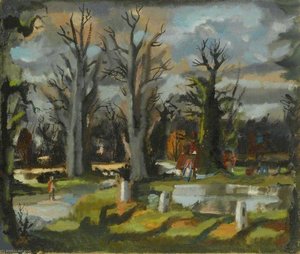
In Poplars, Rowland Suddaby captures a quiet corner of the countryside. The scene centers on a country road, a path cutting through grassy fields and bordered by trees. A white house sits nestled within the greenery, a steady presence amidst the scattered cows that graze in the distance. A lone figure stands near the center, a silent observer of the rural rhythm.

2
Fishing Boats at Staithes, Yorkshire (1938) af Rowland Suddaby

Fishing Boats at Staithes, Yorkshire

1938 · Oil On Canvas · Bristol Museum - Art Gallery, Bristol

In the oil painting Fishing Boats at Staithes, Yorkshire by Rowland Suddaby, the composition focuses on a small blue fishing boat positioned within a choppy seascape. Created about 1938, the work centers on maritime life and the specific challenges faced by fishermen. The boat is the primary subject, surrounded by turbulent water and an overcast sky. The perspective is set at a slightly low angle, which places the viewer near…

3
Coast Scene near the Stour Estuary, Suffolk (1946) af Rowland Suddaby

Coast Scene near the Stour Estuary, Suffolk

1946 · Oil On Canvas

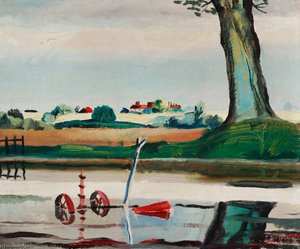
The meeting of land and sea near the Stour Estuary is captured in this 1946 oil painting, rendered with a focus on the quietude of the Suffolk coastline. A single sailing boat occupies the mid-ground, its mast providing a sharp vertical counterpoint to the dominant horizontal planes of the shoreline and the distant horizon. The composition relies on a layered perspective, moving from the textured, weathered wooden structures in the…

Rowland Suddabys berømte malerier, nummer 11 til 26

Rowland Suddabys berømte malerier, periode for periode

Motiverne, der fangede Rowland Suddabys blik

De fire motiver, der optræder hyppigst i disse originaler, hver med sit fineste eksempel.

De museer, der udstiller Rowland Suddabys originalværker

De 8 museer, der rummer flest af malerierne på denne side.

Museum By Værker af Rowland Suddaby Malerier fra denne liste
Walker Art Gallery, LiverpoolWalker Art Gallery Liverpool 2 Flowers in a Hall, Landscape
Government Art Collection, LondonGovernment Art Collection London 2 Stoke by Nayland, Millpond, Bures, Suffolk
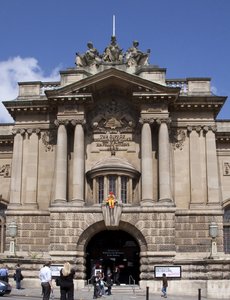
Bristol Museum - Art Gallery, BristolBristol Museum - Art Gallery Bristol 1 Fishing Boats at Staithes, Yorkshire
Arts Council Collection, LondonArts Council Collection London 1 Winter Landscape, near Lavenham
Nottingham Castle Museum And Art Gallery, NottinghamNottingham Castle Museum And Art Gallery Nottingham 1 Hedging at Cornard Tye, Suffolk
The Hepworth Wakefield, WakefieldThe Hepworth Wakefield Wakefield 1 Floods
Wolverhampton Art Gallery, WolverhamptonWolverhampton Art Gallery Wolverhampton 1 Stour Valley, Suffolk
Alfred East Art Gallery, KetteringAlfred East Art Gallery Kettering 1 Sunflowers and Fruit

Rowland Suddaby gennem årtierne: ét unikt originalværk til hver

Værker per årti

Vælg et årti for at se det originale værk, der definerer det.

Rowland Suddabys malerier: spørgsmål til galleriet

Hvad er det mest berømte værk af Rowland Suddaby?Vis svaret

Poplars. Derefter følger Fishing Boats at Staithes, Yorkshire (1938) og Coast Scene near the Stour Estuary, Suffolk (1946).

Hvilke ti malerier af Rowland Suddaby er de mest berømte?Vis svaret

Poplars, Fishing Boats at Staithes, Yorkshire, Coast Scene near the Stour Estuary, Suffolk, Fishing Village, Flowers and Still Life, Scholes, Yorkshire, Still Life, Window at No.5 Portland Place, Flowers in a Hall og Flower Piece. Ranglisten ovenfor viser det enkelte værks årstal og museum.

Hvor mange værker af Rowland Suddaby er kendt?Vis svaret

Vores katalog indeholder 26 værker af Rowland Suddaby, dateret fra 1931 til 1950.

Hvor kan de mest berømte originaler af Rowland Suddaby ses?Vis svaret

Primært i Walker Art Gallery (Liverpool), Government Art Collection (London) og Bristol Museum - Art Gallery (Bristol). Museumslisten ovenfor viser dem alle.

I hvilken periode skabte Rowland Suddaby sine mest kendte malerier?Vis svaret

I 1930s: 8 af de 26 værker på denne side blev skabt dengang, herunder Fishing Boats at Staithes, Yorkshire.

Hvilket berømt maleri af Rowland Suddaby er det tidligste, og hvilket er det seneste?Vis svaret

På denne side er det tidligste Fishing Village (1931) og det seneste Hedging at Cornard Tye, Suffolk (1950).

Hvilke motiver foretrak Rowland Suddaby?Vis svaret

Still life (2), English landscape (2) og Traditional painting (2), fordelt på de 26 værker på denne side.

Hvilke materialer brugte Rowland Suddaby mest til sine malerier?Vis svaret

Oil On Canvas, for 2 af de 26 værker på denne side.

Hvilken stilart tilhører værkerne fra Rowland Suddaby?Vis svaret

Impressionism og Realism, baseret på originalerne på denne side.

Hvilke originalværker af Rowland Suddaby kan jeg se på Walker Art Gallery?Vis svaret

Flowers in a Hall og Landscape: Walker Art Gallery, Liverpool har 2 af værkerne på denne side.

Rowland Suddaby: et portræt af kunstneren

A Quiet Observer of Rural England

Rowland Suddaby (1912–1972) remains a poignant voice in the history of British mid-century art, serving as a dedicated chronicler of the English landscape. Born in Kimberworth, Yorkshire, his artistic sensibilities were forged through a rigorous academic journey that began with a prestigious scholarship to the Sheffield College of Art in 1926. This foundational period provided him with the technical precision that would later allow him to capture the subtle nuances of light and atmosphere. His subsequent training at the Royal College of Art further refined his craft, placing him within a lineage of artists who sought to balance formal excellence with an intimate connection to the natural world. Suddaby’s early life was not merely a period of study but a deep immersion into the textures of the British countryside, a theme that would resonate through every canvas he produced.

The transition to London in 1931 acted as a catalyst for his professional evolution, thrusting him into the vibrant heart of the nation's artistic commerce. During this era, Suddaby demonstrated a remarkable versatility, securing work designing film titles for the studios of Wardour Street—a role that required a keen eye for composition and visual storytelling. This commercial success provided a stable foundation for his more personal explorations in fine art. His emergence into the prestigious London gallery scene, with exhibitions at the Wertheim Gallery and the Redfern Gallery, signaled his arrival as a significant talent. Through these venues, he engaged with the contemporary dialogues of his time, often finding himself aligned with the sensibilities of the New English Art Club, where the pursuit of capturing fleeting moments through light and color was paramount.

The Poetics of Landscape and Still Life

Suddaby’s oeuvre is characterized by a profound ability to elevate the mundane into the monumental. Whether he was painting the rolling hills of Yorkshire or the serene vistas of Suffolk, his work possessed an evocative quality that transcended simple topography. His landscapes often feel like quiet meditations; in works such as Winter Landscape, near Lavenham, one can sense the stillness of a frost-covered morning, where the weight of the atmosphere is rendered with masterful sensitivity. His technique frequently leaned toward an Impressionistic approach, utilizing loose, visible brushstrokes to prioritize the emotional resonance of a scene over rigid realism. This method allowed him to capture the diffused light and soft shadows that define the English countryside, creating a sense of warmth and abundance even in more somber settings.

Beyond the expansive horizon, Suddaby found equal inspiration in the intimate arrangements of his still lifes. In masterpieces like Still Life with Fruit and Flowers, he utilized a vibrant palette of reds, blues, and yellows to breathe life into inanimate objects. These compositions were far more than mere studies of form; they were celebrations of texture and light. The contrast between the smooth surface of a vase and the rough skin of ripening fruit served to ground his more expressive brushwork in a tangible reality. This duality—the ability to move seamlessly from the sweeping vistas of Scholes, Yorkshire to the delicate intimacy of a tabletop arrangement—demonstrates a technical breadth that made him a truly versatile observer of the world around him.

Legacy and Historical Significance

The later years of Suddaby’s life saw him returning to the very landscapes that had shaped his soul. Moving near Sudbury, Suffolk, during the onset of World War II, he found a sanctuary in the rural landscape alongside his family. This period of relative seclusion allowed for a deepening of his connection to the land, a sentiment reflected in his involvement with the Recording Britain project commissioned by Sir Kenneth Clarke. This monumental effort to document the changing face of the British landscape ensured that Suddaby’s vision was woven into the historical fabric of the nation. His later appointment as the curator of Gainsborough's House in Sudbury from 1968 until his death in 1972 further solidified his role as a custodian of British artistic heritage.

Today, the significance of Rowland Suddaby’s work is preserved within the collections of numerous esteemed institutions, including the Victoria and Albert Museum and the Government Art Collection. His legacy is defined by several key contributions to British art:

  • Documentary Value: His meticulous yet emotive depictions provide a vital visual record of mid-century English rural life and landscapes that have since been altered by time.
  • Technical Mastery: He successfully bridged the gap between commercial graphic design and fine art, bringing a unique sense of composition to both mediums.
  • Emotional Depth: Through his use of light and color, he moved beyond mere representation to capture the "feeling" of the English atmosphere, making his work timelessly relatable.

Suddaby remains a celebrated figure for those who seek beauty in the quiet corners of the world, reminding us that there is profound art to be found in the simple observation of nature's enduring rhythms.