The Dual Legacy of Peter Michael Dunn: From Silver Screen to Industrial Canvas
The life of Peter Michael Dunn—born Gary Neil Miller—stands as a remarkable testament to the multifaceted nature of human creativity. While many recognize his name from the golden age of television, where he captivated global audiences with his commanding presence as the brilliant yet villainous Dr. Miguelito Quixote Loveless in The Wild Wild West, his true essence resided in the quiet, profound depths of his oil paintings. Dunn possessed a rare ability to inhabit different worlds, moving seamlessly from the high-stakes drama of cinematic landscapes to the gritty, soot-stained reality of the British industrial heartlands. His journey was one of constant transformation, bridging the gap between the theatricality of Hollywood and the raw, unvarnished truth of the working class.
Born in Liverpool, England, on October 20, 1934, his early years were shaped by a rigorous artistic education at the Liverpool and Portsmouth Colleges of Art. It was during this formative period that he began to cultivate a visual language defined by meticulous detail and a bold use of color. Though his later fame as an actor brought him into the spotlight of American pop culture, his artistic soul remained deeply rooted in the traditions of European art. He drew significant inspiration from the Surrealist masters, particularly René Magritte and Salvador Dalí, whose works encouraged him to explore psychological landscapes and challenge the boundaries of conventional perception. This influence is subtly woven into his later, more realistic works, where a sense of atmospheric tension and psychological depth lingers beneath the surface of even the most straightforward industrial scenes.
A Visionary of the Industrial Soul
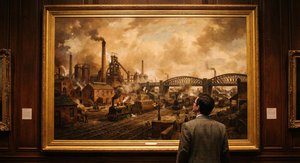
As his career progressed, Dunn’s focus shifted toward a profound exploration of mining life and the rugged beauty of industrial landscapes. His paintings serve as a poignant chronicle of an era, capturing the heavy atmosphere of coal mines and the rhythmic toil of the laborers within them. In masterpieces such as At the Coalface, he utilizes earthy tones and expressive, bold brushstrokes to convey the sheer physical demand of mining. The composition often emphasizes teamwork and the shared struggle of the men, using light and shadow to highlight the tools of the trade—the pickaxe, the shovel, and the hammer—transforming mundane objects into symbols of human endurance.
His ability to find beauty in the subterranean and the mechanical is perhaps most evident in works like Filling Core and Pony. In these pieces, Dunn transports the viewer into dark, tunnel-like environments where the presence of horses and heavy carts suggests a historical continuity of labor. There is a palpable sense of weight and texture in his work; one can almost feel the dampness of the earth and the grit of the coal dust. Through his lens, the industrial landscape is not merely a setting for work, but a living, breathing character that shapes the identity of those who inhabit it.
Artistic Significance and Enduring Impact
The historical significance of Peter Michael Dunn lies in his ability to synthesize disparate worlds. He was an artist capable of navigating the surreal and the realistic, the cinematic and the documentary. His work provides a vital visual record of British heritage and the social realism of the working class, much of which is preserved today within institutions such as the Chesterfield Museum - Art Gallery. By documenting the essence of mining life with such sensitivity, he ensured that the dignity of this labor was immortalized in oil.
Though his life was tragically short, ending on August 30, 1973, the breadth of his achievements remains staggering. His legacy is twofold:
- As a Performer: He broke barriers for actors with dwarfism, proving that talent and charisma know no physical bounds, and left an indelible mark on the history of television and film.
- As a Painter: He created a powerful, evocative body of work that continues to resonate with those moved by themes of industry, heritage, and the human spirit's resilience in the face of hardship.
Ultimately, the works of Peter Michael Dunn invite us to look closer at the shadows—to find the stories hidden in the dark corners of a mine or the intense gaze of a portrait. He remains a visionary who saw the profound beauty in the most rugged of landscapes.